
Should You Move to Niagara for Retirement? Halton vs. Niagara for Downsizers

Should You Move to Niagara for Retirement? Halton vs. Niagara for Downsizers
Could Selling in Halton and Moving to Niagara Change Your Retirement?
It's a conversation I increasingly have with homeowners:
“What if we sold here and moved toward Niagara?”
For someone sitting on significant equity in a home in:
Georgetown
Oakville
Burlington
Milton
or elsewhere in Halton Region, the idea can be appealing.
Sell the family home.
Buy something that better suits retirement.
Potentially release some equity.
Reduce maintenance.
Slow things down.
Maybe get closer to:
Lake Ontario.
Wineries.
Golf.
Trails.
Smaller communities.
But moving to Niagara isn't automatically the right retirement strategy.
Before you make that decision, compare more than house prices.
Why Are Halton Homeowners Considering Niagara?
For many people, it's a combination of:
Lifestyle
They want something quieter or different from the GTA.
Housing
They're looking for a bungalow, condo, townhome or retirement-oriented community.
Equity
They want to determine whether moving could release some of the capital tied up in their current home.
Retirement
They no longer need to structure their life around commuting to Toronto or another employment centre.
Space
Some people still want a house—but no longer need a large Halton family home.
Recreation
Wine country, golf, restaurants, trails and the lake can all contribute to Niagara's appeal.
The important question is whether those advantages align with your actual retirement priorities.
HALTON VS. NIAGARA — START WITH YOUR EQUITY
For many downsizers, this is where the conversation begins.
Imagine you've owned your Halton home for decades.
Your first question shouldn't be:
“What can I buy in Niagara?”
It should be:
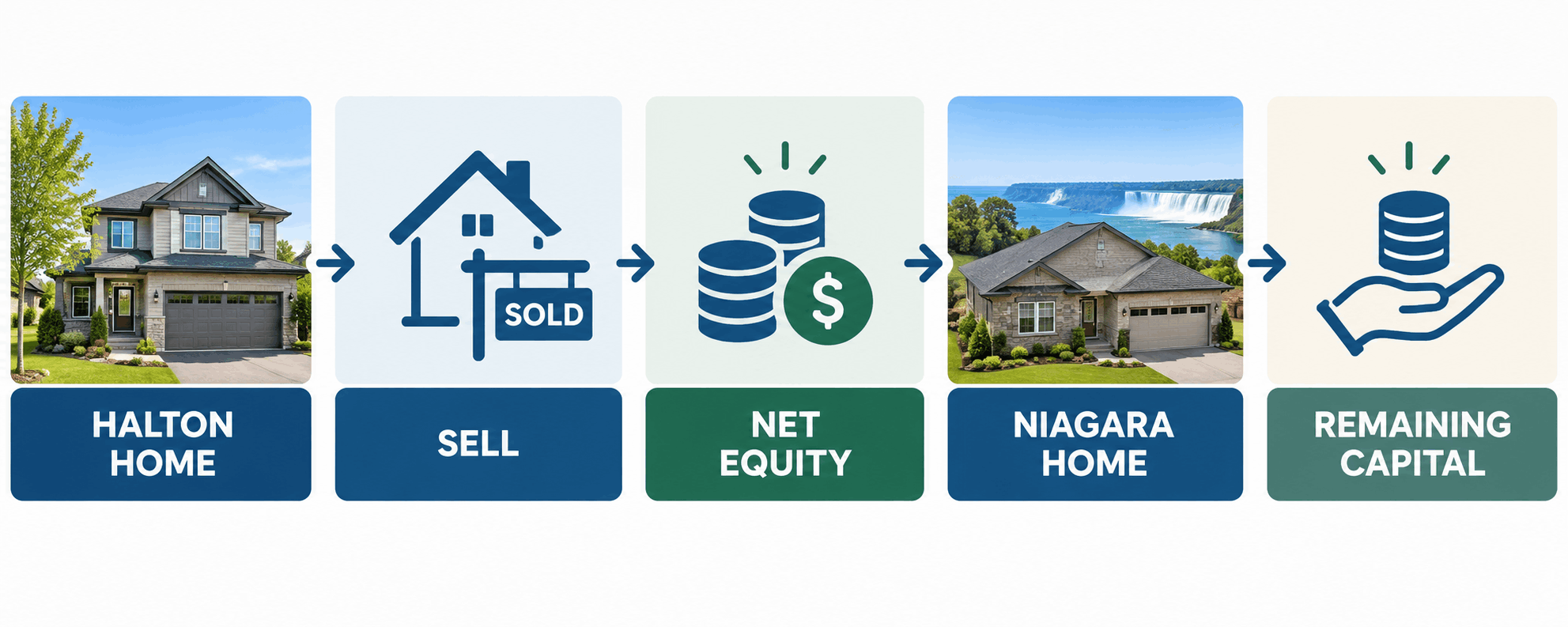
“What will I realistically have available after selling my current home?”
Start with:
Estimated market value
minus
Mortgage
minus
Estimated selling and closing expenses
=
Approximate Net Proceeds
Then compare realistic Niagara properties.
A Hypothetical Example
Let's say a homeowner has approximately:
$1,200,000 in net proceeds
after selling their Halton home.
They identify a Niagara property that would require approximately:
$750,000
before applicable purchase and moving costs.
That creates a potential difference of roughly:
$450,000
before those additional expenses.
That $450,000 could materially change someone's financial position.
But that doesn't mean:
“Moving to Niagara gives you $450,000 for retirement.”
The homeowner still needs to account for:
Land transfer tax
Legal costs
Moving
Renovations
Furniture
Condo fees if applicable
Property taxes
Insurance
and other expenses.
Then the remaining capital needs to be considered within the homeowner's broader financial plan.
Could Niagara Be Less Expensive Than Halton?
Depending on the specific municipalities and properties being compared, there can be meaningful differences in real estate prices.
But this is where broad statements become dangerous.
Niagara is not one housing market.
Neither is Halton.
A premium property in Niagara-on-the-Lake may have very different economics from a condo in St. Catharines.
A waterfront property can be very different from an inland bungalow.
A newer Grimsby condo can be very different from a rural property in Lincoln.
So don't ask:
“Is Niagara cheaper?”
Ask:
“Is the Niagara property I actually want meaningfully less expensive than the Halton property I'm selling?”
That's the calculation that matters.
RETIRING IN NIAGARA-ON-THE-LAKE
Best For: Lifestyle, Wine Country & Destination Living
Niagara-on-the-Lake is often one of the first places people picture when considering retirement in Niagara.
And understandably so.
The area is known for its:
Historic character
Wineries
Restaurants
Theatre and cultural attractions
Cycling
Golf
Lake and river setting
Tourism
For someone whose retirement vision includes dining, entertaining, wine country and a destination-style community, it can be extremely appealing.
But Don't Assume Niagara-on-the-Lake Is a Budget Move
This is important.
Someone moving from Halton shouldn't automatically assume Niagara-on-the-Lake will create a dramatic housing-cost reduction.
Certain properties and locations can command premium pricing.
If releasing equity is one of your primary goals, compare actual available properties before deciding this is your destination.
Lifestyle and affordability are two separate questions.
Niagara-on-the-Lake May Be Best If...
You:
Prioritize lifestyle over maximizing released equity.
Love wine country.
Enjoy restaurants and cultural activities.
Want a destination-style retirement community.
Don't need to commute regularly into Toronto.
RETIRING IN GRIMSBY
Best For: Maintaining Better GTA Access While Entering Niagara
For Halton homeowners who like the idea of Niagara but aren't ready to feel far removed from the GTA, Grimsby can be an interesting option.
Geographically, it provides a bridge between:
Hamilton/Halton
and
the broader Niagara Region.
That can matter enormously if your children and grandchildren remain in the western GTA.
Why Downsizers May Consider Grimsby
Depending on the property, buyers can explore:
Condos
Townhomes
Bungalows
Detached homes
and other lower-maintenance options.
For someone leaving Burlington or Oakville, Grimsby may feel like a less dramatic geographic transition than moving farther into Niagara.
Grimsby May Be Best If...
You:
Want Niagara but still expect frequent trips toward Halton.
Have family in Burlington, Hamilton or the western GTA.
Want access to the lake and Niagara lifestyle.
Want to explore multiple property types.
RETIRING IN LINCOLN & BEAMSVILLE
Best For: Wine Country Feel & Smaller-Community Living
Lincoln—including Beamsville and surrounding communities—can appeal to people who want:
Wine country
Agricultural surroundings
Smaller communities
Outdoor lifestyle
while remaining along the Niagara corridor.
This can feel substantially different from retirement in Oakville or Burlington.
And for some people, that's precisely the point.
Think Carefully About Transportation
Smaller communities can provide a wonderful lifestyle.
But ask:
How dependent will I be on my vehicle?
Where is:
Your grocery store?
Doctor?
Pharmacy?
Hospital?
Family?
Recreation?
Restaurants?
If you eventually stop driving, would the location still work?
Retirement real estate needs to be evaluated for both today and later.
Lincoln / Beamsville May Be Best If...
You:
Want a smaller-community atmosphere.
Love wine-country living.
Don't require an urban downtown lifestyle.
Are comfortable with the transportation requirements of your specific location.
RETIRING IN ST. CATHARINES
Best For: Amenities, Housing Variety & More Urban Convenience
Someone who likes Niagara but doesn't want to give up city conveniences may want to explore St. Catharines.
Compared with smaller Niagara communities, it can provide access to a broader range of:
Housing
Shopping
Restaurants
Healthcare
Recreation
Services
and daily amenities.
For downsizers, the variety of housing can be particularly useful.
St. Catharines May Be Best If...
You:
Want Niagara without giving up city amenities.
Want broader housing choices.
Prioritize access to services and healthcare.
Prefer a more urban environment than wine-country communities.
What About Niagara Falls?
Niagara Falls shouldn't automatically be dismissed simply because most people first associate it with tourism.
The municipality contains residential neighbourhoods and housing options well beyond the tourist core.
For someone evaluating Niagara primarily based on:
Housing
Amenities
Family
Lifestyle
and
budget
it may deserve consideration.
The important thing is choosing the right neighbourhood, not simply the municipality.
Halton vs. Niagara — Quick Retirement Comparison
|
Priority |
Halton |
Niagara |
|
Staying close to existing GTA network |
Strong |
Depends on location |
|
Toronto/GTA access |
Generally stronger |
Varies significantly |
|
Waterfront opportunities |
Strong |
Strong |
|
Wine-country lifestyle |
Limited |
Very strong |
|
Smaller-community options |
Georgetown/Halton Hills |
Multiple options |
|
Condo downsizing |
Strong |
Strong |
|
Bungalow options |
Available |
Available |
|
Retirement communities |
Strong |
Strong |
|
Potential to release equity |
Property dependent |
Can be attractive depending on move |
|
Existing doctors/social network |
Advantage if already in Halton |
Requires consideration |
|
Tourism/destination lifestyle |
Moderate |
Strong in certain areas |
The Biggest Question: Where Does Your Family Live?
This can matter more than the house.
Suppose you move to Niagara and your children live in:
Oakville.
Milton.
Georgetown.
or Toronto.
Ask:
How often do I see them now?
How often do I want to see them in retirement?
Will they realistically drive to me?
Will I constantly drive back toward Halton?
What happens when I no longer want to drive as much?
A beautiful retirement property can become inconvenient if the people you care about are always somewhere else.
Grandchildren Change the Equation
Many people imagine retirement as:
Travel.
Wine.
Golf.
Relaxation.
Then grandchildren arrive.
Suddenly:
“We want to be close enough to help.”
becomes a major priority.
If your children are likely to remain in Halton, factor that into the decision before moving farther away.
Healthcare Should Be Part of the Decision
Don't choose a retirement location solely because you're healthy today.
Consider:
Family doctor
Specialists
Pharmacy
Hospital access
Transportation
Potential future services
Moving regions can mean rebuilding parts of your healthcare network.
That doesn't mean you shouldn't move.
It means the transition should be considered.
Don't Forget Your Friends
This is frequently overlooked.
If you've lived in Halton for 30 years, your social network may be there.
Your:
Neighbours
Friends
Golf group
Church
Clubs
Favourite restaurants
Community organizations
may all form part of your quality of life.
Before moving, ask:
Am I excited to build a new community?
Some people are.
Others discover they spend every weekend driving back to the life they left.
Test Niagara Before You Buy
This is one of the best things you can do.
If you're seriously considering moving, spend meaningful time in the community first.
Not just Saturday afternoon.
Try:
A weekday morning.
An evening.
Winter.
Grocery shopping.
Driving to healthcare.
Driving back to visit family.
Exploring restaurants and recreation.
Seeing what the neighbourhood feels like outside tourist season.
Retirement is everyday life.
Evaluate the everyday version of the community.
Should You Rent in Niagara First?
For someone uncertain about making a permanent move, renting may deserve consideration.
It can allow you to experience the area before committing substantial capital.
However, that creates another decision:
Do you sell your Halton home first?
Keep it temporarily?
Rent it?
Buy later?
Those choices can have financial and tax implications.
Discuss the structure with your appropriate financial, tax and legal professionals before making assumptions.
What If You Keep Your Halton Home and Rent It Out?
Some homeowners think:
“We'll move to Niagara but keep the Halton house as an investment.”
Maybe.
But now you're not simply retiring.
You're becoming—or remaining—a landlord.
Evaluate:
Expected rent
Mortgage
Taxes
Insurance
Maintenance
Management
Vacancy
Repairs
Tax implications
and most importantly:
Return on the equity tied up in the property.
Keeping a property because you've owned it for decades isn't automatically an investment strategy.
Run the numbers.
Compare Total Monthly Costs
Suppose Niagara Property A is $200,000 less than Halton Property B.
Great.
But Niagara Property A might have:
Higher condo fees.
Different property taxes.
More driving.
More maintenance.
Renovation requirements.
Different insurance costs.
The correct comparison is:
TOTAL COST OF LIVING
not simply:
PURCHASE PRICE
The Equity Release Test
If one of your goals is freeing up retirement capital, calculate:
STEP 1
Approximate net proceeds from your Halton home.
STEP 2
Total cost of acquiring the Niagara property.
STEP 3
Immediate renovation/moving costs.
STEP 4
Capital remaining after the move.
STEP 5
Difference in monthly housing costs.
Then take those numbers to your financial advisor/planner and accountant.
Ask:
“Does this move materially improve our retirement plan?”
That's a far better question than:
“Is Niagara cheaper?”
What If the Move Releases $300,000, $500,000 or More?
That can be significant.
But the next question isn't:
“How much income will this generate?”
That's outside the real estate decision.
Instead:
“How should this released capital fit into our retirement plan?”
Your financial professional can evaluate:
Investment strategy
Risk
Income requirements
Taxes
Estate planning
Emergency reserves
Future care
and other considerations.
My job is to help establish the real estate numbers accurately.
Could Moving to Niagara Allow You to Retire Earlier?
Potentially, but don't make that assumption from property values alone.
A lower housing cost and released equity could change someone's financial position.
Whether it actually makes earlier retirement feasible depends on:
Income
Pensions
Investments
Debt
Lifestyle spending
Longevity assumptions
Taxes
Future housing costs
and the broader financial plan.
That's a conversation for the appropriate financial professional.
Should You Buy a Condo or Bungalow in Niagara?
This depends on what problem you're trying to solve.
Choose a Condo If You Prioritize:
Lower exterior maintenance.
Travel.
Lock-and-leave convenience.
Amenities.
Choose a Bungalow If You Prioritize:
Main-floor living.
Private outdoor space.
Traditional homeownership.
More control.
Consider Retirement Living If You Prioritize:
Services.
Social connection.
Meals.
Housekeeping.
Potential future support.
For a deeper comparison:
READ: Condo vs. Bungalow vs. Retirement Community →
What About a 55+ Community?
This can be an attractive middle ground.
You may still live independently while choosing housing and amenities oriented toward people at a similar stage of life.
But always understand:
Ownership structure
Monthly fees
Rules
Resale
Age requirements
Amenities
Maintenance responsibilities
and any contractual restrictions.
If it's a life lease:
READ: Life Lease vs. Condo in Ontario →
Don't Buy Your Retirement Home for Your Children
Family proximity matters.
But your children shouldn't choose your house for you.
If they say:
“Mom, move to Niagara—we'll visit all the time.”
Ask yourself:
Would I still want to live here if they visited less than expected?
You need to enjoy your community independently.
And Don't Stay in Halton Only Because of Your Children
The opposite is also true.
If you dream about:
Wine country.
Golf.
A quieter community.
A different pace.
and have the financial flexibility to do it, don't automatically remain in a large Halton house because your adult children are nearby.
The decision needs to balance:
YOUR LIFE + FAMILY + FINANCES.
Start With a Halton Home Value Review
If you're considering Niagara, the first number we need is:
What could your current Halton property realistically sell for?
Then we can estimate:
Market value
↓
Mortgage
↓
Selling costs
↓
Approximate net proceeds
Then Teresa and our Niagara coverage can help compare realistic housing options on the other side.
REQUEST A COMPLIMENTARY HOME VALUE REVIEW →
The Ana Bastas SRES® Halton-to-Niagara Strategy
This is where our geographic coverage can be particularly useful.
Instead of:
One Realtor selling your Halton home
and
Another unrelated Realtor helping you in Niagara,
our team can coordinate the transition.
The process:
1. HALTON HOME VALUE
Establish the likely value and equity position.
↓
2. RETIREMENT PRIORITIES
Lifestyle, family, maintenance, budget and location.
↓
3. NIAGARA EXPLORATION
Compare communities and property types.
↓
4. FINANCIAL COMPARISON
Understand the real estate costs and potential released equity.
↓
5. PROFESSIONAL REVIEW
Financial, tax and legal professionals as required.
↓
6. SELL-FIRST VS. BUY-FIRST STRATEGY
Determine the appropriate transaction sequence.
↓
7. HALTON SALE
Prepare and market the existing home.
↓
8. NIAGARA PURCHASE
Secure the next property.
↓
9. COORDINATED CLOSING & MOVE
Manage the transition between markets.
ONE PLAN. TWO MARKETS. ONE TEAM.
Thinking About Leaving Halton for Niagara?
You don't need to decide yet.
Start by asking:
What is my Halton home worth?
How much equity would I have after selling?
What would I actually buy in Niagara?
How much capital would remain?
What happens to my monthly expenses?
How close would I be to family?
What happens to healthcare?
Would I enjoy living there year-round?
Does the move improve my life—not just my balance sheet?
Then decide.
DON'T MOVE TO NIAGARA JUST BECAUSE THE HOUSE MAY COST LESS.
MOVE IF THE NUMBERS AND THE LIFESTYLE BOTH MAKE SENSE.
BOOK A HALTON-TO-NIAGARA RETIREMENT STRATEGY CALL →
REQUEST A COMPLIMENTARY HOME VALUE REVIEW →
FAQ SECTION
Is Niagara Region a good place to retire?
Niagara can appeal to retirees seeking smaller communities, wine country, waterfront access, recreation and a range of housing and retirement-living options. The best location depends on lifestyle, finances, family proximity, transportation and healthcare needs.
Is Niagara cheaper than Halton Region?
Housing costs vary significantly by municipality, neighbourhood and property type. Some Halton-to-Niagara moves may create an opportunity to release home equity, but buyers should compare actual properties rather than assuming all Niagara housing is less expensive.
Where are the best places to retire in Niagara Region?
Communities frequently considered by downsizers include Niagara-on-the-Lake, Grimsby, Lincoln/Beamsville, St. Catharines and Niagara Falls. Each provides a different lifestyle and housing mix.
Is Grimsby a good place to retire?
Grimsby may appeal to retirees who want to enter Niagara while retaining relatively convenient access toward Hamilton, Burlington and the western GTA.
Is Niagara-on-the-Lake good for retirement?
It can be attractive for people prioritizing wine country, dining, cultural attractions and a destination-oriented lifestyle. Buyers should not assume it is necessarily a low-cost retirement option.
Should I move away from my children when I retire?
That depends on your relationship, expected frequency of visits, transportation and how independently you would enjoy the new community. Family proximity should be considered alongside finances and lifestyle.
Should I sell my Halton home before buying in Niagara?
The appropriate sell-first versus buy-first strategy depends on finances, market conditions, available inventory, timing and risk tolerance. It should be established before making offers.
Can downsizing from Halton to Niagara release retirement equity?
Potentially. The amount depends on the net proceeds from the existing property and the total cost of the replacement property and move. Those numbers should then be reviewed as part of the homeowner's broader financial plan.
Categories
- All Blogs (1296)
- Ana Bastas Real Estate Team (1)
- Ana Bastas Realtor (1)
- Ana bastas Realty (1)
- Brampton (1)
- Burlington (2)
- Buy & Travel™ Program (12)
- Buyer (213)
- Divorce (18)
- Downsizing (6)
- Events (8)
- First Time Home Buyers (140)
- Georgetown (21)
- Georgetown Buyers (8)
- Halton Hills (265)
- Hamilton (23)
- Holidays (1)
- How To (127)
- Interest Rates (2)
- Investor (7)
- Landlord (93)
- Lifestyle (128)
- Milton (73)
- Mississauga (1)
- Mortgage (5)
- Niagara (37)
- Oakville (3)
- Real Estate News (161)
- Realtor (21)
- Renter (96)
- Seller (192)
- Tax's (19)
- Tips (13)
- Toronto (135)
- Wealth Building (7)
- Wellington (3)
- YYZ (107)
Recent Posts










"My job is to find and attract mastery-based agents to the office, protect the culture, and make sure everyone is happy! "