
Foundation Cracks in Ontario Homes: When Should Buyers Be Concerned?
Foundation Cracks in Older Ontario Homes: When Should Buyers Be Concerned?
“We Found a Foundation Crack. Is the House Structurally Unsafe?”
Not necessarily.
This is one of the fastest ways for a home inspection to go from:
“Everything is looking pretty good.”
to:
“WAIT—THERE'S A CRACK IN THE FOUNDATION.”
And then everyone's imagination takes over.
The buyer sees:
Structural failure.
$100,000 repair.
House collapsing.
Water everywhere.
Walk away.
But:
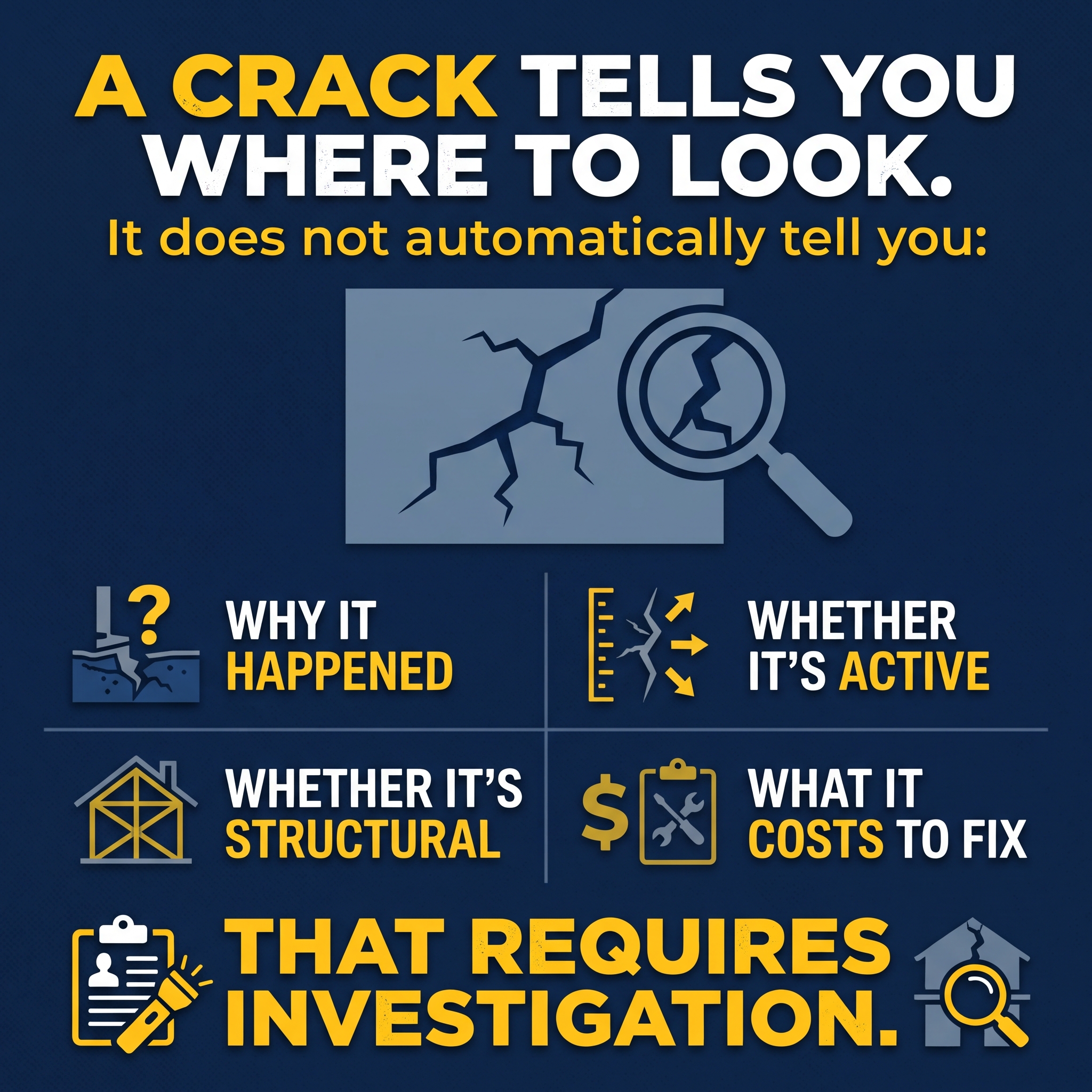
A CRACK DOES NOT DIAGNOSE ITSELF.
The important questions are:
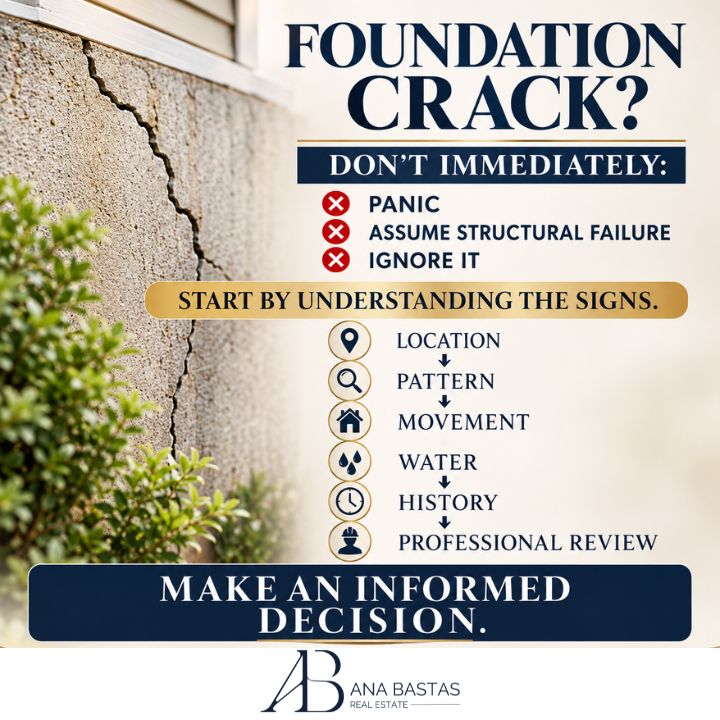
Where is it?
What direction does it run?
How wide is it?
Is there displacement?
Is there evidence of movement?
Is water entering?
Has it been repaired previously?
Has it changed?
Are there other related symptoms?
Does the home inspector recommend further professional evaluation?
Why Do Foundations Crack?
Different foundation materials can develop cracks for different reasons.
Potential contributing factors can include:
Concrete shrinkage.
Normal settlement.
Soil movement.
Hydrostatic pressure.
Drainage conditions.
Temperature changes.
Construction.
Structural movement.
Deterioration.
Previous alterations.
That's exactly why:
“THERE'S A CRACK” IS NOT ENOUGH INFORMATION.
The cause and significance matter.
Are Foundation Cracks Normal?
Some cracking can occur in concrete and masonry over time.
But buyers should be careful with the word:
NORMAL.
Seeing a crack does not give a Realtor, buyer or internet article enough information to declare:
“That's normal.”
Likewise, a crack doesn't automatically establish:
“The foundation is failing.”
OBSERVE IT. DOCUMENT IT. INVESTIGATE IT WHEN APPROPRIATE.
Vertical Foundation Cracks
Buyers commonly encounter vertical or near-vertical cracks in poured-concrete foundation walls.
Some may be associated with:
Shrinkage.
Settlement.
Other movement.
But:
THE DIRECTION ALONE DOESN'T TELL YOU WHETHER TO IGNORE IT.
Look at the complete picture.
Is there:
Water staining?
Active moisture?
Previous repair?
Significant width?
Displacement?
Multiple cracks?
Other movement?
Professional recommendation for further investigation?
Horizontal Foundation Cracks
Horizontal cracking can warrant particular attention because lateral forces on a foundation wall may be one potential consideration.
But again:
DON'T DIAGNOSE IT YOURSELF.
If your home inspector identifies a horizontal crack or other condition that raises structural concerns:
Follow the recommendation for further professional assessment.
Stair-Step Cracks
In masonry foundations or exterior brickwork, buyers may encounter cracks that follow mortar joints in a stair-step pattern.
Possible causes vary.
The important questions remain:
Is movement occurring?
Is there displacement?
Is this old or recent?
Are openings affected?
Are there other structural indicators?
Does it warrant engineering review?
THE PATTERN IS A CLUE—not the final diagnosis.
Foundation Crack vs. Foundation Leak
These are related but different questions.
A crack can potentially provide a pathway for water without necessarily establishing a major structural problem.
So when a buyer says:
“There's a foundation problem.”
I want to separate:
STRUCTURE
from:
WATER
because the investigation and potential solutions may be different.
Look for Evidence of Water
Foundation due diligence shouldn't focus only on the crack itself.
Look at the surrounding area for evidence such as:
Water staining.
Efflorescence.
Dampness.
Musty odours.
Damaged drywall.
Damaged flooring.
Previous waterproofing.
Sump systems.
Drainage improvements.
Previous repairs.
But remember:
EVIDENCE OF WATER DOESN'T AUTOMATICALLY IDENTIFY THE SOURCE.
Where Is the Water Coming From?
This is one of the most important older-home questions.
Basement water can potentially relate to:
Foundation cracks.
Grading.
Downspouts.
Surface drainage.
Window wells.
Plumbing.
Sewer backup.
Drainage systems.
Other building-envelope issues.
So:
“THE BASEMENT GOT WET” IS NOT A COMPLETE DIAGNOSIS.
Ask:
WHY?
What Is Efflorescence?
Buyers sometimes notice a white, powdery material on concrete or masonry basement walls.
Efflorescence can occur when moisture moves through masonry and leaves mineral salts behind as the moisture evaporates.
It can be useful evidence that:
Moisture has been present.
But:
IT DOESN'T, BY ITSELF, TELL YOU THE SOURCE OR SEVERITY OF THE WATER CONDITION.
Further investigation may be appropriate.
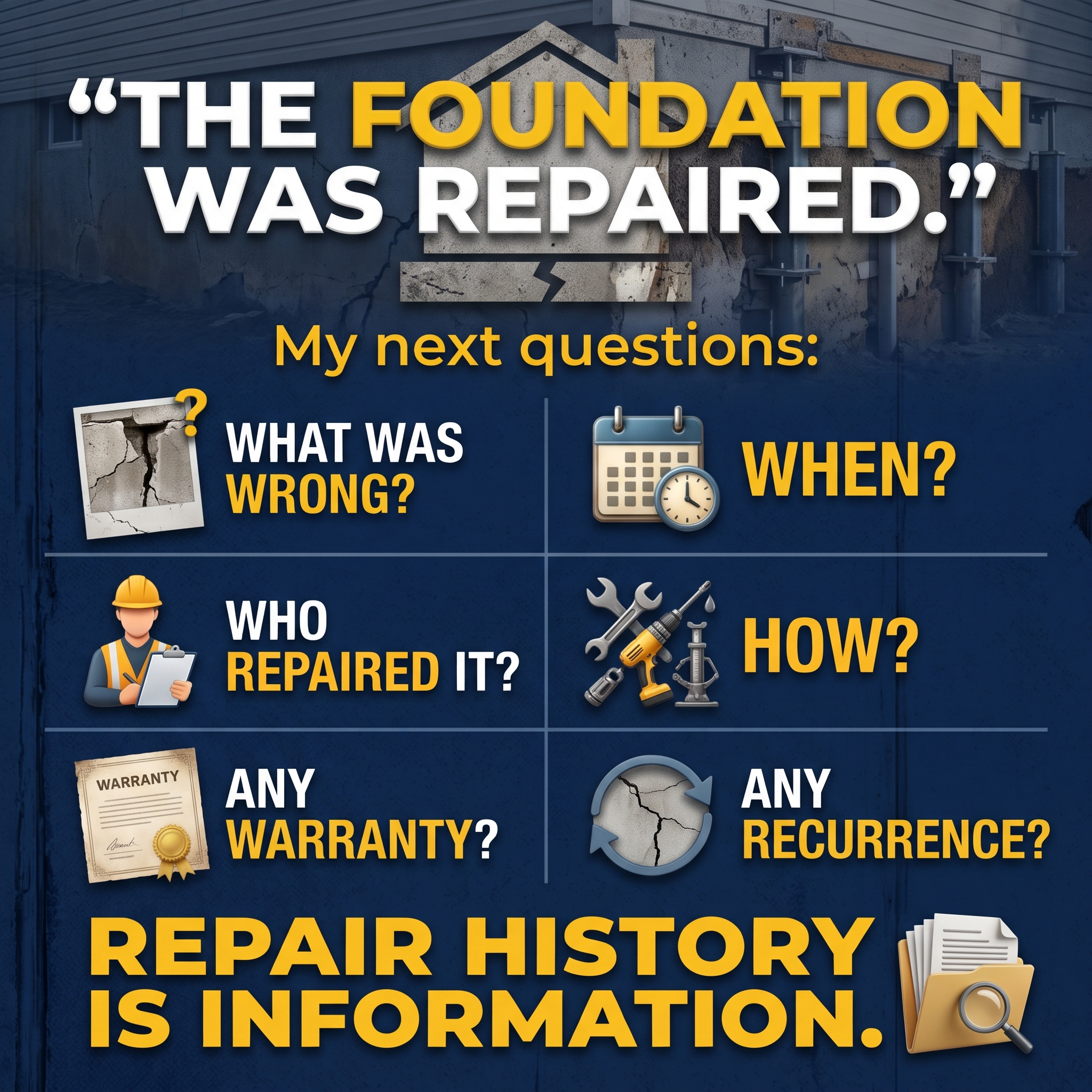
What If the Crack Has Already Been Repaired?
That isn't automatically bad.
In fact, repair history can provide useful information.
Ask:
When was it repaired?
Why?
What method was used?
Who completed it?
Is there an invoice?
Is there a warranty?
Was there water infiltration?
Was structural movement identified?
Has the problem returned?
REPAIRED DOESN'T MEAN HIDE IT.
It means:
UNDERSTAND THE HISTORY.
 Previous Waterproofing
If a seller tells you:
“The basement was waterproofed.”
Great.
Now determine:
Interior or exterior?
Which walls?
Why was it done?
Was there an active leak?
Drainage work?
Foundation repair?
Warranty?
Documentation?
When?
The word:
“WATERPROOFED”
can describe very different scopes of work.
Interior vs. Exterior Waterproofing
Buyers often hear these terms without understanding that they may represent different approaches to managing water.
We should not recommend one universally over another in the blog.
The appropriate solution depends on:
Source of water.
Foundation construction.
Site conditions.
Drainage.
Accessibility.
Professional assessment.
The key real-estate question is:
WHAT PROBLEM WAS THE WORK INTENDED TO SOLVE?
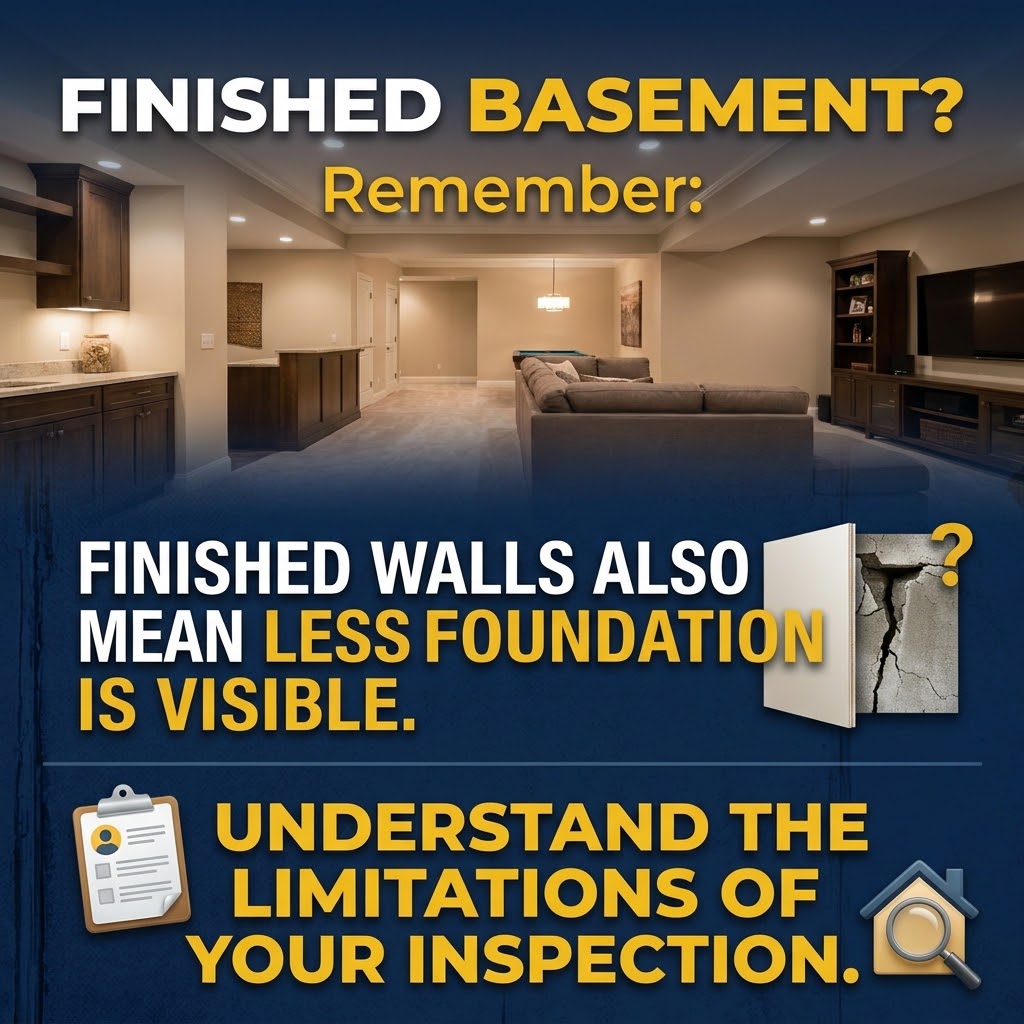
What About a Finished Basement?
Finished basements create another due-diligence limitation.
A beautiful basement may have:
Drywall.
Insulation.
Flooring.
Built-ins.
Storage.
covering much of the foundation.
That doesn't mean:
“The seller is hiding something.”
It simply means:
YOU CAN'T INSPECT WHAT YOU CAN'T SEE.
Buyers need to understand the limitations of visual inspection.
What Other Signs Can Accompany Foundation Movement?
A professional evaluating structural concerns may consider more than the basement wall.
Potential observations can include:
Cracking elsewhere.
Doors/windows behaving unusually.
Floor movement.
Wall displacement.
Exterior masonry cracking.
Structural alterations.
Beam/post conditions.
Previous repairs.
But:
ONE STICKING DOOR DOESN'T MEAN THE FOUNDATION IS FAILING.
Look at the entire property.
What About Sloping Floors?
Older houses sometimes have floors that aren't perfectly level.
Again:
Sloping floor ≠ automatic structural failure.
But the degree, cause and whether movement is active can matter.
For a century home in particular, buyers need to distinguish:
Character and historic movement
from:
A condition requiring further structural investigation.
That distinction should be made by the appropriate professional where necessary.
When Should You Call a Structural Engineer?
If the home inspector or another qualified professional identifies concerns about:
Structural movement.
Foundation displacement.
Significant cracking.
Bowing.
Settlement.
Structural alterations.
Beams/posts.
Load-bearing components.
then further evaluation by a qualified structural professional may be appropriate.
THE ENGINEER'S JOB IS TO EVALUATE THE STRUCTURE.
My job as your Realtor is to help you:
Obtain the information.
Understand how it affects the transaction.
Determine your options.
Make an informed real-estate decision.
Foundation Repairs Can Vary Dramatically
“Foundation repair” can mean:
Sealing a crack.
or:
Waterproofing.
or:
Drainage improvements.
or:
Structural reinforcement.
or:
Excavation.
or:
Significant structural work.
Those are completely different scopes.
Therefore:
NEVER NEGOTIATE FROM THE PHRASE “FOUNDATION PROBLEM.”
First determine:
What is actually wrong?
How Much Does Foundation Repair Cost in Ontario?
There is no responsible universal answer.
Costs can vary based on:
Cause.
Repair method.
Structural involvement.
Accessibility.
Excavation.
Waterproofing.
Drainage.
Foundation material.
Length/area affected.
Restoration.
Contractor.
So:
GET A PROPERTY-SPECIFIC PROFESSIONAL ASSESSMENT AND QUOTE.
Don't Let a Contractor Quote Become the Diagnosis
This is another important distinction.
If the concern may be structural, the buyer may want independent professional advice regarding:
Cause and required remedy
before relying solely on someone whose business is:
Selling the repair.
The appropriate professional depends on the issue.
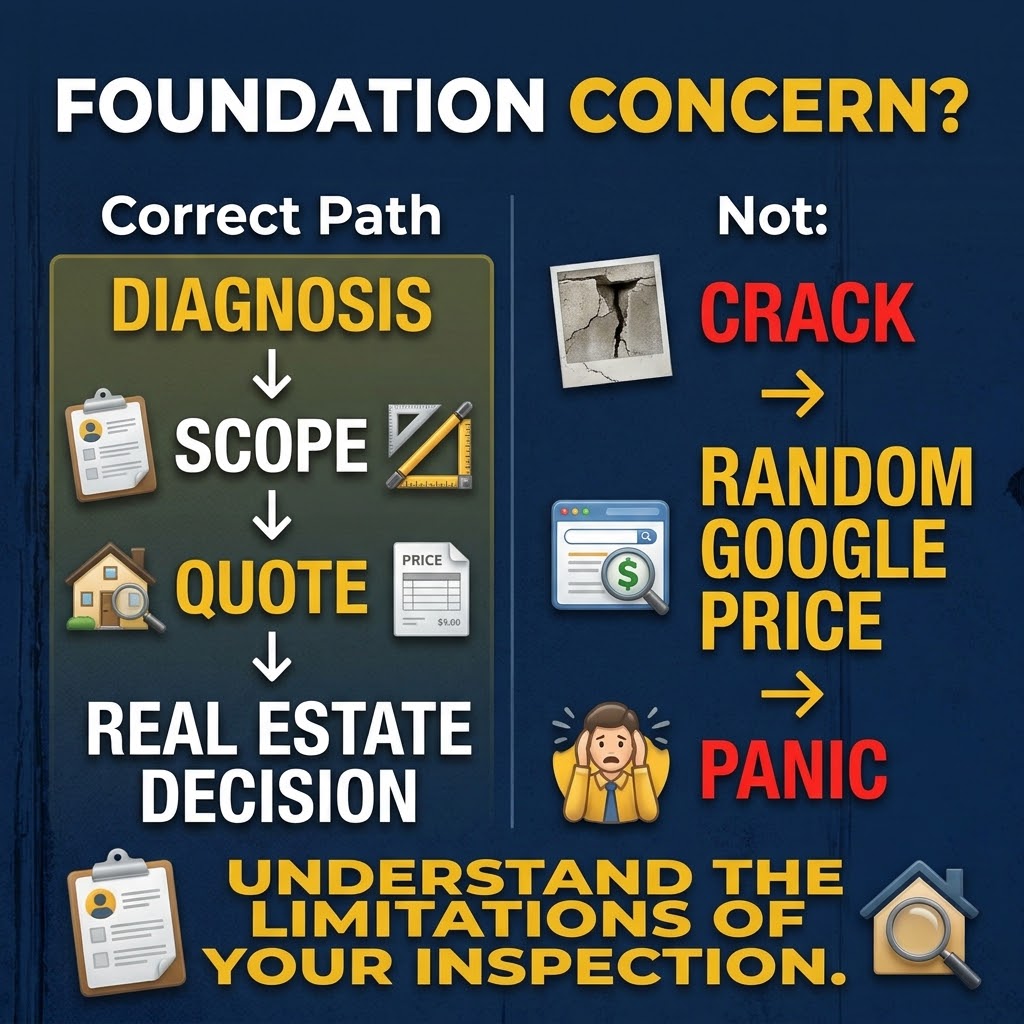
DIAGNOSIS FIRST. SCOPE SECOND. QUOTE THIRD.
Buying a House With a Foundation Crack
Let's put this into a real transaction.
You love the house.
Then the inspection finds a crack.
Don't immediately ask:
“Do we walk?”
Ask:
What did the inspector observe?
Is further evaluation recommended?
Is there water?
Is there movement?
Has it been repaired?
Is there documentation?
What does the appropriate professional say?
What work is recommended?
What will it cost?
Then decide.
A Foundation Issue Isn't Automatically a Bad Investment
Suppose a buyer discovers a repair is needed.
The real-estate question becomes:
What is the property worth?
What is the repair?
What does it cost?
Is the seller addressing it?
Is the price appropriate?
What is the buyer's tolerance?
Will it affect financing or insurance?
What are the long-term implications?
A REPAIRABLE PROBLEM AND A BAD PURCHASE ARE NOT AUTOMATICALLY THE SAME THING.
But Don't Ignore a Serious Finding Because You Love the House
The opposite mistake is equally dangerous.
Buyers sometimes become emotionally attached and say:
“It's probably nothing.”
If the inspector recommends:
Structural evaluation,
get the evaluation.
If water is unexplained:
Investigate.
If movement is suspected:
Investigate.
LOVE THE HOUSE AFTER YOU UNDERSTAND THE HOUSE.
Should the Seller Repair the Foundation?
Not automatically.
First:
Diagnose.
Determine scope.
Determine urgency.
Obtain cost information.
Then decide the negotiation strategy.
Depending on the agreement and circumstances, possibilities might include:
Seller repair.
Price adjustment.
Other negotiated solution.
Buyer accepts condition.
Further investigation.
Buyer does not proceed where contractually permitted.
There is no universal answer.
Be Careful With Seller Repairs
If the issue is material:
“Seller agrees to fix foundation crack”
may be far too vague.
What does:
“fix”
mean?
Seal it?
Waterproof it?
Structural repair?
Paint over it?
The contractual language needs to reflect the actual issue and intended result, with appropriate professional/legal input.
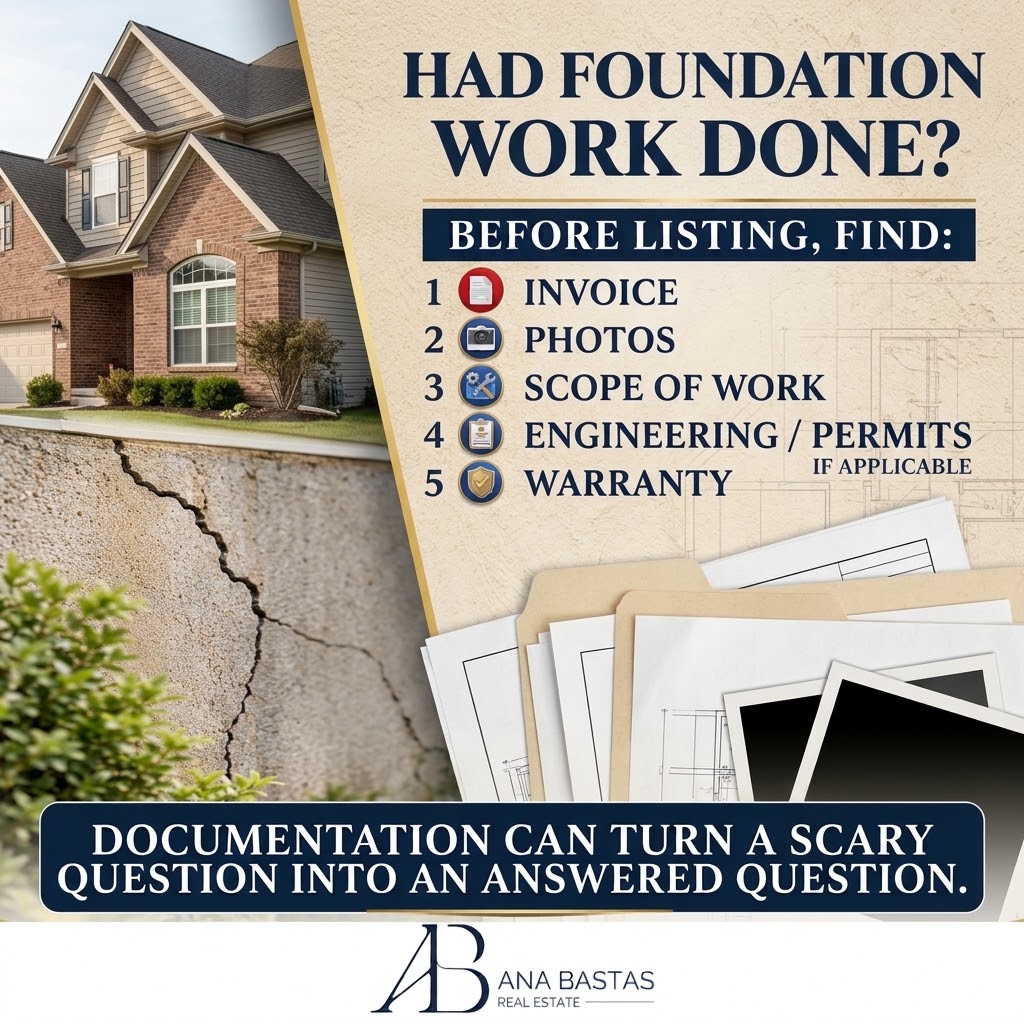
Selling a Home With Foundation Repair History
A prior foundation repair doesn't automatically destroy marketability.
But:
DOCUMENTATION BUILDS CONFIDENCE.
Where available, gather:
Contractor invoice.
Scope.
Engineering documentation.
Permits where applicable.
Warranty.
Waterproofing records.
Photos.
Dates.
Transferability of warranty where applicable.
The stronger the documentation:
THE LESS THE BUYER HAS TO GUESS.
Grading and Drainage Matter Too
Foundation discussions shouldn't stop at the wall.
Water management around a home may involve:
Lot grading.
Downspouts.
Eavestroughs.
Window wells.
Landscaping.
Drainage.
Adjacent hard surfaces.
The foundation is part of a larger system.
WHEN WATER IS THE PROBLEM, ASK WHERE THE WATER IS COMING FROM AND WHERE IT IS GOING.
Older Homes and Foundation Materials
Not every older Ontario home has the same foundation.
Depending on age and construction, buyers may encounter different materials and construction methods.
That is another reason why:
A universal “crack guide”
is inadequate.
The appropriate professional needs to consider:
Material.
Construction.
Age.
Condition.
Site.
Movement.
Moisture.
Buying a Century Home
If you're buying a century home, some movement and historical repairs may exist.
The objective isn't:
FIND A 100-YEAR-OLD HOUSE THAT HAS NEVER MOVED.
It's:
UNDERSTAND WHAT MOVEMENT HAS OCCURRED, WHETHER IT'S ACTIVE AND WHETHER PROFESSIONAL ACTION IS NEEDED.
Buying a Century Home in Ontario: Complete Buyer Guide
Foundation + Sewer + Water
This is why our Older Home cluster is becoming powerful.
A basement issue may involve:
FOUNDATION
or:
DRAINAGE
or:
SEWER
or:
PLUMBING
or:
A COMBINATION.
So we shouldn't evaluate older-home problems in isolation.
THE HOUSE IS A SYSTEM.
The Ana Bastas Foundation Due-Diligence Framework
When a foundation concern is identified:
1. OBSERVE
What exactly was found?
↓
2. LOCATION
Where is it?
↓
3. PATTERN
What does the professional observe?
↓
4. MOVEMENT
Any evidence requiring structural investigation?
↓
5. WATER
Any active or historical moisture?
↓
6. HISTORY
Previous repairs?
↓
7. DOCUMENTATION
Invoices + warranties + professional reports.
↓
8. PROFESSIONAL REVIEW
Inspector → engineer / appropriate specialist where warranted.
↓
9. SCOPE
What work is actually recommended?
↓
10. COST
Obtain a property-specific quote.
↓
11. TRANSACTION
Accept, investigate, negotiate or reconsider.
↓
12. DECISION
DON'T DIAGNOSE THE CRACK. UNDERSTAND WHAT THE CRACK MEANS FOR THIS HOUSE.
Foundation Buyer Checklist
Fona, add this to the Ontario Older Home Buyer Due Diligence Toolkit.
OBSERVATION
☐ Foundation visible where accessible
☐ Cracks documented
☐ Location noted
☐ Water evidence noted
☐ Displacement noted by professional where applicable
☐ Other movement indicators considered
HISTORY
☐ Previous foundation repairs requested
☐ Waterproofing history requested
☐ Basement flooding history investigated
☐ Documentation obtained where available
☐ Warranty reviewed where applicable
PROFESSIONAL
☐ Home inspector comments reviewed
☐ Further investigation recommendation followed
☐ Structural professional consulted where warranted
☐ Water specialist consulted where warranted
EXTERIOR
☐ Grading considered
☐ Downspouts considered
☐ Eavestroughs considered
☐ Window wells considered
☐ Drainage considered
FINANCIAL
☐ Recommended work determined
☐ Quote obtained
☐ Excavation considered
☐ Waterproofing considered
☐ Restoration considered
☐ Future monitoring/maintenance understood
TRANSACTION
☐ Buyer understands issue
☐ Insurance implications investigated if applicable
☐ Financing implications investigated if applicable
☐ Negotiation strategy considered
☐ Buyer comfortable proceeding
Frequently Asked Questions
Are foundation cracks normal in older homes?
Some cracking can occur as building materials shrink, settle or move over time, but a crack should not be declared harmless solely because the house is old. Its characteristics and surrounding conditions matter.
Does a foundation crack mean the house has structural problems?
No. A crack alone doesn't establish structural failure. Some findings may warrant further evaluation to determine whether structural movement is involved.
Are vertical foundation cracks serious?
Direction alone isn't enough to determine significance. Condition, width, displacement, moisture, history and other evidence should be considered.
Is a horizontal foundation crack serious?
Horizontal cracking can warrant further investigation, particularly if movement or displacement is suspected. Buyers should follow professional recommendations rather than self-diagnosing.
What is a stair-step foundation crack?
It is cracking that follows mortar joints in a step-like pattern in masonry. Its significance depends on the specific structure and surrounding evidence.
Can a foundation crack cause basement water?
A crack can potentially provide a pathway for moisture, but basement water can have numerous causes. The source should be properly investigated.
Should I buy a house with a foundation crack?
Potentially. First determine what the crack represents, whether further professional evaluation is required, what repair is recommended and what it will cost.
Should I hire a structural engineer?
If structural movement or another significant structural condition is suspected or your home inspector recommends further evaluation, consultation with an appropriately qualified structural professional may be warranted.
How much does foundation repair cost in Ontario?
There is no universal price. Costs depend heavily on the cause and repair scope. A crack repair, waterproofing project and structural repair can involve very different costs.
Does a repaired foundation crack mean there is still a problem?
Not necessarily. Investigate why it was repaired, how, when, whether documentation exists and whether the condition has recurred.
Is basement waterproofing the same as foundation repair?
Not necessarily. Waterproofing can address water-management concerns while structural foundation work addresses different conditions. Determine what work was actually performed.
Should a seller repair foundation cracks before listing?
Not automatically. Sellers should first understand what the crack represents, whether professional work is recommended and how the issue affects the property's sale strategy.
Categories
- All Blogs (1392)
- Ana Bastas Real Estate Team (1)
- Ana Bastas Realtor (1)
- Ana bastas Realty (1)
- Brampton (2)
- Burlington (10)
- Buy & Travel™ Program (12)
- Buyer (347)
- Community News (2)
- Divorce (21)
- Downsizing (20)
- Events (73)
- First Time Home Buyers (156)
- Georgetown (38)
- Georgetown Buyers (8)
- Halton Hills (273)
- Hamilton (29)
- Holidays (18)
- How To (139)
- Interest Rates (11)
- Investor (49)
- Join ABR Team (4)
- Landlord (105)
- Lifestyle (178)
- Milton (83)
- Mississauga (3)
- Mortgage (23)
- Niagara (39)
- Oakville (6)
- Real Estate News (236)
- Realtor (68)
- Renter (100)
- Seller (266)
- Tax's (28)
- Tips (41)
- Toronto (149)
- Wealth Building (14)
- Wellington (4)
- YYZ (107)
Recent Posts







"My job is to find and attract mastery-based agents to the office, protect the culture, and make sure everyone is happy! "