
Old Plumbing in Ontario Homes: What Buyers Need to Know

Old Plumbing in Ontario Homes: Galvanized Pipes, Cast Iron & What Buyers Should Know
“The House Has Old Plumbing. Is That a Problem?”
Maybe.
But:
“OLD PLUMBING” ISN’T A DIAGNOSIS.
A house may contain plumbing installed:
When it was originally built.
During a kitchen renovation.
During a bathroom renovation.
When the basement was finished.
During an addition.
After a leak.
During a partial repipe.
That means an older Ontario home can contain a mixture of plumbing materials and ages.
The right questions are:
What pipe materials are present?
Where?
What condition are they in?
Has plumbing been partially replaced?
Is there evidence of leakage?
How is the water pressure?
How well do fixtures drain?
What work has previously been completed?
What does the home inspector observe?
Is further plumbing evaluation recommended?
IDENTIFY → INSPECT → UNDERSTAND → BUDGET → DECIDE.

Plumbing Is Actually Multiple Systems
When buyers say:
“The plumbing looks good,”
they may be looking at:
Faucets.
Toilets.
Sinks.
Shower fixtures.
But those are only the visible components.
A home's plumbing includes systems responsible for:
BRINGING WATER IN
and:
TAKING WASTEWATER OUT.
These can involve completely different materials and conditions.
Supply Plumbing vs. Drain Plumbing
This distinction is important.
SUPPLY PIPING
delivers water to fixtures.
DRAINAGE PIPING
carries wastewater away.
So a home might have:
Updated copper supply lines
but:
Older drainage components.
Or vice versa.
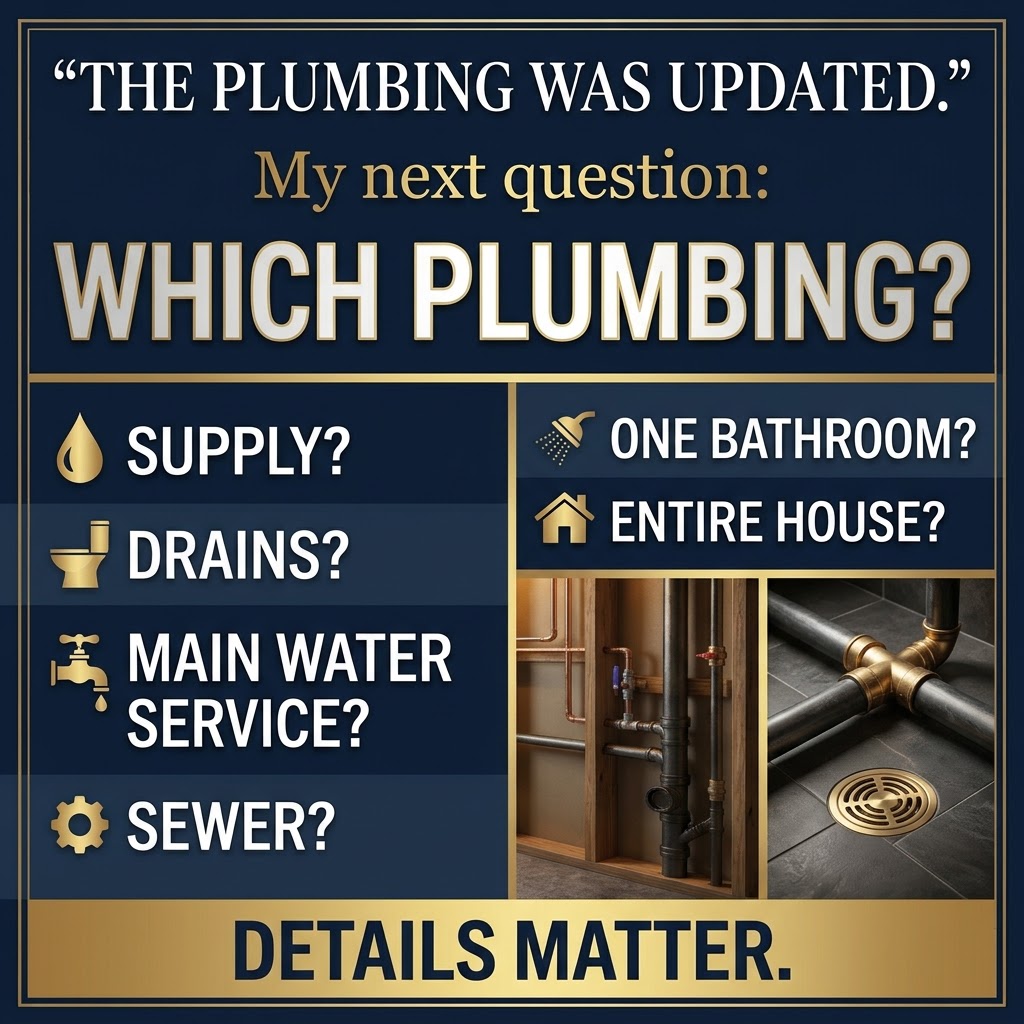
“PLUMBING UPDATED” IS TOO VAGUE.
Ask:
WHAT WAS ACTUALLY UPDATED?
What Are Galvanized Pipes?
Galvanized steel piping can be found in some older homes.
It was historically used for water-supply plumbing.
Over time, galvanized piping can be affected by:
Internal corrosion.
Mineral buildup.
Reduced internal diameter.
Deterioration.
Leakage.
This can potentially contribute to issues such as:
Reduced water flow.
Pressure concerns.
Discoloured water.
Leakage.
But:
SEEING ONE GALVANIZED PIPE DOESN’T AUTOMATICALLY MEAN THE ENTIRE HOUSE NEEDS TO BE REPLUMBED.
Determine the actual extent.
Why Can Galvanized Pipes Have Low Water Flow?
One potential issue is what happens inside the pipe.
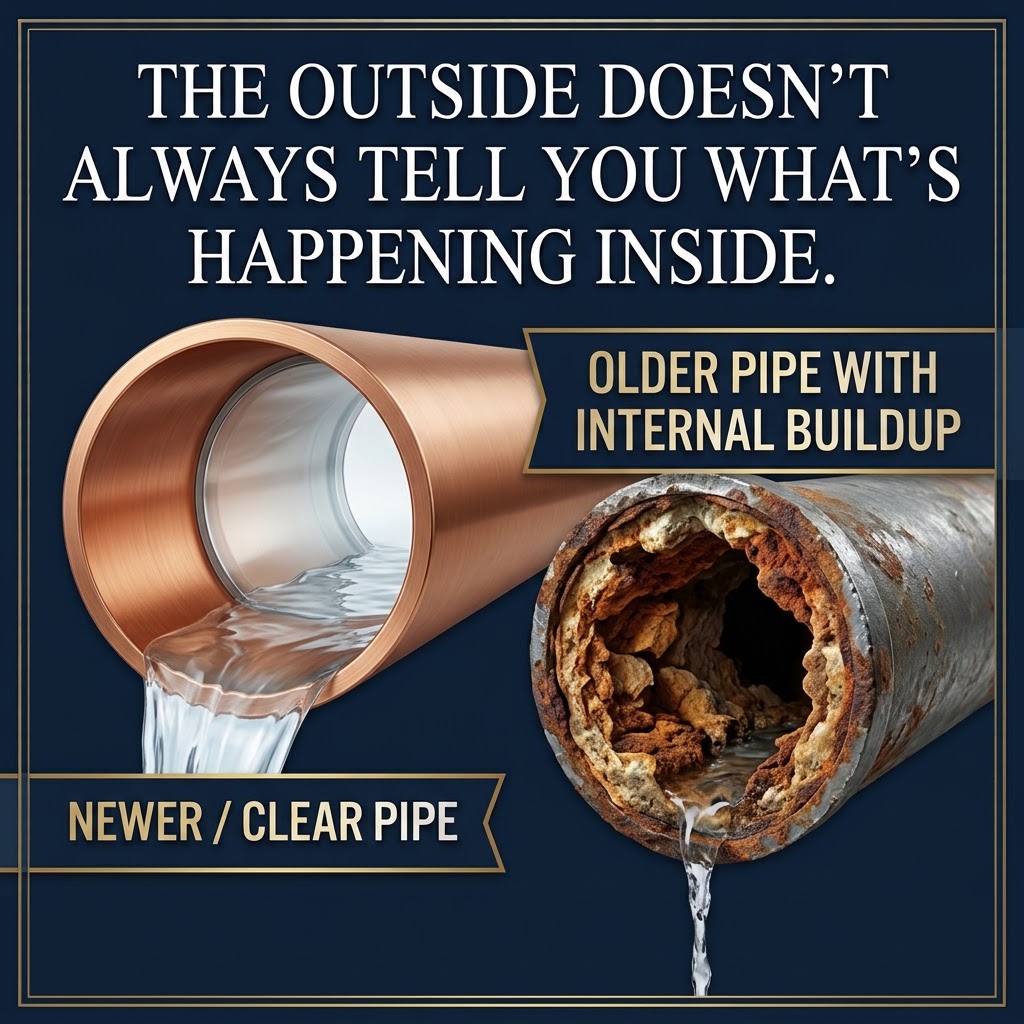
A pipe may appear intact externally while corrosion and mineral accumulation have reduced the available interior opening.
That's why a buyer shouldn't evaluate plumbing solely by:
Looking at exposed pipes in the basement.
Test and investigate the actual system.
Does Galvanized Plumbing Have to Be Replaced?
Not automatically simply because the material exists.
The decision depends on factors such as:
Condition.
Extent.
Leakage.
Corrosion.
Water flow.
Professional recommendation.
Renovation plans.
Insurance considerations where applicable.
If replacement is recommended:
GET A PROPERTY-SPECIFIC SCOPE AND QUOTE.
What Are Cast-Iron Drain Pipes?
Cast iron has historically been used in drainage systems and may still be present in older homes.
Again:
CAST IRON ≠ AUTOMATIC FAILURE.
But older drainage components may warrant investigation for:
Corrosion.
Leakage.
Cracking.
Deterioration.
Joint conditions.
Drainage performance.
Previous repairs.
The condition of the actual pipe matters more than the fact that the words:
CAST IRON
appear on an inspection report.
Cast Iron Inside the House vs. Sewer Outside
This is where we connect to the previous article.
A buyer may have older cast-iron drainage components inside the house while the underground sewer lateral outside involves another material.
They aren't necessarily the same system or the same repair.
INTERIOR DRAINAGE ≠ EXTERIOR SEWER LATERAL.
READ: Sewer Line Inspections in Ontario →
What About Copper Plumbing?
Copper is common in many homes and may represent:
Original plumbing from a later construction era.
or:
An upgrade from an older system.
But:
COPPER DOESN’T AUTOMATICALLY MEAN “NO PLUMBING ISSUES.”
Any plumbing material can still have:
Poor workmanship.
Damaged connections.
Leakage.
Previous modifications.
Other problems.
Evaluate condition—not simply material.
What About PEX?
PEX is another material buyers may encounter, particularly in newer plumbing work and renovations.
Again:
Seeing PEX doesn't prove the entire home was professionally replumbed.
A house might have:
PEX in renovated bathroom.
Copper elsewhere.
Galvanized pipe elsewhere.
Older drainage.
This is why:
OLDER HOMES OFTEN TELL THEIR RENOVATION HISTORY THROUGH THEIR PLUMBING.
Mixed Plumbing Is Common in Older Homes
Imagine a 90-year-old house.
Original bathroom:
Older plumbing.
Kitchen renovated in 1998:
Different plumbing.
Basement finished in 2012:
Another material.
Upstairs bathroom renovated in 2023:
Newer plumbing.
That isn't automatically problematic.
But it does mean:
YOU NEED TO UNDERSTAND THE SYSTEM AS A WHOLE.

What About Poly-B Plumbing?
Polybutylene—or Poly-B—is another plumbing material buyers may encounter in certain homes, although it generally relates to a different construction era than galvanized plumbing.
If identified:
Determine extent.
Obtain professional advice.
Confirm insurance implications where applicable.
Investigate replacement history.
Obtain cost information if work is recommended.
We should eventually let Search Console tell us whether this deserves a standalone article rather than expanding this cluster indefinitely.
Water Pressure
Buyers love turning on the shower and saying:
“Pressure is great!”
Useful—but not enough.
Water pressure and water flow can be influenced by several factors.
If a buyer or inspector identifies concerns:
Investigate the cause.
Don't immediately assume:
“Old pipes.”
And don't assume:
“Municipal pressure.”
The property needs to be evaluated.
Test Multiple Fixtures
During appropriate inspection, professionals may evaluate how plumbing behaves under use.
For example:
What happens when more than one fixture operates?
Does flow change significantly?
Do fixtures drain properly?
Are there unusual sounds?
Is there evidence of leakage?
Again:
LET THE INSPECTOR DO THE INSPECTING.
Buyers should not attempt invasive plumbing testing themselves.
Slow Drains
A slow drain can potentially relate to:
Local blockage.
Drainage configuration.
Venting.
Older piping.
Larger drainage problem.
Sewer issue.
Therefore:
ONE SLOW SINK DOESN’T AUTOMATICALLY MEAN THE SEWER IS BROKEN.
But multiple drainage symptoms may justify further investigation.
Look for Signs of Previous Leaks
Older-home plumbing due diligence should include looking for evidence such as:
Water staining.
Ceiling repairs.
Damaged cabinetry.
Corrosion.
Patched drywall.
Previous plumbing repairs.
Moisture.
Damaged flooring.
But:
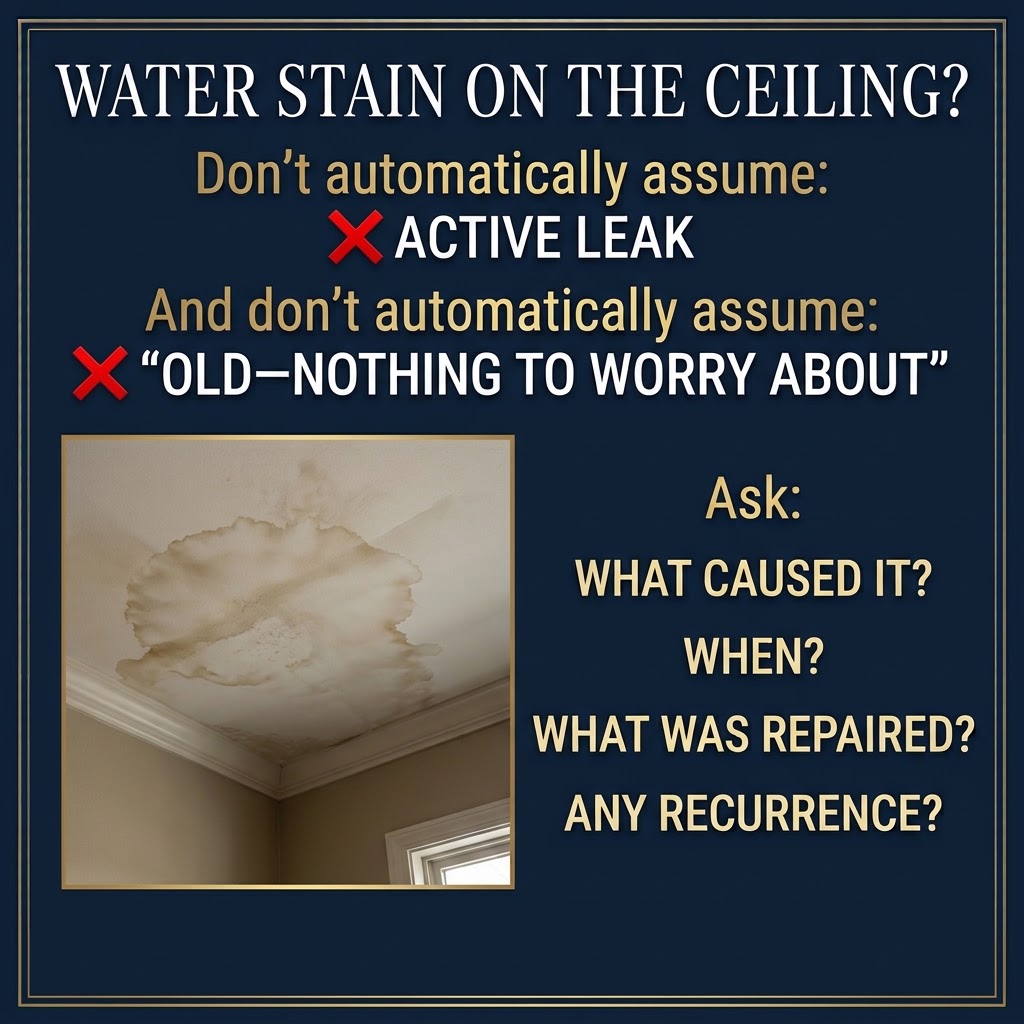
A STAIN DOESN’T TELL YOU WHETHER THE LEAK IS ACTIVE.
Ask:
What happened?
When?
What was repaired?
Is documentation available?
Renovated Bathrooms Need Investigation Too
A beautiful bathroom can actually create more questions.
Ask:
When was it renovated?
Was plumbing relocated?
Were supply lines replaced?
Were drains replaced?
Was appropriate professional work completed?
Were permits required/obtained where applicable?
Is documentation available?
COSMETIC RENOVATION AND PLUMBING RENOVATION ARE NOT THE SAME THING.
New Kitchen ≠ New Plumbing
Same principle.
Quartz countertops tell you:
The countertops are newer.
They don't tell you:
What pipe runs behind the cabinets.
What drain exists below the floor.
Whether plumbing was relocated.
Whether the work was professionally completed.
LOOK PAST THE FINISHES.
What About the Main Water Service?
Buyers often focus exclusively on plumbing inside the home.
But there may also be infrastructure bringing water from the municipal system toward the house.
Material, responsibility and replacement considerations can vary by property and municipality.
If concerns are identified:
INVESTIGATE THE SPECIFIC PROPERTY AND LOCAL RESPONSIBILITY.
Don't assume everything underground belongs to:
The City.
Water Shutoff
A surprisingly practical question:
WHERE IS THE MAIN WATER SHUTOFF?
Buyers should know where it is after closing.
In an emergency:
A beautiful kitchen is irrelevant.
You need to know:
HOW TO STOP THE WATER.
Water Heater
The water heater is part of the broader water system but deserves separate attention.
Determine:
Age.
Condition.
Ownership.
Rental status.
Rental contract where applicable.
Evidence of leakage.
Replacement expectations.
In Ontario, buyers should be particularly attentive to whether equipment is:
OWNED OR RENTED.
That can have ongoing financial implications.
Plumbing + Asbestos Can Become a Renovation Issue
Suppose a buyer wants to replace old plumbing.
The contractor needs access behind:
Plaster.
Drywall compound.
Flooring.
Other older building materials.
If those materials contain asbestos:
Plumbing work
can become:
Plumbing + environmental management + restoration.
That's why our older-home cluster works as a system.
READ: Asbestos in Older Homes Ontario →
Plumbing + Foundation + Water
A wet basement can potentially involve:
Plumbing leak.
Foundation water.
Sewer backup.
Drainage.
Other causes.
So:
DON'T LABEL EVERY BASEMENT WATER PROBLEM “FOUNDATION.”
And don't label every water problem:
“PLUMBING.”
Determine the source.
How Much Does It Cost to Replace Old Plumbing in Ontario?
There is no responsible universal number.
Costs depend on:
House size.
Pipe material.
Extent.
Accessibility.
Number of bathrooms.
Kitchens.
Wall construction.
Finished basement.
Number of storeys.
Required restoration.
Contractor.
Scope.
And remember:
THE PLUMBER'S PRICE MAY NOT BE THE ENTIRE PROJECT PRICE.

Don't Use Generic Per-Square-Foot Numbers
We want to rank for:
“galvanized pipe replacement cost Ontario”
and:
“old plumbing replacement cost Ontario”
But we shouldn't pretend there is one reliable number.
Use:
The cost of replacing older plumbing varies significantly based on the amount and type of piping, accessibility, house configuration and restoration required. Buyers should obtain a property-specific assessment and written quotation where replacement is recommended.
Buying a House With Galvanized Pipes
Should you automatically walk away?
NO.
Determine:
How much remains?
What condition?
Any leakage?
Water flow?
Previous replacement?
Future renovation plans?
Professional recommendation?
Cost?
Then evaluate the entire property.
If You're Already Renovating, the Equation Changes
Buyer A:
Wants move-in ready.
Buyer B:
Plans full renovation.
Same plumbing.
Different impact.
If Buyer B is already:
Opening walls.
Replacing kitchen.
Renovating bathrooms.
Finishing basement.
then coordinating plumbing upgrades may be more practical than doing them later.
YOUR RENOVATION PLAN CHANGES YOUR RISK AND COST.
Don't Ignore It Because “It's Been Fine for 60 Years”
This logic appears constantly with older houses.
“It hasn't leaked yet.”
doesn't establish:
Remaining service life.
Likewise:
“It's old.”
doesn't establish:
Immediate failure.
Our approach remains:
DON'T PANIC. DON'T DISMISS. INVESTIGATE.
Should the Seller Replace Old Plumbing?
Not automatically.
First determine:
Condition.
Problem.
Recommended work.
Cost.
Market conditions.
Purchase price.
Then develop the negotiation strategy.
A buyer shouldn't demand:
“REPLACE ALL OLD PLUMBING.”
simply because some piping isn't new.
Selling a Home With Older Plumbing
For sellers, preparation matters.
If you've had plumbing work completed, gather:
Invoices.
Contractor information.
Permits where applicable.
Renovation documentation.
Warranty information.
Dates.
Scope.
If only part of the house was replumbed:
SAY WHAT WAS ACTUALLY DONE.
What About Insurance?
Some plumbing materials or conditions may affect an insurer's underwriting requirements.
Requirements vary.
Therefore, where a potentially material plumbing condition is identified:
CONFIRM WITH THE BUYER'S INSURANCE PROFESSIONAL.
Do not rely on:
Seller's insurer.
Realtor assumptions.
What happened on another house.
What About Financing?
If a plumbing issue is significant enough to affect:
Property condition.
Insurance.
Habitability.
Appraisal/lender requirements,
the buyer should keep their mortgage professional informed.
Again:
PRE-APPROVED BUYER ≠ EVERY HOUSE AUTOMATICALLY APPROVED.
The Ana Bastas Older-Home Plumbing Review
When older plumbing is identified:
1. IDENTIFY
What materials are present?
↓
2. EXTENT
Where and how much?
↓
3. SUPPLY
How is water entering and moving through the home?
↓
4. DRAINAGE
How is wastewater leaving?
↓
5. CONDITION
Leaks + corrosion + drainage + flow.
↓
6. HISTORY
What has previously been repaired or replaced?
↓
7. DOCUMENTATION
Invoices + permits + renovation records where available.
↓
8. PROFESSIONAL REVIEW
Inspector → plumber where warranted.
↓
9. SCOPE
What work is actually recommended?
↓
10. COST
Plumbing + access + restoration.
↓
11. RENOVATION
What is the buyer already planning?
↓
12. DECISION
DON'T ASK WHETHER THE PLUMBING IS OLD. ASK WHETHER YOU UNDERSTAND ITS CONDITION, COST AND FUTURE.
Older-Home Plumbing Buyer Checklist
Fona, add this to the Ontario Older Home Buyer Due Diligence Toolkit.
SUPPLY
☐ Visible pipe materials identified
☐ Galvanized piping?
☐ Copper?
☐ PEX?
☐ Other materials?
☐ Mixed plumbing?
☐ Water flow considered
☐ Evidence of corrosion/leaks
DRAINAGE
☐ Visible drainage material identified
☐ Cast iron?
☐ Other older drainage?
☐ Slow drains?
☐ Leakage?
☐ Previous repairs?
HISTORY
☐ Plumbing renovations requested
☐ Invoices available
☐ Permit information where applicable
☐ Leak history investigated
☐ Water-damage history considered
SYSTEMS
☐ Main shutoff located
☐ Water heater reviewed
☐ Water heater owned/rented confirmed
☐ Main water service concerns investigated where appropriate
PROFESSIONAL
☐ Inspector findings reviewed
☐ Plumber consulted where warranted
☐ Sewer scope considered separately
☐ Further investigation completed
COST
☐ Recommended work determined
☐ Quote obtained
☐ Wall access considered
☐ Restoration considered
☐ Renovation plans coordinated
TRANSACTION
☐ Insurance checked if relevant
☐ Financing checked if relevant
☐ Negotiation strategy considered
☐ Buyer comfortable proceeding
Frequently Asked Questions
What plumbing should I look for in an older Ontario home?
Buyers should understand both supply and drainage systems, including visible pipe materials, condition, leakage, water flow, drainage performance and previous updates.
Are galvanized pipes bad?
Galvanized steel piping can deteriorate internally over time and may experience corrosion or reduced flow. Its presence alone doesn't establish that immediate complete replacement is required; the actual system should be evaluated.
Should I buy a house with galvanized plumbing?
Potentially. Determine the extent, condition, performance, professional recommendations and expected future cost before deciding.
What is cast-iron plumbing?
Cast iron has historically been used for drainage systems. Older cast-iron components may warrant evaluation for deterioration, leakage and other conditions.
Does cast iron have to be replaced?
Not automatically based solely on material. Condition and professional assessment matter.
Does a renovated bathroom mean the plumbing is new?
No. New fixtures and finishes don't establish that all supply and drainage piping was replaced.
Does copper plumbing mean the plumbing is good?
Not automatically. Material is only one factor; installation, condition, modifications and leakage history also matter.
What does “plumbing updated” mean?
Nothing specific unless the scope is explained. Buyers should ask what pipes or systems were actually replaced, when and whether documentation exists.
Should I get a plumbing inspection when buying an older home?
A home inspector will generally evaluate accessible plumbing as part of an inspection. If concerns arise, further assessment by a qualified plumbing professional may be appropriate.
Is a sewer scope the same as a plumbing inspection?
No. A sewer camera inspection examines accessible portions of underground drainage/sewer infrastructure and serves a different purpose from inspecting visible plumbing inside the house.
How much does it cost to replace galvanized plumbing in Ontario?
There is no universal amount. Cost depends on the house, amount of piping, accessibility and restoration required. Obtain a property-specific quote.
Can old plumbing affect home insurance?
Potentially. Insurer requirements vary depending on the plumbing material and property condition, so buyers should confirm significant findings with their insurance professional.
Should a seller replace old plumbing before listing?
Not automatically. First understand its condition, recommended work, cost and effect on marketability before deciding.
Categories
- All Blogs (1388)
- Ana Bastas Real Estate Team (1)
- Ana Bastas Realtor (1)
- Ana bastas Realty (1)
- Brampton (2)
- Burlington (10)
- Buy & Travel™ Program (12)
- Buyer (343)
- Community News (2)
- Divorce (21)
- Downsizing (20)
- Events (73)
- First Time Home Buyers (156)
- Georgetown (38)
- Georgetown Buyers (8)
- Halton Hills (273)
- Hamilton (26)
- Holidays (18)
- How To (138)
- Interest Rates (11)
- Investor (49)
- Join ABR Team (2)
- Landlord (105)
- Lifestyle (178)
- Milton (84)
- Mississauga (3)
- Mortgage (23)
- Niagara (39)
- Oakville (6)
- Real Estate News (236)
- Realtor (67)
- Renter (100)
- Seller (265)
- Tax's (28)
- Tips (41)
- Toronto (149)
- Wealth Building (14)
- Wellington (3)
- YYZ (107)
Recent Posts









"My job is to find and attract mastery-based agents to the office, protect the culture, and make sure everyone is happy! "