
Basement Moisture in Older Ontario Homes: What Buyers Should Know

Water & Basement Moisture in Older Ontario Homes: What Buyers Should Investigate
“There’s Water in the Basement. Is This a Foundation Problem?”
Maybe.
But:
WATER IN THE BASEMENT DOESN'T AUTOMATICALLY MEAN THE FOUNDATION IS FAILING.
Basement moisture can potentially originate from different sources.
Depending on the property, possibilities may include:
Surface drainage.
Grading.
Foundation cracks.
Window wells.
Roof drainage.
Plumbing leaks.
Sewer backup.
Groundwater.
Drainage-system issues.
Other building-envelope conditions.
So when I'm helping a buyer evaluate an older home, I don't want to stop at:
“THE BASEMENT GOT WET.”
I want to know:
WHY?
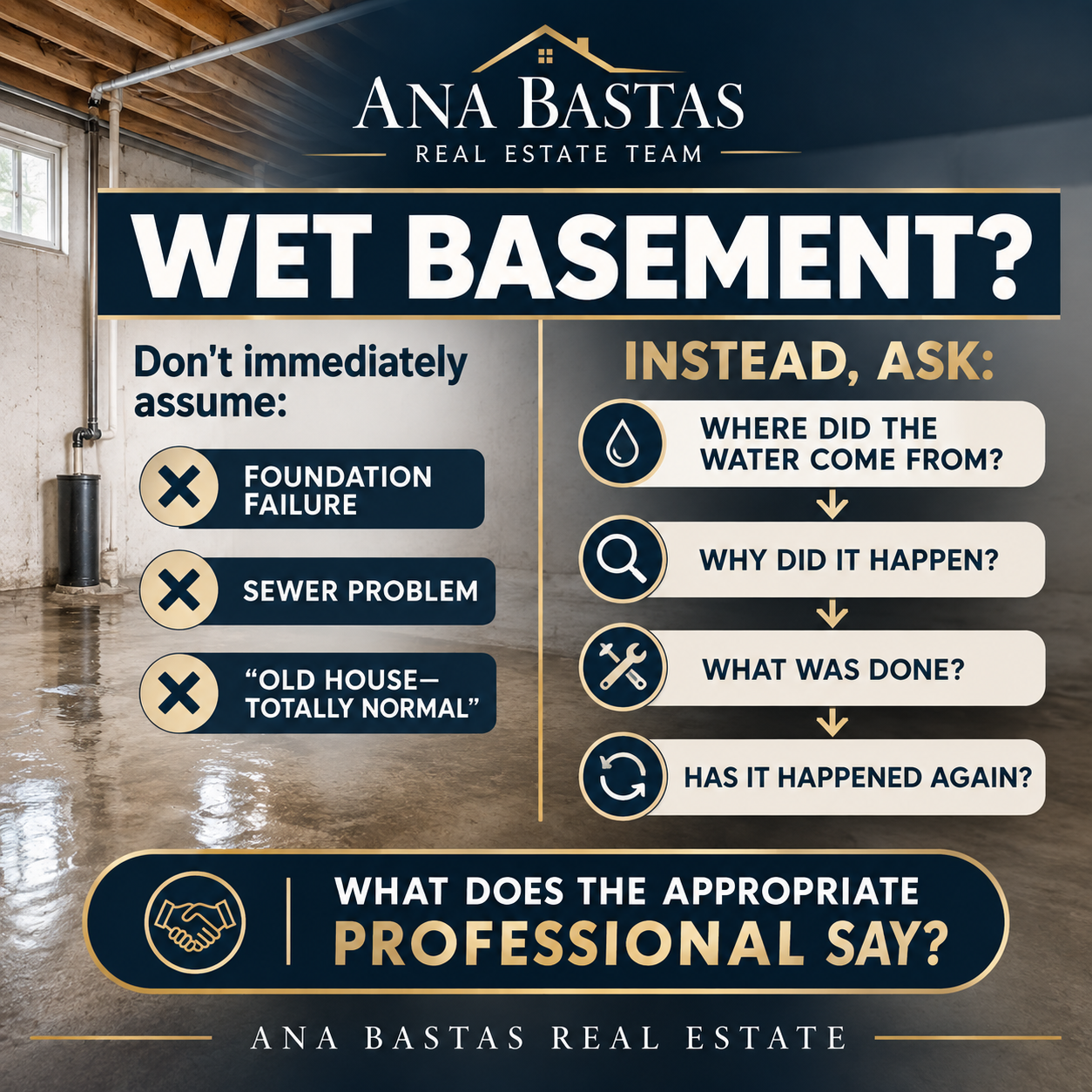
Water Is a Symptom, Not a Diagnosis
This is the core of this entire article.
Imagine three homes with water in the basement.
HOUSE A
A plumbing connection leaked.
HOUSE B
Surface water was directed toward the foundation.
HOUSE C
Water entered through a foundation condition.
All three homeowners might say:
“We had water in the basement.”
But those are completely different problems.
That's why:
THE SOURCE MATTERS MORE THAN THE WORD “WATER.”
Start Outside the House
When buyers think about a wet basement, they tend to immediately look at:
Basement walls.
But water management starts outside too.
Professionals evaluating moisture concerns may consider factors such as:
Lot grading.
Downspouts.
Eavestroughs.
Window wells.
Landscaping.
Hard surfaces.
Drainage patterns.
Foundation conditions.
The house and the land around it function together.

What Is Grading?
Grading describes how the ground around a home slopes and directs surface water.
Generally, water management around the property should help move water appropriately rather than concentrating it against the foundation.
But buyers shouldn't stand in the backyard and attempt to diagnose drainage engineering themselves.
Instead:
Observe.
Ask questions.
Review inspector findings.
Bring in appropriate expertise when concerns arise.
What About Downspouts?
Downspouts are simple but important.
They help direct roof water away from the building.
During due diligence, consider:
Where do they discharge?
Are extensions present?
Is water being directed appropriately?
Is there evidence of pooling?
Have drainage modifications been made?
Again:
SMALL WATER-MANAGEMENT DETAILS CAN MATTER.
Window Wells
Basement windows and window wells can also deserve attention.
Professionals may evaluate:
Drainage.
Covers where applicable.
Condition.
Height relative to surrounding grade.
Evidence of previous water entry.
A water stain beneath a basement window may point to a completely different investigation than moisture appearing elsewhere.
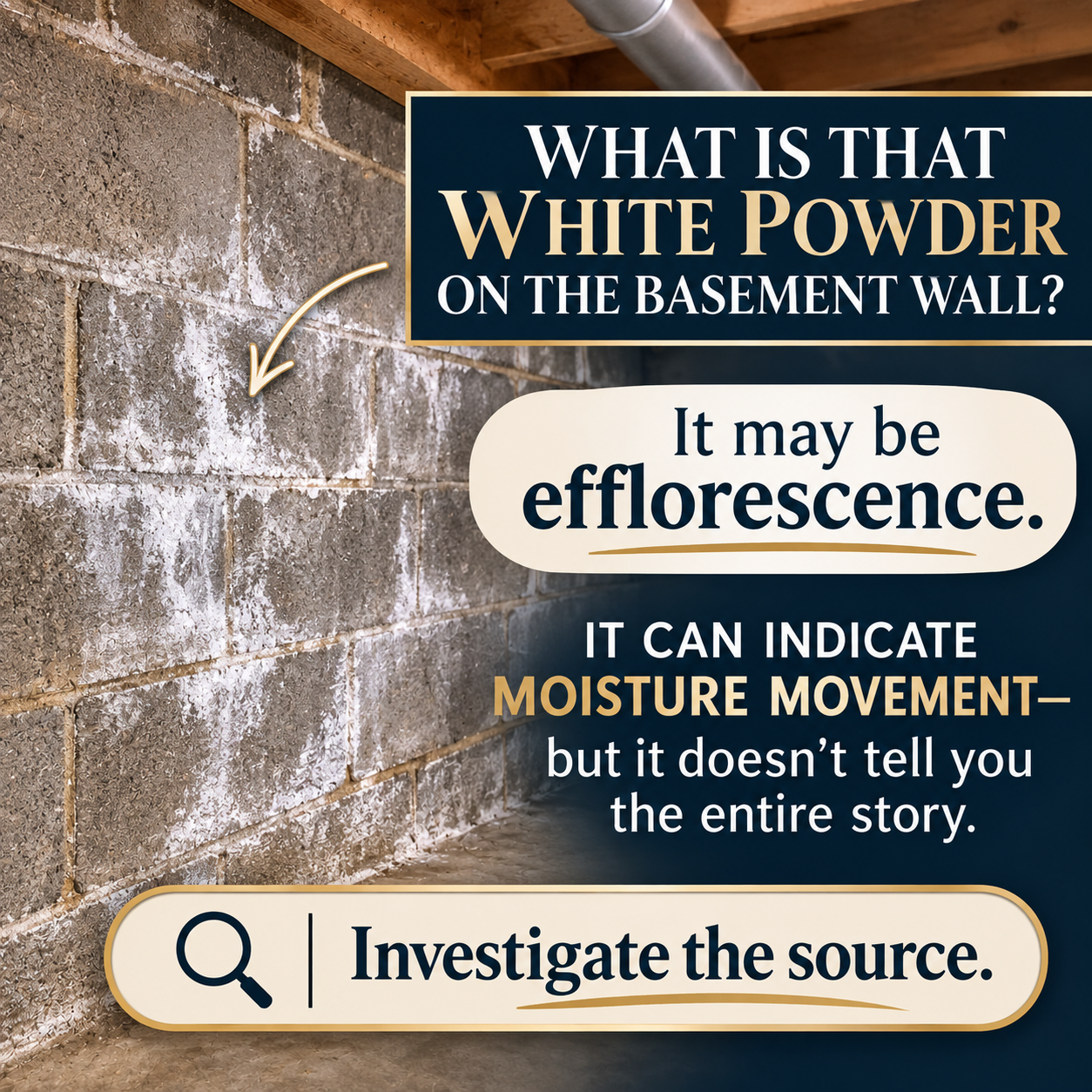
What Is Efflorescence?
Efflorescence often appears as a:
White.
Chalky.
Powdery.
deposit on concrete or masonry.
It can occur when moisture travels through masonry and dissolved salts remain behind after the moisture evaporates.
The important takeaway:
EFFLORESCENCE CAN BE EVIDENCE OF MOISTURE MOVEMENT.
But it doesn't automatically tell you:
How much water.
When.
Why.
Whether the condition is active.
Whether structural damage exists.
It is:
A CLUE—not a complete diagnosis.
What About a Musty Smell?
A musty odour can warrant further investigation.
But:
SMELL ≠ DIAGNOSIS.
Potential moisture or indoor-environment concerns should be investigated appropriately rather than diagnosed by:
Realtor.
Buyer.
Seller.
Internet article.
If there is concern about mould or another environmental condition:
Bring in an appropriate professional.
Is Mould the Same Thing as Moisture?
No.
Moisture can contribute to conditions that support mould growth, but:
Seeing moisture doesn't automatically prove mould.
And:
Seeing discolouration doesn't automatically establish what it is.
This is another area where we should avoid DIY diagnosis.
CONTROL THE WATER SOURCE AND GET APPROPRIATE PROFESSIONAL ADVICE WHERE NECESSARY.
Foundation Cracks and Water
A foundation crack may potentially provide a pathway for moisture.
But:
FOUNDATION CRACK ≠ AUTOMATIC STRUCTURAL FAILURE.
And:
WATER THROUGH A CRACK ≠ AUTOMATICALLY A STRUCTURAL PROBLEM.
We already have the supporting article:
READ: Foundation Cracks in Older Ontario Homes →
Sewer Backup vs. Foundation Water
This distinction is critical.
Water entering because of:
Surface/foundation conditions
is different from:
Wastewater backing up through the drainage system.
The investigation, risk and potential solution can be completely different.
If there is history of:
Sewer backup.
Repeated drain problems.
Underground sewer concerns,
consider whether sewer investigation is warranted.
READ: Sewer Line Inspections in Ontario →
Plumbing Leaks
Sometimes the basement water problem isn't:
Basement.
Foundation.
Sewer.
It is simply:
PLUMBING.
Potential sources could involve:
Supply piping.
Fixtures.
Water heater.
Drainage piping.
Appliances.
Other plumbing components.
That's why water staining needs context.
READ: Old Plumbing in Ontario Homes →

What If the Basement Flooded Before?
Ask questions.
When?
How much water?
Where did it enter?
What caused it?
Was insurance involved?
What was damaged?
What repairs were completed?
Was the underlying cause corrected?
Has it happened again?
Is documentation available?
Don't stop at:
“Yes, but it was fixed.”
Ask:
WHAT WAS FIXED?
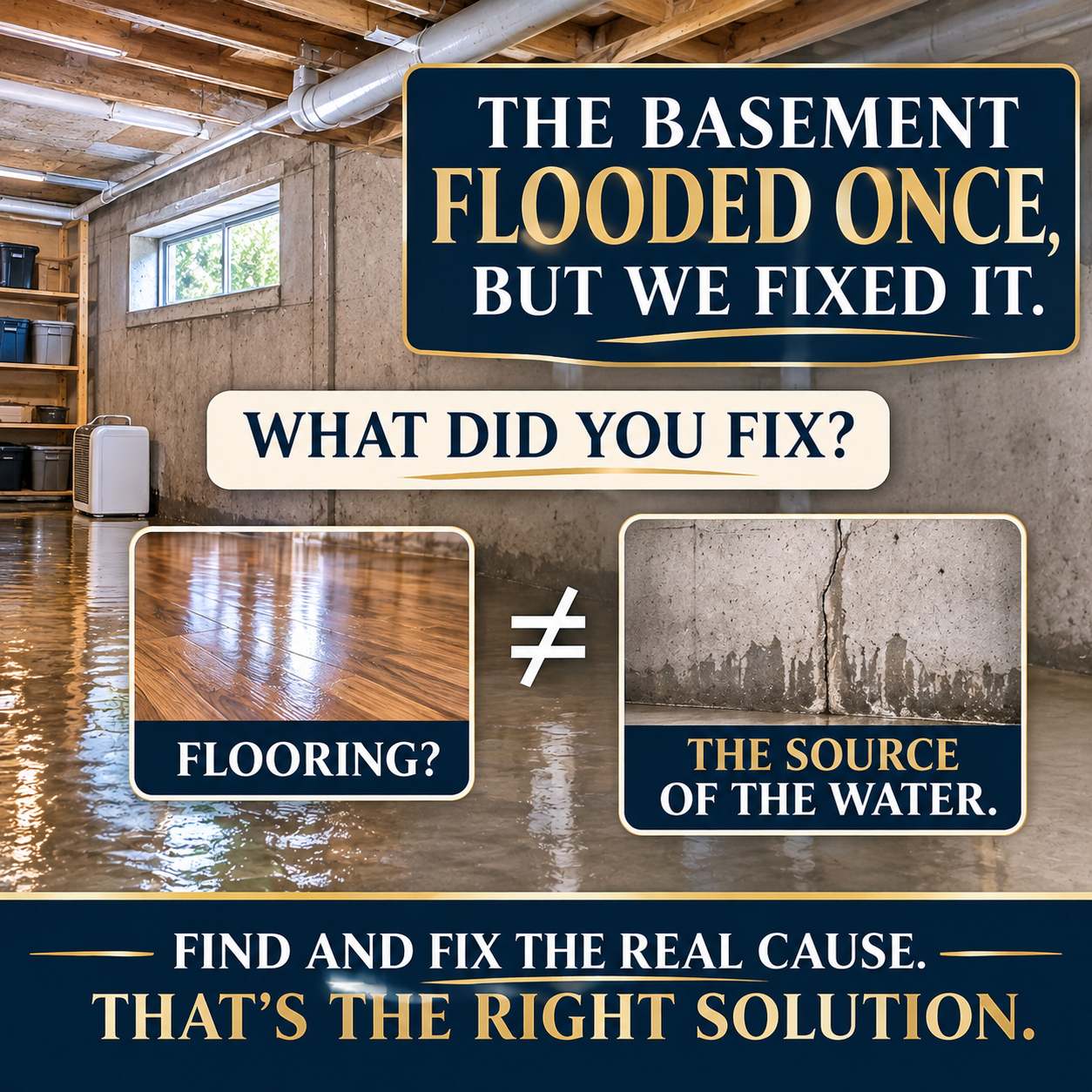
Replacing Flooring Isn't Water Remediation
This is a major buyer mistake.
Suppose a basement flooded.
The owner:
Removed carpet.
Installed vinyl plank.
Painted.
Replaced baseboards.
That tells us:
Finishes were replaced.
It doesn't necessarily tell us:
Why the water entered.
COSMETIC REPAIR ≠ SOURCE CORRECTION.
What Does “Waterproofed Basement” Mean?
This phrase is far too broad.
A seller might say:
“The basement was professionally waterproofed.”
Good.
Now ask:
Interior or exterior work?
Which walls?
Why?
What drainage was installed?
Were cracks repaired?
Was excavation involved?
Was a sump installed?
Is there a warranty?
Is it transferable?
Is there an invoice?
When was the work completed?
THE WORD “WATERPROOFED” ISN'T THE SCOPE OF WORK.

Interior Waterproofing vs. Exterior Waterproofing
Buyers frequently ask:
Which is better?
There isn't a responsible universal answer in a real-estate blog.
Different approaches can address different conditions.
The appropriate solution depends on:
Source.
Foundation.
Site.
Drainage.
Accessibility.
Existing construction.
Professional recommendation.
Our job isn't to prescribe a waterproofing system.
Our job is to ask:
WHAT PROBLEM WAS THIS SYSTEM DESIGNED TO SOLVE?
What Is a Sump Pump?
A sump pump is part of a water-management system designed to move collected water away from the home.
If a property has one:
Don't automatically assume there's a water problem.
And don't automatically assume:
“There's a sump pump, so water can never get in.”
Instead investigate:
Why is it there?
How is the system configured?
Does it operate?
Is there backup protection?
Where does it discharge?
What maintenance is required?
A home inspector can provide observations and recommend further investigation where appropriate.
What About a Battery Backup?
If a home's water-management system relies on an electrically powered pump, buyers may want to understand:
What happens during a power outage?
Backup systems may be worth discussing with the appropriate professional.
But again:
We're not designing the system.
We're identifying the question.
What About a Backwater Valve?
A backwater valve is intended to reduce the risk of certain sewer-backup events.
But:
BACKWATER VALVE ≠ BASEMENT WATERPROOFING.
And:
BACKWATER VALVE ≠ PERFECT SEWER.
It addresses a particular type of risk.
This is another natural internal link to the sewer article.
Finished Basements Make Moisture Investigation Harder
A fully finished basement can look beautiful.
But:
Drywall covers foundation walls.
Flooring covers the slab.
Built-ins cover surfaces.
Insulation conceals components.
That doesn't mean:
“The seller is hiding water.”
It simply means:
THE MORE FINISHED THE BASEMENT, THE LESS OF THE FOUNDATION YOU MAY BE ABLE TO SEE.
Understand inspection limitations.

Fresh Paint in the Basement
Fresh paint isn't automatically suspicious.
People paint houses before selling.
That's normal.
But if fresh paint appears in a location with:
Water staining.
Damaged materials.
Musty odour.
Previous repair.
Other moisture indicators,
the inspector may investigate further.
DON'T ACCUSE. INVESTIGATE.
New Flooring
Same principle.
New basement flooring can simply mean:
Renovation.
But if there is known water history:
What flooring was removed?
Why?
Was water involved?
Was the source corrected?
Again:
ASK QUESTIONS WITHOUT JUMPING TO CONCLUSIONS.
Older Homes and Basement Expectations
This is particularly relevant with century homes.
Some older foundations and basements were constructed differently from modern basements.
A buyer planning to create:
Luxury finished basement.
Bedroom.
Gym.
Office.
Theatre.
needs to understand the actual basement:
Height.
Moisture.
Structure.
Insulation.
Egress.
Mechanical systems.
Renovation feasibility.
YOUR INTENDED USE MATTERS.
A Storage Basement and Luxury Basement Have Different Expectations
Buyer A says:
“I just need storage and laundry.”
Buyer B says:
“I want a $150,000 finished basement.”
Same house.
Different due-diligence needs.
THE PROPERTY NEEDS TO WORK FOR YOUR PLAN—not somebody else's.
Water + Renovation Can Get Expensive
Imagine the buyer wants to finish the basement.
Then discovers:
Moisture issue.
Before installing:
Framing.
Insulation.
Drywall.
Flooring.
the underlying water issue should be appropriately understood.
Otherwise:
YOU MAY BE RENOVATING OVER A PROBLEM INSTEAD OF SOLVING IT.
How Much Does Basement Waterproofing Cost in Ontario?
There is no responsible universal number.
Cost depends on:
Cause.
Interior vs. exterior work.
Area affected.
Excavation.
Accessibility.
Foundation construction.
Drainage.
Landscaping.
Structural work.
Restoration.
Contractor.
So:
DIAGNOSE FIRST. PRICE SECOND.
Water Problems Can Affect More Than Repair Cost
Depending on severity and circumstances, a significant water history may also affect:
Insurance.
Renovation plans.
Property use.
Future resale.
Financing in some situations.
Buyer comfort.
That's why we evaluate:
THE WHOLE REAL ESTATE DECISION—not just the repair quote.
Insurance
If a property has experienced:
Flooding.
Sewer backup.
Significant water damage.
or other material water events:
The buyer should discuss the specific property with their insurance professional.
Don't assume:
Seller has insurance = buyer gets identical coverage.
Underwriting can vary.
Should You Walk Away From a House With Basement Water?
Not automatically.
First determine:
What happened?
What caused it?
Is it active?
What has been repaired?
Is documentation available?
Is further work recommended?
What will it cost?
Does it affect your intended use?
Then decide.
WATER HISTORY IS INFORMATION—not automatically a verdict on the property.
But Don't Ignore Water Because You Love the House
The opposite mistake is equally problematic.
If the inspector recommends:
Further moisture investigation,
do it.
If there's unexplained water:
Investigate.
If significant previous flooding is disclosed:
Understand it.
DON'T LET EMOTION TURN AN UNKNOWN INTO AN ASSUMPTION.
Should the Seller Fix the Water Problem?
Maybe.
But first:
FIND THE SOURCE.
A clause saying:
“Seller agrees to fix basement leak”
may be inadequate if nobody has established:
Where the water is entering.
Why.
What work is required.
What result is expected.
Significant repair clauses should be transaction-specific and drafted appropriately.
Selling a Home With Previous Basement Water
Preparation matters.
If you've previously completed:
Waterproofing.
Foundation repairs.
Drainage improvements.
Sewer work.
Sump installation.
Backwater valve.
Flood remediation.
gather your documentation.
Potentially:
Invoices.
Contractor information.
Scope.
Warranty.
Photos.
Permits where applicable.
Professional reports.
DOCUMENTED REPAIR HISTORY IS BETTER THAN MAKING THE BUYER GUESS.
The Ana Bastas Basement Moisture Review
When water or moisture is identified:
1. EVIDENCE
What was observed?
↓
2. HISTORY
Has water entered before?
↓
3. SOURCE
Foundation? Surface? Plumbing? Sewer? Other?
↓
4. EXTERIOR
Grading + roof drainage + window wells + landscaping.
↓
5. FOUNDATION
Cracks + moisture + previous repairs.
↓
6. PLUMBING / SEWER
Could another system be responsible?
↓
7. PREVIOUS WORK
What was done and why?
↓
8. DOCUMENTATION
Invoices + warranties + reports.
↓
9. PROFESSIONAL REVIEW
Appropriate expert where warranted.
↓
10. SOLUTION
What work is actually recommended?
↓
11. COST
Property-specific quote.
↓
12. USE
What does the buyer intend to do with the basement?
↓
13. DECISION
DON'T JUST ASK WHETHER THE BASEMENT HAS EVER BEEN WET. ASK WHY, WHAT WAS DONE AND WHETHER YOU UNDERSTAND THE RISK TODAY.
Basement Moisture Buyer Checklist
Fona, add this to the Ontario Older Home Buyer Due Diligence Toolkit.
INTERIOR
☐ Water staining
☐ Efflorescence
☐ Dampness
☐ Musty odour
☐ Damaged finishes
☐ Visible cracks
☐ Previous repairs
☐ Finished areas limiting visibility
EXTERIOR
☐ Grading considered
☐ Downspouts reviewed
☐ Eavestroughs reviewed
☐ Window wells reviewed
☐ Landscaping/drainage considered
☐ Evidence of pooling considered
HISTORY
☐ Previous water entry asked about
☐ Flooding history investigated
☐ Sewer backup history investigated
☐ Waterproofing history requested
☐ Foundation repair history requested
☐ Documentation obtained where available
WATER MANAGEMENT
☐ Sump pump present?
☐ Operation reviewed by appropriate professional
☐ Backup system?
☐ Backwater valve?
☐ Previous drainage improvements?
PROFESSIONAL
☐ Inspector findings reviewed
☐ Further investigation followed where warranted
☐ Foundation specialist/engineer where appropriate
☐ Plumbing/sewer investigation where appropriate
☐ Environmental professional where warranted
FINANCIAL
☐ Source identified
☐ Recommended work determined
☐ Quote obtained
☐ Restoration considered
☐ Renovation plans considered
TRANSACTION
☐ Insurance consulted if relevant
☐ Financing consulted if relevant
☐ Buyer understands risk
☐ Negotiation strategy considered
☐ Buyer comfortable proceeding
Frequently Asked Questions
Is basement moisture common in older homes?
Older homes can have moisture-related conditions for many reasons, but age alone doesn't establish that a wet basement is acceptable or inevitable. The source and severity should be understood.
Does a wet basement mean the foundation is bad?
No. Basement water can have multiple causes, including exterior drainage, foundation conditions, plumbing or sewer issues. The source needs to be investigated.
What is efflorescence on a basement wall?
Efflorescence is a mineral deposit that can appear when moisture moves through masonry and evaporates. It can indicate moisture movement but doesn't by itself establish the source or severity.
Is a musty basement a sign of mould?
A musty odour can warrant further investigation, but odour alone does not diagnose mould. Appropriate professional evaluation may be warranted where there are environmental concerns.
Should I buy a house that previously had basement water?
Potentially. Understand the cause, extent, repairs completed, documentation, recurrence and current condition before deciding.
Does basement waterproofing mean the problem is permanently fixed?
Not automatically. Determine what work was performed, why, where and whether there has been any recurrence.
Is a sump pump a red flag?
Not automatically. A sump pump is a water-management component. Buyers should understand why it is present, how the system functions and any maintenance or backup requirements.
Does a backwater valve prevent all basement flooding?
No. A backwater valve addresses certain sewer-backup risks and does not protect against every potential source of basement water.
Can a regular home inspection detect basement moisture?
An inspector can observe accessible evidence and conditions, but concealed areas and intermittent water events can limit what is visible during an inspection.
Should I worry about a freshly painted basement?
Fresh paint alone isn't evidence of a problem. Consider it in context with other observations, disclosures and inspection findings.
How much does basement waterproofing cost in Ontario?
There is no universal amount because the appropriate solution depends on the source, foundation, access and scope. Obtain a property-specific assessment and quote.
Can basement flooding affect home insurance?
Potentially. Insurance underwriting depends on the property and circumstances, so significant water or sewer-backup history should be discussed with the buyer's insurance professional.
Categories
- All Blogs (1399)
- Ana Bastas Real Estate Team (1)
- Ana Bastas Realtor (1)
- Ana bastas Realty (1)
- Brampton (2)
- Burlington (10)
- Buy & Travel™ Program (12)
- Buyer (347)
- Community News (2)
- Divorce (22)
- Downsizing (21)
- Events (73)
- First Time Home Buyers (154)
- Georgetown (38)
- Georgetown Buyers (8)
- Halton Hills (272)
- Hamilton (29)
- Holidays (18)
- How To (140)
- Interest Rates (11)
- Investor (51)
- Join ABR Team (4)
- Landlord (105)
- Lifestyle (177)
- Milton (83)
- Mississauga (3)
- Mortgage (23)
- Niagara (39)
- Oakville (6)
- Real Estate News (235)
- Realtor (69)
- Renter (99)
- Seller (265)
- Tax's (28)
- Tips (42)
- Toronto (148)
- Wealth Building (15)
- Wellington (4)
- YYZ (105)
Recent Posts










"My job is to find and attract mastery-based agents to the office, protect the culture, and make sure everyone is happy! "