
How Much Home Equity Do You Need to Retire Comfortably? What Ontario Homeowners Should Consider

How Much Home Equity Do You Need to Retire Comfortably? What Ontario Homeowners Should Consider
“My House Is Worth $1.5 Million. Am I Set for Retirement?”
Maybe.
But the value of your home alone can't answer that question.
I meet homeowners who have owned their properties for decades.
They purchased when prices were substantially lower.
They paid down—or completely paid off—the mortgage.
Today, they may own a property worth:
$1,000,000.
$1,500,000.
$2,000,000+.
On paper, they're wealthy.
But then they tell me:
“We still worry about having enough money every month in retirement.”
That's where an important distinction comes in.
NET WORTH AND CASH FLOW ARE NOT THE SAME THING.
Your house may represent significant wealth.
But unless you change how that equity is held or accessed, the home itself doesn't necessarily pay your monthly groceries, travel expenses or other retirement costs.
Understanding that distinction can help you make better housing decisions.
First: What Is Home Equity?
At its simplest:
CURRENT HOME VALUE
minus
AMOUNTS OWED AGAINST THE PROPERTY
=
APPROXIMATE HOME EQUITY
For example:
Estimated home value:
$1,400,000
Mortgage:
$250,000
Approximate gross equity:
$1,150,000
But that's not necessarily what you would have available if you sold.
Selling has costs.
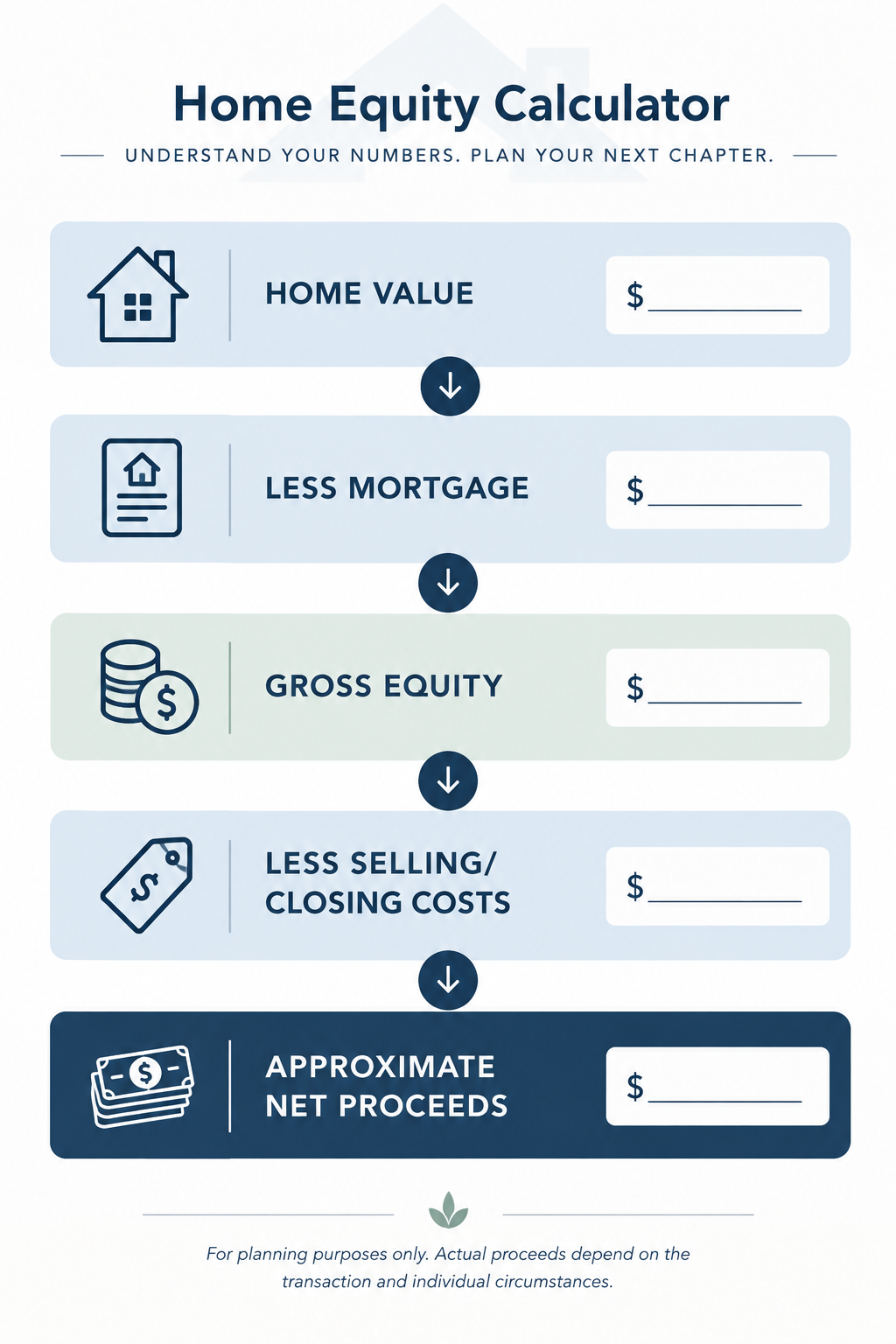
So for retirement planning, we also need to estimate net proceeds.
Home Equity Is Not the Same as Net Sale Proceeds
If you're considering selling, calculate:
Estimated Selling Price
minus
Mortgage / Secured Amounts to Be Repaid
minus
Estimated Selling Expenses
minus
Legal / Closing Expenses
minus
Other Applicable Transaction Costs
=
APPROXIMATE NET PROCEEDS
That's a much more useful planning number.
So How Much Home Equity Do You Need to Retire?
There isn't one universal number.
Someone with:
$1 million of home equity
could be extremely comfortable.
Another homeowner with:
$2 million of home equity
could still face retirement cash-flow challenges.
Why?
Because retirement depends on much more than the house.
Your broader financial professionals may need to consider:
Pension income
CPP/OAS where applicable
Savings
Investments
Debt
Other real estate
Lifestyle spending
Taxes
Insurance
Longevity
Family obligations
Estate goals
Potential future care
and many other factors.
Your home is one component of your retirement picture—not the entire retirement plan.
The “House Rich, Cash Flow Tight” Problem
Imagine a homeowner owns:
A $1.5 million mortgage-free house.
That sounds financially strong.
And from a net-worth perspective, it is a substantial asset.
But suppose the homeowner has relatively limited liquid investments and monthly retirement income.
They still need to pay:
Property taxes.
Insurance.
Utilities.
Food.
Vehicle costs.
Repairs.
Travel.
Healthcare-related expenses.
Lifestyle expenses.
The house may be worth $1.5 million.
But the homeowner can't use the kitchen.
Real estate wealth isn't automatically retirement cash flow.
Does That Mean You Should Sell?
No.
This is where the conversation needs to be careful.
You may have:
A valuable home.
No mortgage.
Strong pensions.
Substantial investments.
Comfortable monthly cash flow.
And absolutely love where you live.
Why would you automatically sell?
You shouldn't.
Home equity only becomes a housing-strategy issue when accessing it would potentially help achieve another objective.
Ask: What Job Does Your Home Need to Perform?
This is a useful retirement question.
Does your home primarily need to provide:
A place you love living?
Financial security?
An estate asset?
Housing stability?
A future source of capital?
A property to leave to your children?
Potentially several of these?
Understanding the role of the property helps determine what to do with it.
OPTION 1 — STAY IN THE HOME
This may make sense if:
You love it.
It physically works for you.
Maintenance is manageable.
Your social network is nearby.
Your monthly expenses are comfortable.
You don't need to access the equity.
The property remains suitable for your future needs.
In that case:
Leaving the equity in the home may be perfectly reasonable.
Your financial and estate professionals can help you understand how the property fits within the broader plan.
OPTION 2 — DOWNSIZE AND RELEASE SOME EQUITY
Suppose:
Current home net proceeds: $1,300,000
and your replacement home plus purchase/moving costs is:
$850,000
The move could potentially leave approximately:
$450,000
in capital outside the replacement property.
Now the conversation changes.
The real estate question is:
Can we realistically create that $450,000 difference?
The financial planning question is:
What should you do with it?
Those are different professional roles.
→ Read: Downsizing in Georgetown
→ Read: Condo vs. Bungalow vs. Retirement Community
→ Read: Should I Sell My House & Downsize in Retirement?
What Could Released Equity Potentially Do?
Depending on your circumstances and the advice of your financial professionals, released capital may become part of a broader plan involving things such as:
Retirement reserves
Income planning
Investments
Debt reduction
Travel
Family support
Estate planning
Future housing
Potential future care
But don't decide to downsize simply because:
“I can pull $500,000 out of the house.”
First determine why you want to access it.
OPTION 3 — MOVE TO A LOWER-COST COMMUNITY
Some homeowners can release more equity by changing not only the property but also the location.
For example, someone selling in:
Oakville
Burlington
Georgetown
or another higher-value market may explore housing elsewhere.
That might include:
Niagara.
But don't assume the move automatically improves retirement.
Compare:
Net proceeds from current home
minus
Total cost of replacement home
minus
Transaction costs
minus
Moving/improvements
=
Potential Remaining Capital
Then compare the lifestyle.
READ: Should You Move to Niagara for Retirement? Halton vs. Niagara →
OPTION 4 — REMAIN IN THE HOME AND EXPLORE OTHER FINANCIAL STRATEGIES
Selling isn't the only way homeowners may potentially access or restructure home equity.
There are financing products and strategies that may be available depending on circumstances.
However:
That is a financing decision—not simply a real estate decision.
Speak with appropriately qualified mortgage and financial professionals about:
Eligibility
Interest
Fees
Repayment
Tax considerations
Estate implications
Long-term cost
and available alternatives.
Do not choose a financial product simply because you have equity.
→ Read: Life Lease vs. Condo
Does Being Mortgage-Free Mean You're Ready to Retire?
Being mortgage-free can substantially reduce one major household expense.
But it doesn't answer the entire retirement question.
You still need to fund:
Housing operating costs.
Food.
Transportation.
Insurance.
Travel.
Entertainment.
Taxes.
Personal expenses.
Unexpected costs.
Potential future support.
So:
MORTGAGE-FREE ≠ EXPENSE-FREE.
Calculate the True Cost of Keeping Your House
Start with annual expenses.
PROPERTY TAXES
$________
HOME INSURANCE
$________
UTILITIES
$________
LANDSCAPING
$________
SNOW REMOVAL
$________
CLEANING
$________
REPAIRS / MAINTENANCE
$________
ESTIMATED MAJOR CAPITAL EXPENSES
$________
Then divide the annual amount by 12.
ESTIMATED MONTHLY COST OF CURRENT HOME: $________
Now you have something useful to compare.
Compare It With the Downsized Home
Suppose the replacement property is a condominium.
Calculate:
CONDO FEES
$________
PROPERTY TAX
$________
INSURANCE
$________
UTILITIES
$________
PARKING / STORAGE
$________
MAINTENANCE NOT COVERED BY CONDO
$________
MORTGAGE, IF ANY
$________
ESTIMATED MONTHLY COST: $________
Now compare.
Don't assume the smaller property automatically costs less.
Home Equity vs. Monthly Housing Cost
These are two separate calculations.
A move may:
Release significant equity
but
increase monthly housing costs.
Or it may:
release equity
and
reduce monthly costs.
Or it could:
release almost no equity
but dramatically improve lifestyle.
None of these is automatically right or wrong.
You need to understand which outcome you're choosing.
What If You Have $1 Million in Home Equity?
Don't ask:
“Is $1 million enough?”
Ask:
How much of that equity will remain in my next home?
How much could actually become available?
What are my other retirement assets?
What income will I have?
What will my expenses be?
What lifestyle do I want?
What are my estate goals?
How long does the plan need to support me?
Those questions require broader financial planning.
What If You Have $2 Million in Home Equity?
Same answer.
A $2 million house doesn't automatically mean:
“You can comfortably spend $15,000 per month in retirement.”
Nor does it automatically mean you should sell.
A home's value tells us the approximate value of one asset.
It doesn't tell us your sustainable retirement spending level.
That requires a comprehensive financial analysis.
How Much of Your Net Worth Should Be in Your Home?
Again, there is no universal percentage appropriate for everyone.
But it can be useful to ask:
What percentage of my wealth is tied up in real estate?
Imagine:
Home equity: $1,500,000
Investments/savings: $300,000
versus another homeowner with:
Home equity: $800,000
Investments/savings: $2,000,000
Those households may approach housing very differently.
The point isn't that one is better.
Their balance sheets are structured differently.
→ Read: How Much Is My Georgetown Home Worth?
Your Home Is Also Providing Housing
This gets overlooked when people talk about home equity purely as an investment.
Your home isn't simply:
$1.5 million sitting there doing nothing.
It's providing:
Shelter.
Stability.
Lifestyle.
Community.
Privacy.
Potential appreciation.
A place to live.
If you sell it, you still need housing.
That's why we don't treat the full property value as available retirement capital.
The Replacement-Housing Rule
Whenever someone says:
“We have $1.5 million in our house.”
My next question is:
“Where will you live if you sell it?”
Because if the replacement property costs:
$1.2 million,
you haven't suddenly created $1.5 million of investable capital.
The difference after all costs is the number that matters.
What About Leaving the House to Your Children?
Many homeowners tell me:
“I want the kids to inherit the house.”
That's a valid estate objective.
But ask your children what they actually want.
Would they:
Live there?
Keep it?
Sell it?
Want you to remain in it regardless of your own retirement needs?
Often adult children would rather see their parents:
Live comfortably and make the housing decision that best supports their retirement.
Discuss the estate objectives with your lawyer and financial professionals rather than making assumptions.
What About Gifting Equity to Your Children?
Some downsizers consider helping adult children after selling.
Potentially for:
A home purchase.
Education.
Grandchildren.
Other family goals.
That's a significant financial and estate-planning decision.
Before transferring substantial capital, discuss:
Your own future needs
Taxes
Estate planning
Family implications
and appropriate legal documentation with qualified professionals.
Secure your own retirement plan first.
What If You Own Multiple Properties?
Then your retirement real estate analysis becomes broader.
You may have:
Principal residence.
Rental property.
Condo.
Cottage.
Commercial property.
Other real estate.
Ask:
Which properties produce income?
Which require capital?
Which have substantial equity?
Which require management?
Which still fit my objectives?
Which do I actually want to own in retirement?
Don't evaluate each property emotionally and independently.
Your financial, tax and real estate professionals should help you understand the overall portfolio from their respective areas of expertise.
A Rental Property Isn't Automatically Good Retirement Income
Suppose you own a rental worth:
$900,000
and it produces:
$2,800/month rent.
That doesn't tell us whether it's a strong investment.
You still need to consider:
Mortgage
Taxes
Insurance
Condo fees
Maintenance
Vacancy
Management
Repairs
Net operating income
and the equity tied up in the property.
Retirement is an excellent time to review whether every property still deserves a place in the portfolio.
Home Equity and Estate Planning
Your property may eventually form a significant component of your estate.
That makes coordination with an estate lawyer important.
Questions may include:
How is title held?
What does the will say?
Who is intended to inherit?
Are there multiple beneficiaries?
What happens if one spouse dies?
Is there a Power of Attorney?
How does the real estate fit into the broader estate plan?
Real estate decisions shouldn't be disconnected from estate planning.
Don't Wait Until Retirement to Understand Your Home Value
If you're 55, 60 or 65 and thinking several years ahead, that's actually an excellent time to establish a baseline.
Knowing:
What is my home worth today?
allows you to begin discussing realistic scenarios.
Stay.
Downsize.
Move communities.
Sell a rental.
Keep everything.
You don't need to act immediately.
Information gives you options.
Annual Home Value Reviews Become Particularly Useful Here
Your home may be one of your largest assets.
Just as you periodically review other parts of your financial life, it can be useful to maintain an updated understanding of your property's market position.
Through our Annual Home Care Program, we can provide a regular real estate review so you aren't making retirement decisions using a home-value estimate from five years ago.
LEARN ABOUT OUR ANNUAL HOME CARE PROGRAM →
The Retirement Home Equity Worksheet
Before meeting with your financial advisor, complete this.
REAL ESTATE
Estimated current home value: $________
Mortgage/secured debt: $________
Approximate gross equity: $________
Estimated selling/closing costs: $________
Approximate Net Proceeds: $________
NEXT HOME
Target purchase/entry price: $________
Purchase/closing costs: $________
Moving costs: $________
Immediate improvements: $________
Estimated Total Transition Cost: $________
DIFFERENCE
Approximate net proceeds:
$________
minus total transition cost:
$________
=
POTENTIALLY RELEASED CAPITAL: $________
Then take that number to your financial professional.
Four Retirement Housing Scenarios to Compare
For clients considering their options, I like to create four columns.
SCENARIO A — STAY
Current home.
Current monthly costs.
No transaction.
SCENARIO B — DOWNSIZE LOCALLY
Sell current property.
Purchase smaller home nearby.
Calculate released equity.
SCENARIO C — MOVE TO LOWER-COST MARKET
Sell current property.
Purchase elsewhere.
Calculate released equity and lifestyle impact.
SCENARIO D — RETIREMENT / SERVICE-BASED LIVING
Sell current property.
Compare monthly retirement-living costs and capital remaining.
Now your financial professional has real housing scenarios to evaluate.
The Ana Bastas Retirement Real Estate Approach
I don't tell clients:
“You have enough money to retire.”
That's not my role.
My role is to help establish the real estate side accurately.
1. CURRENT PROPERTY VALUE
What might the home realistically sell for?
↓
2. APPROXIMATE NET EQUITY
What might remain after mortgage and transaction costs?
↓
3. HOUSING OPTIONS
Stay? Condo? Bungalow? Retirement community? Niagara?
↓
4. REPLACEMENT-HOUSING COST
What will the next option realistically cost?
↓
5. POTENTIAL RELEASED EQUITY
What capital might remain after the transition?
↓
6. PROFESSIONAL REVIEW
Financial advisor/planner.
Accountant.
Lawyer.
↓
7. INFORMED REAL ESTATE DECISION
That's the process.
Start With One Number
If you're thinking about retirement but have no idea what your home is currently worth, start there.
You don't need to:
List.
Downsize.
Move.
Make any commitment.
You simply need accurate information.
Your home may be one of your largest assets. You should understand its current market position.
REQUEST A COMPLIMENTARY HOME VALUE REVIEW →
Planning Your Retirement Housing?
You may discover:
Staying makes sense.
Or:
Downsizing locally makes sense.
Or:
Moving toward Niagara makes sense.
Or:
Selling another property makes sense.
The correct answer depends on your entire situation.
YOUR HOUSE CAN MAKE YOU WEALTHY ON PAPER.
YOUR RETIREMENT PLAN STILL NEEDS TO WORK MONTH TO MONTH.
Understanding both is where better decisions begin.
BOOK A RETIREMENT REAL ESTATE STRATEGY CALL →
REQUEST A COMPLIMENTARY HOME VALUE REVIEW →
FAQ SECTION
How much home equity do I need to retire comfortably?
There is no universal amount of home equity that guarantees a comfortable retirement. Home equity is only one part of the financial picture, which may also include retirement income, investments, savings, debt, expenses, taxes and future needs.
Is $1 million in home equity enough to retire?
Home equity alone can't answer that question. A homeowner must still consider how much equity would remain tied up in replacement housing, other assets and income, expenses and broader retirement objectives with appropriate financial professionals.
Does a mortgage-free home mean I can retire?
Not necessarily. Being mortgage-free removes a major expense, but homeowners still have property taxes, insurance, utilities, maintenance and other living expenses.
Should I sell my house to fund retirement?
Not automatically. Selling may make sense if accessing equity supports your retirement goals, but staying can also be appropriate when the home works well and retirement finances are comfortable.
Can downsizing help fund retirement?
Downsizing may release some home equity if the total cost of replacement housing and moving is meaningfully lower than the net proceeds from the existing home. What to do with released capital should be discussed with qualified financial professionals.
What does “house rich, cash poor” mean?
It generally describes someone with substantial wealth tied up in their home but comparatively limited liquid assets or available cash flow.
Should I move to a cheaper city when I retire?
Possibly, but housing cost should be compared with family proximity, healthcare, transportation, community, lifestyle and the actual amount of capital the move would release.
Should I leave my house to my children instead of downsizing?
That's a personal and estate-planning decision. Consider your own retirement needs and discuss estate implications with your lawyer and financial professionals.
Categories
- All Blogs (1306)
- Ana Bastas Real Estate Team (1)
- Ana Bastas Realtor (1)
- Ana bastas Realty (1)
- Brampton (1)
- Burlington (2)
- Buy & Travel™ Program (12)
- Buyer (213)
- Divorce (18)
- Downsizing (9)
- Events (8)
- First Time Home Buyers (140)
- Georgetown (21)
- Georgetown Buyers (8)
- Halton Hills (265)
- Hamilton (23)
- Holidays (1)
- How To (128)
- Interest Rates (2)
- Investor (8)
- Landlord (94)
- Lifestyle (128)
- Milton (76)
- Mississauga (1)
- Mortgage (5)
- Niagara (37)
- Oakville (3)
- Real Estate News (161)
- Realtor (21)
- Renter (96)
- Seller (193)
- Tax's (19)
- Tips (14)
- Toronto (135)
- Wealth Building (8)
- Wellington (3)
- YYZ (107)
Recent Posts










"My job is to find and attract mastery-based agents to the office, protect the culture, and make sure everyone is happy! "