
Should You Pay Off Your Mortgage Before Retirement? What Ontario Homeowners Should Consider

Should You Pay Off Your Mortgage Before Retirement? What Ontario Homeowners Should Consider
Do You Need to Be Mortgage-Free Before You Retire?
For generations, one of the classic retirement goals has been:
“Pay off the house before you retire.”
And emotionally, it's easy to understand why.
No mortgage payment.
No large debt attached to your home.
Lower monthly obligations.
A house you own outright.
For many homeowners, that sounds like security.
But does everyone need to be mortgage-free before retirement?
Not necessarily.
And more importantly:
Paying off the mortgage isn't purely a real estate decision.
It can involve your:
Cash flow
Savings
Investments
Interest rate
Taxes
Liquidity
Other debts
Retirement income
Estate objectives
and overall financial plan.
So rather than beginning with:
“How quickly can I pay this mortgage off?”
I would begin with:
“What housing situation do I actually want when I retire?”
Start With Your Retirement Housing Plan
Imagine you're 60 and planning to retire at 65.
You currently live in a four-bedroom detached home.
Before aggressively trying to eliminate the mortgage, ask:
Do I intend to live here for another 20 years?
Am I planning to downsize?
Do I want a condo?
Do I want a bungalow?
Am I moving closer to my children?
Am I considering Niagara?
Will I travel extensively?
Does this house still make sense for retirement?
Because if you're planning to sell the property shortly after retirement, your mortgage strategy may need to be evaluated in that context.
Step 1 — Know Your Mortgage Balance
Start with the basics.
Estimated Current Home Value
$________
Current Mortgage Balance
$________
Approximate Gross Home Equity
$________
For example:
Home value:
$1,300,000
Mortgage:
$300,000
Approximate gross equity:
$1,000,000
That's useful information.
But it still doesn't tell us whether paying off the $300,000 mortgage is the right financial decision.
Step 2 — Know Your Mortgage Payment
Now calculate the effect on monthly cash flow.
Suppose your mortgage payment is:
$2,500/month
That's:
$30,000 per year
of cash flow committed to the mortgage payment.
If that mortgage disappeared, your monthly housing obligations could change significantly.
That's why entering retirement mortgage-free can feel so attractive.
But we still need to ask what it costs you to eliminate that mortgage.
Mortgage-Free Does Not Mean Housing-Cost-Free
This is extremely important.
You pay off the mortgage.
Wonderful.
But you still have:
Property taxes
Home insurance
Utilities
Maintenance
Landscaping
Snow removal
Repairs
Roof
Windows
HVAC
and other home expenses.
So:
MORTGAGE-FREE ≠ FREE HOUSING
A large mortgage-free detached home can still be expensive to operate.
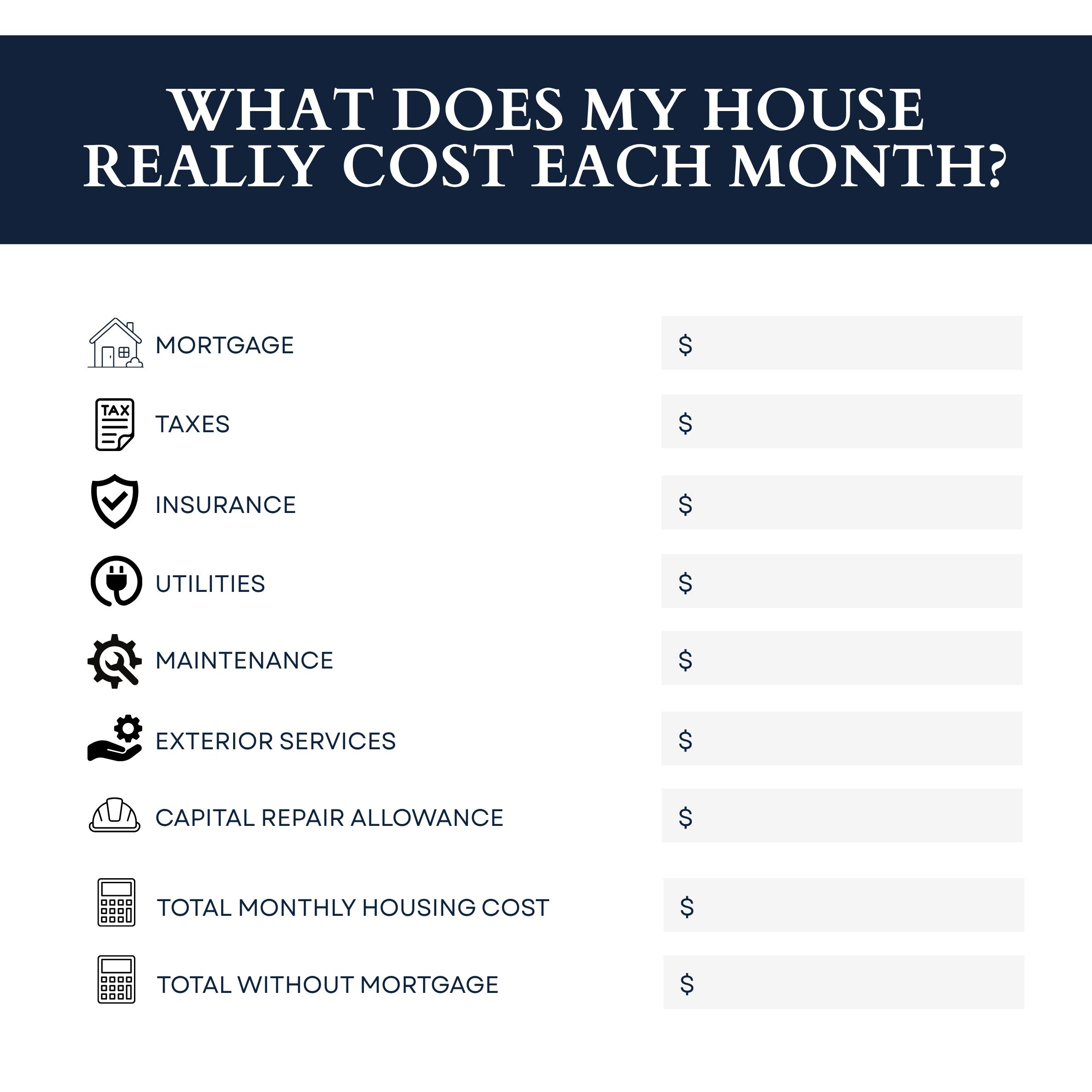
Calculate Your True Monthly Housing Cost
Let's create a more complete picture.
Mortgage
$________ / month
Property Taxes
$________ / month
Insurance
$________ / month
Utilities
$________ / month
Maintenance
$________ / month
Landscaping / Snow
$________ / month
Estimated Capital Repairs
$________ / month
TOTAL CURRENT HOUSING COST
$________ / month
Now calculate it again without the mortgage.
That gives you a much clearer picture of what becoming mortgage-free would actually change.
Why Being Mortgage-Free Can Feel So Powerful
There are obvious potential advantages.
Removing a mortgage payment can mean:
Lower required monthly cash flow.
Less exposure to future mortgage renewals.
Reduced debt.
Greater emotional comfort.
More flexibility in retirement spending.
For some homeowners, that peace of mind is extremely valuable.
And peace of mind shouldn't automatically be dismissed simply because it doesn't appear in a spreadsheet.
But Where Is the Money Coming From?
This is the other side of the conversation.
Suppose you owe:
$300,000
and have:
$350,000 in savings and investments.
Should you use $300,000 to eliminate the mortgage immediately?
That's not a decision your Realtor should make for you.
Your financial professional needs to evaluate what happens to:
Liquidity
Investments
Emergency reserves
Taxes
Retirement income
Risk
and the broader financial plan.
Paying off debt uses capital.
That trade-off needs to be understood.
Don't Become House Rich and Cash Poor Just to Say You're Mortgage-Free
Imagine:
House value: $1,500,000
Mortgage: $200,000
Liquid savings: $225,000
You use $200,000 to eliminate the mortgage.
Now:
Home equity ≈ $1.5 million
but your liquid savings have been substantially reduced.
On paper, your net worth may still look strong.
But your access to readily available funds has changed.
Again:
NET WORTH ≠ CASH FLOW ≠ LIQUIDITY
All three matter.
What If You Still Have a Mortgage When You Retire?
Having a mortgage doesn't automatically mean you're financially unprepared for retirement.
Some retirees intentionally or circumstantially continue carrying mortgages.
The relevant questions include:
What is the payment?
What income supports it?
When does the mortgage mature?
What happens at renewal?
Is the payment comfortable?
How does it affect retirement cash flow?
How long do you intend to own the home?
What alternatives exist?
Those questions should be reviewed with the appropriate financial and mortgage professionals.
What Happens When Your Mortgage Renews in Retirement?
This deserves attention before retirement—not after.
If your mortgage renews after you stop working, understand:
Renewal timing
Interest rate exposure
Payment implications
Remaining amortization
Financing options
and any qualification considerations that may apply to future borrowing or restructuring.
Speak with your mortgage professional early.
Don't wait until two weeks before renewal to begin the conversation.
What If Your Mortgage Is Almost Paid Off?
Suppose retirement is five years away and your mortgage is scheduled to be paid off around the same time.
Great.
You can now model:
TODAY
Current housing costs.
RETIREMENT
Housing costs after mortgage elimination.
That can give your financial professional a clearer retirement cash-flow picture.
What If You Still Owe $500,000?
Then the housing conversation may become more significant.
Imagine:
Home value:
$1,500,000
Mortgage:
$500,000
Approximate gross equity:
$1,000,000
You may have several potential housing paths.
OPTION 1 — KEEP THE HOME AND MORTGAGE
If:
The payment is manageable.
You love the property.
The home works for retirement.
Your broader financial plan supports it.
keeping both may be reasonable.
OPTION 2 — PAY DOWN OR PAY OFF THE MORTGAGE
Depending on your circumstances, your financial professional may help you evaluate whether using available capital to reduce the mortgage aligns with your broader plan.
This is primarily a financial-planning decision.
OPTION 3 — SELL AND BUY A LESS EXPENSIVE HOME
This is where the real estate strategy becomes very relevant.
Suppose:
Current home sells for approximately:
$1,500,000
Mortgage:
$500,000
After mortgage repayment and applicable selling/closing costs, you determine your approximate net proceeds.
Then suppose your replacement property costs:
$750,000
plus transaction and moving costs.
Depending on the actual numbers, you may be able to:
Purchase the replacement home without a mortgage
and potentially retain additional capital.
Now we have a completely different retirement housing scenario.
OPTION 4 — SELL AND MOVE TO A DIFFERENT MARKET
Perhaps remaining in Oakville or Burlington doesn't release enough equity.
So you explore:
Georgetown
Grimsby
Lincoln
St. Catharines
or another community that fits your lifestyle.
Again:
Don't move solely because the real estate is less expensive.
But location can materially affect the housing equation.
READ: Halton vs. Niagara for Retirement →
Downsizing Can Be a Mortgage Strategy
People often think downsizing is about:
Smaller house.
But financially, it can also be about:
Changing the amount of capital tied up in housing.
A move might allow you to:
Reduce or eliminate mortgage debt.
Lower monthly housing expenses.
Release some home equity.
Or accomplish some combination.
But don't assume every downsizing move does all three.
A Smaller Home Can Still Have a Mortgage
Suppose you sell:
$1.2M home
with:
$500K mortgage.
Then purchase:
$900K condo.
Depending on selling costs, buying costs and available capital, you may still require financing.
So:
Downsizing does not automatically mean mortgage-free.
Run the numbers before making assumptions.
A Condo Can Eliminate the Mortgage but Increase Monthly Fees
Another important scenario.
You sell your detached home and purchase a condo outright.
Mortgage:
$0.
Wonderful.
But the condo has:
$1,000/month condo fees.
That isn't necessarily bad.
The fees may cover services you value.
But when comparing retirement housing, look at:
TOTAL MONTHLY COST
not simply:
MORTGAGE PAYMENT
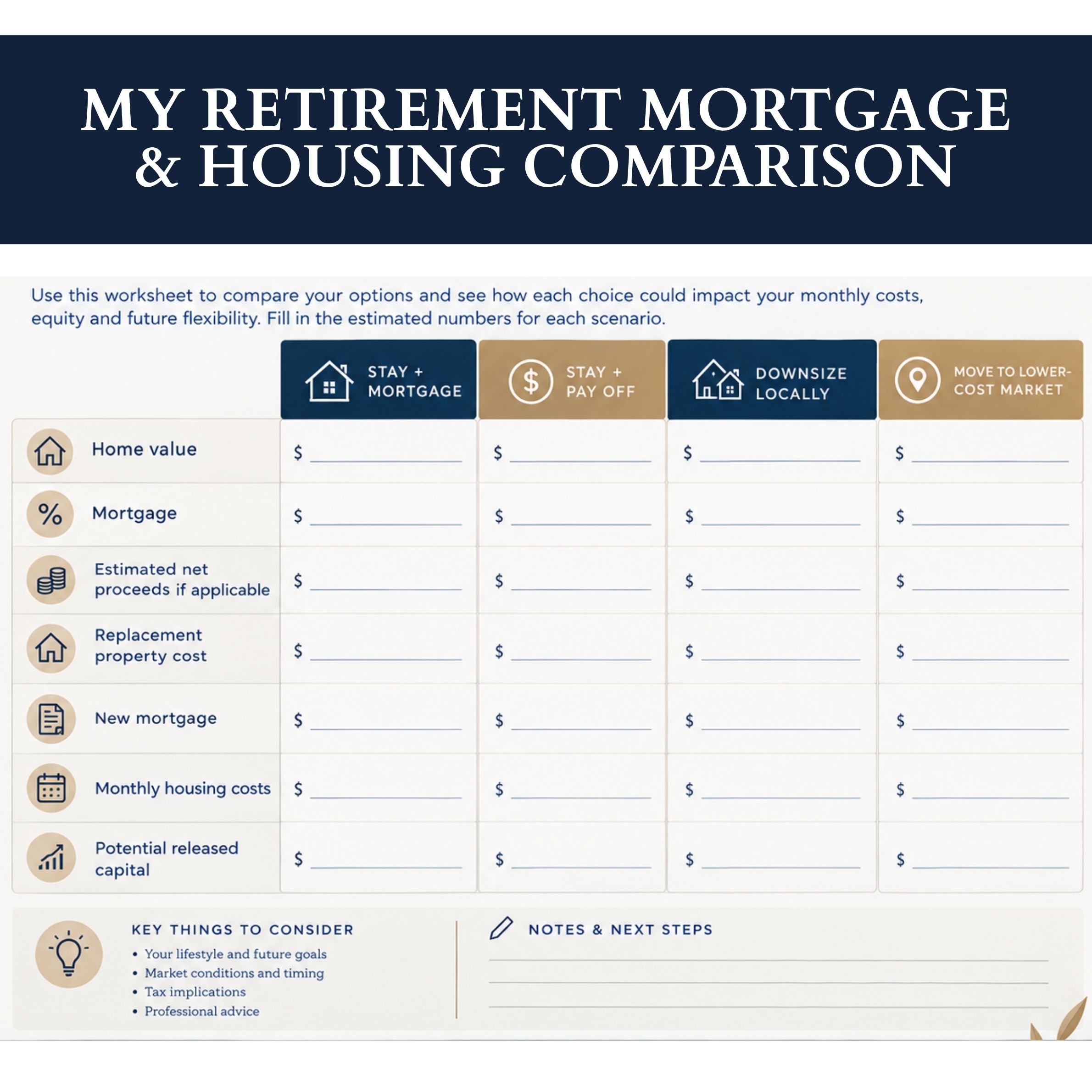
Compare Three Housing Scenarios
Before deciding what to do with your mortgage, model:
SCENARIO A — STAY WITH MORTGAGE
Mortgage: $________
Other housing costs: $________
Total monthly housing: $________
SCENARIO B — STAY MORTGAGE-FREE
Mortgage: $0
Other housing costs: $________
Capital required to eliminate mortgage: $________
Total monthly housing: $________
SCENARIO C — DOWNSIZE
New mortgage: $________
Condo/other fees: $________
Taxes: $________
Insurance/utilities: $________
Total monthly housing: $________
Potential released equity: $________
Now your financial professional has real scenarios to evaluate.
What About Using Home Equity to Pay Off Other Debt?
Homeowners sometimes consider refinancing, borrowing against home equity or restructuring debt before retirement.
These are financing decisions.
Potential considerations can include:
Interest rates
Fees
Repayment
Security against the property
Cash flow
tax implications where relevant
and overall financial risk.
Speak with qualified mortgage and financial professionals before using home equity to restructure debt.
What About a HELOC?
A home equity line of credit can provide access to borrowing secured against a property, subject to qualification and lender terms.
But:
Available credit is not the same thing as retirement income.
Borrowed money generally needs to be repaid and carries costs.
If you're considering using home equity as part of retirement planning, understand the product fully with your mortgage and financial professionals.
What About a Reverse Mortgage?
Some homeowners may explore reverse-mortgage products as an alternative to selling.
These products can be appropriate in some circumstances and inappropriate in others.
Before making a decision, understand:
Eligibility
Interest
Fees
Repayment structure
Effect on remaining home equity
Estate implications
Alternatives
and long-term costs.
Discuss the product with qualified professionals and review legal documentation carefully.
What If You Want to Leave the House to Your Children?
Some homeowners prioritize paying off the mortgage because they want their children to inherit the property debt-free.
That's an estate objective worth discussing.
But first ask:
Do your children actually want the house?
And then speak with your estate lawyer and financial professionals about the implications.
Your own retirement security should remain part of the conversation.
What If Your Children Are Encouraging You to Pay Off the House?
Remember:
It's your retirement.
Your adult children may have opinions about:
Selling.
Staying.
Paying off the mortgage.
Keeping the family home.
But they don't necessarily understand your complete financial picture.
Make the decision with your professional team.
What If Your Mortgage Is on a Rental Property?
That's a different analysis.
Rental-property debt needs to be considered alongside:
Rent
Operating expenses
Cash flow
Equity
tax considerations
interest
property performance
and your broader investment strategy.
READ: Should You Sell Your Rental Properties Before Retirement? →
Don't Look at the Mortgage in Isolation
This is the central point.
Your mortgage is connected to:
Your house.
Your equity.
Your monthly expenses.
Your liquidity.
Your retirement income.
Your future housing plan.
Your estate.
So the question:
“Should I pay off my mortgage?”
may actually be too narrow.
The better question is:
“What housing and debt structure best supports the retirement plan I've built with my qualified professionals?”
Five Years Before Retirement: Do This
If retirement is approximately five years away, start gathering information.
1. GET YOUR CURRENT HOME VALUE
Know what the property is worth.
2. GET YOUR MORTGAGE DETAILS
Balance.
Rate.
Renewal.
Amortization.
Prepayment terms.
3. CALCULATE YOUR REAL HOUSING COSTS
Not just the mortgage.
4. DECIDE WHETHER YOU WANT TO STAY
Don't optimize a mortgage on a house you don't want.
5. EXPLORE DOWNSIZING OPTIONS
Know what replacement housing costs.
6. TAKE THE NUMBERS TO YOUR FINANCIAL PROFESSIONAL
Now they can evaluate actual housing scenarios rather than estimates.
Two Years Before Retirement
Narrow the plan.
Are you:
Staying?
Downsizing?
Relocating?
Selling investment properties?
Paying down debt?
Changing your housing structure?
If a real estate transaction may be involved, begin planning early enough to avoid making everything happen simultaneously with retirement.
One Year Before Retirement
By now, ideally you understand:
Where you intend to live.
What your home is worth.
What mortgage will remain.
What housing will cost.
Whether a move is likely.
Which professionals need to be involved.
Retirement is a major life transition.
Housing shouldn't be an afterthought.
The Ana Bastas Retirement Mortgage & Real Estate Review
My role isn't to tell you:
“Pay off your mortgage.”
or:
“Keep your mortgage.”
My role is to help establish the real estate side of the equation.
CURRENT HOME VALUE
↓
CURRENT MORTGAGE
↓
APPROXIMATE HOME EQUITY
↓
CURRENT HOUSING COST
↓
STAY vs. DOWNSIZE
↓
REPLACEMENT HOUSING COST
↓
POTENTIAL EQUITY RELEASE
↓
PROFESSIONAL FINANCIAL / MORTGAGE REVIEW
↓
YOUR DECISION
That's a much stronger process than simply trying to reach a zero mortgage balance because retirement is approaching.
Start With Your Home Value
If you're five or ten years from retirement, you don't need to decide anything today.
But you should understand the value of one of your largest assets.
Knowing:
What is my home worth?
and
How much equity do I have?
gives your financial professional much better information to work with.
REQUEST A COMPLIMENTARY HOME VALUE REVIEW →
Annual Home Care Can Help You Track the Real Estate Side
If you're several years away from retirement, our Annual Home Care Program can help you maintain an updated understanding of your home's market position rather than waiting until the year you retire.
That allows the real estate side of your retirement plan to evolve as:
Your property value changes
Your mortgage decreases
The market changes
Your lifestyle changes
and your timeline becomes clearer.
LEARN ABOUT OUR ANNUAL HOME CARE PROGRAM →
Planning to Retire With a Mortgage?
Don't panic.
And don't assume you need to sell.
Instead, understand the numbers.
YOUR GOAL ISN'T NECESSARILY TO ENTER RETIREMENT WITH A $0 MORTGAGE.
YOUR GOAL IS TO ENTER RETIREMENT WITH A HOUSING PLAN YOU CAN COMFORTABLY SUPPORT.
Your financial and mortgage professionals can help determine the appropriate debt strategy.
I can help make sure the real estate numbers they're using are grounded in the actual market.
BOOK A RETIREMENT REAL ESTATE STRATEGY CALL →
REQUEST A COMPLIMENTARY HOME VALUE REVIEW →
FAQ SECTION
Should I pay off my mortgage before retirement in Canada?
There is no universal answer. Being mortgage-free can reduce monthly obligations, but using capital to eliminate a mortgage may affect liquidity and other parts of a retirement plan. Review the decision with qualified financial and mortgage professionals.
Can I retire if I still have a mortgage?
Potentially. The important considerations include the size of the payment, retirement income, other housing expenses, debt, assets and overall financial plan.
Is it better to pay off my mortgage or downsize?
That depends on whether you want to remain in the current home, the cost of replacement housing, available home equity, monthly costs and your broader financial objectives.
Does downsizing mean I will be mortgage-free?
Not necessarily. Selling a larger property and purchasing a smaller one may reduce or eliminate a mortgage, but transaction costs and replacement-home prices need to be calculated.
What expenses remain after my mortgage is paid off?
Homeowners may still have property taxes, insurance, utilities, maintenance, repairs, landscaping, snow removal and future capital expenses.
Should I use my savings to pay off my mortgage before retirement?
That's an individualized financial decision because it may affect liquidity, investments, taxes and retirement planning. Discuss it with your qualified financial professional.
Should I use home equity to pay off debt before retirement?
Borrowing against home equity or restructuring debt involves financing costs and risks. Review available strategies with qualified mortgage and financial professionals.
Should I sell my house to become mortgage-free?
Potentially, if selling and purchasing less expensive housing aligns with your financial and lifestyle objectives. Calculate actual net proceeds and replacement-housing costs before assuming the move will eliminate the mortgage.
Categories
- All Blogs (1311)
- Ana Bastas Real Estate Team (1)
- Ana Bastas Realtor (1)
- Ana bastas Realty (1)
- Brampton (1)
- Burlington (2)
- Buy & Travel™ Program (12)
- Buyer (213)
- Divorce (18)
- Downsizing (10)
- Events (8)
- First Time Home Buyers (140)
- Georgetown (21)
- Georgetown Buyers (8)
- Halton Hills (265)
- Hamilton (23)
- Holidays (1)
- How To (128)
- Interest Rates (2)
- Investor (8)
- Landlord (94)
- Lifestyle (128)
- Milton (78)
- Mississauga (1)
- Mortgage (6)
- Niagara (37)
- Oakville (3)
- Real Estate News (161)
- Realtor (21)
- Renter (97)
- Seller (193)
- Tax's (19)
- Tips (14)
- Toronto (135)
- Wealth Building (8)
- Wellington (3)
- YYZ (107)
Recent Posts








"My job is to find and attract mastery-based agents to the office, protect the culture, and make sure everyone is happy! "