
Should You Sell Your Rental Properties Before Retirement? An Ontario Real Estate Portfolio Review

Should You Sell Your Rental Properties Before Retirement? An Ontario Real Estate Portfolio Review
Your Rental Property Made Sense at 45. Does It Still Make Sense at 65?
You bought the condo years ago.
Or maybe it was your first house and you kept it when you moved.
The mortgage gradually came down.
The property appreciated.
Rent increased.
And today you have a significant amount of equity.
So naturally:
“We should keep it forever, right?”
Not necessarily.
But that doesn't mean you should sell it either.
As retirement approaches, I believe every investment property deserves a fresh review.
Not because you've reached a certain age.
Because your objectives have changed.
At 45, you may have been focused on:
Accumulation.
At retirement, you may care more about:
Cash flow.
Simplicity.
Liquidity.
Time.
Risk.
Estate planning.
Lifestyle.
The property hasn't necessarily changed.
You have.
Retirement Doesn't Automatically Mean Selling Your Real Estate
Let's establish this immediately.
A well-performing rental property may continue to be a valuable part of someone's retirement strategy.
It may provide:
Rental income
Long-term ownership
Potential appreciation
Diversification within a broader portfolio
An asset for future sale
An estate asset
But the property needs to be evaluated based on what it is doing today, not simply because it performed well historically.
Start With a Complete Real Estate Portfolio Review
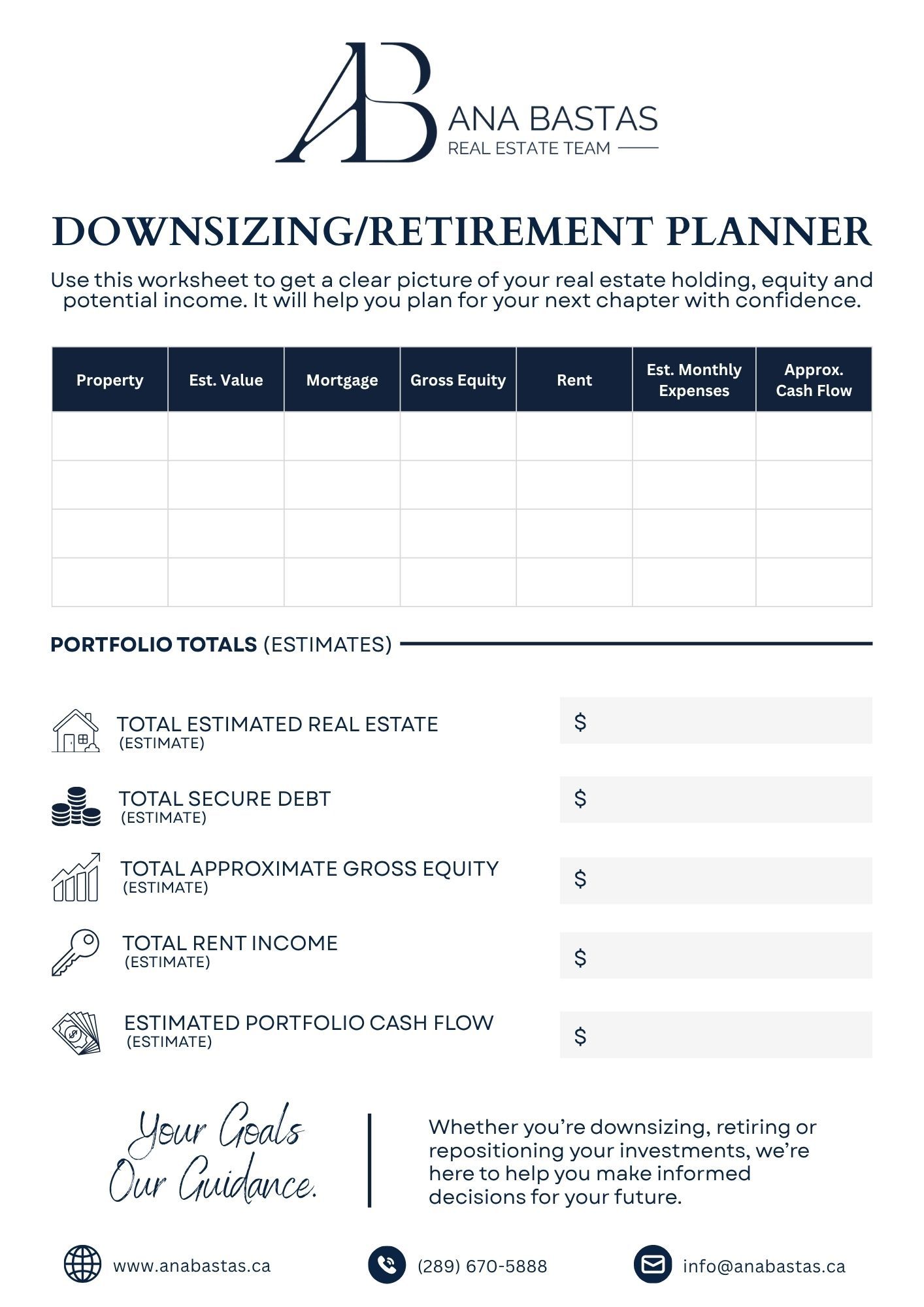
Before deciding whether to sell anything, list everything you own.
For example:
PRINCIPAL RESIDENCE
Estimated value: $________
Mortgage: $________
RENTAL PROPERTY #1
Estimated value: $________
Mortgage: $________
Monthly rent: $________
RENTAL PROPERTY #2
Estimated value: $________
Mortgage: $________
Monthly rent: $________
COTTAGE / SECOND HOME
Estimated value: $________
Mortgage: $________
COMMERCIAL / OTHER REAL ESTATE
Estimated value: $________
Mortgage: $________
Then step back.
How much of your total wealth is tied up in real estate?
That is an important question to bring to your financial professionals.
Question #1 — Is the Property Actually Cash Flowing?
Don't tell me:
“It rents for $3,000 a month.”
That's gross rent.
I want to understand what remains after the property's expenses.
Depending on the property, consider:
Mortgage payments
Property taxes
Insurance
Condo fees
Utilities paid by landlord
Maintenance
Repairs
Property management
Vacancy
Leasing costs
Other operating expenses
Then determine the property's actual financial performance.
Rent Is Not Profit
This distinction becomes particularly important in retirement.
If a condo rents for:
$3,000/month
but you're paying:
Mortgage.
Condo fees.
Property tax.
Insurance.
Repairs.
Management.
then:
$3,000 is not your retirement income from the property.
It's revenue.
The relevant question is:
WHAT DOES THE PROPERTY ACTUALLY PRODUCE AFTER ITS COSTS?
Question #2 — How Much Equity Is Tied Up in the Property?
Suppose a rental is worth approximately:
$900,000
and the mortgage is:
$200,000
That means approximately:
$700,000 of gross equity
is tied up in the property before considering disposition costs and taxes.
Now suppose the property generates relatively modest cash flow.
That creates a worthwhile discussion:
What is this $700,000 of equity accomplishing within my overall retirement strategy?
That's not an instruction to sell.
It's a question worth asking.
Equity and Cash Flow Are Different
This is the same principle we discussed with the principal residence.
NET WORTH ≠ CASH FLOW
You could own:
$3 million of real estate
and still have relatively limited monthly cash flow.
Or you could have a smaller real estate portfolio producing meaningful positive cash flow.
The headline property value doesn't tell us whether the portfolio is doing the job you need it to do.
Question #3 — What Is Your Return on Equity?
This is an important concept for investors to understand.
As a property's mortgage decreases and value increases, the amount of equity tied up in it can become substantial.
That means a property that once looked exceptional based on the original investment may look different when evaluated against its current equity.
This is where your financial and investment professionals can help evaluate whether the capital allocation still makes sense within the broader portfolio.
As your Realtor, I can help establish:
Current market value.
Likely selling range.
Real estate transaction costs.
Market rent where appropriate.
Real estate alternatives.
Then your financial professionals can evaluate the broader investment implications.
Question #4 — What Major Expenses Are Coming?
A rental can look great until:
The roof needs replacing.
The furnace fails.
The tenant leaves.
The condo corporation announces a special assessment.
The property requires substantial renovations.
As retirement approaches, review potential capital expenditures.
Ask:
Roof?
Windows?
HVAC?
Plumbing?
Electrical?
Appliances?
Exterior?
Condo reserve / potential assessments?
Interior renovation?
Tenant turnover?
You don't need to predict every future expense.
But you shouldn't evaluate cash flow as though repairs never happen.
→ Read: Should You Renovate Before Downsizing?
Question #5 — How Much Work Does the Property Create?
Financial spreadsheets don't measure:
11:00 PM tenant calls.
Plumbing emergencies.
Contractor coordination.
Leasing.
Inspections.
Maintenance.
Documentation.
Tenant turnover.
Administrative work.
At 45, you may not care.
At 70, you might.
Or perhaps you genuinely enjoy being a landlord.
Then management isn't necessarily a burden.
Again:
There is no automatic answer.
Could Property Management Solve the Problem?
Potentially.
If you like owning the asset but don't want day-to-day involvement, professional property management may be worth evaluating.
Calculate the cost.
Then ask:
Does the property still perform acceptably to me after management expenses?
If yes, keeping it may become significantly easier.
If no, that's useful information too.
Question #6 — What Happens If the Tenant Stops Paying?
Rental properties carry risk.
Retirement doesn't eliminate:
Vacancy
Non-payment
Repairs
Legal expenses
Insurance issues
Unexpected capital costs
Market fluctuations
The relevant question becomes:
Do I have sufficient reserves and financial flexibility to comfortably absorb problems with this property?
That's particularly important if you're relying heavily on the rental's income.
Question #7 — Are You Relying on Gross Rent as Retirement Income?
Be careful.
If you're planning retirement around:
“My rentals bring in $8,000/month.”
calculate what actually remains.
You need to understand:
GROSS RENT
versus
NET PROPERTY CASH FLOW
and then discuss the tax and financial implications with your accountant and financial professional.
Question #8 — What Happens to the Mortgage in Retirement?
Some investors enter retirement with mortgages on rental properties.
That isn't automatically good or bad.
But you need to understand:
Payment
Interest rate
Renewal timing
Amortization
Cash-flow effect
Qualification considerations for future financing
and your broader debt strategy.
Discuss financing decisions with the appropriate mortgage and financial professionals.
Question #9 — Is Your Portfolio Too Concentrated?
Imagine your net worth is largely:
Principal residence + three GTA investment properties.
That may represent substantial wealth.
But it's also substantial exposure to:
Real estate.
And potentially:
one geographic market.
Whether that concentration is appropriate is an investment-planning question for your qualified financial professional.
But your real estate review should provide the numbers they need to evaluate it.
Question #10 — Would You Buy This Property Again Today?
This is one of my favourite questions.
Forget what you paid.
Forget how much it appreciated.
Forget that you've owned it for 18 years.
Ask:
If I had the property's current equity sitting in cash today, would I buy this exact property again?
If the answer is:
Absolutely.
That's meaningful.
If the answer is:
Not a chance.
That's also meaningful.
Past ownership shouldn't automatically determine future ownership.
Question #11 — Are You Keeping It Because of the Tax Bill?
This comes up frequently.
A homeowner says:
“I can't sell because I'll have to pay tax.”
There may indeed be significant tax implications when disposing of an investment property.
But:
“There may be tax owing”
and
“I should therefore never sell”
are not the same conclusion.
Your accountant should estimate the tax consequences.
Then evaluate the after-tax result within your broader financial plan.
Question #12 — Did You Ever Live in the Property?
If an investment property was previously:
Your principal residence.
A family property.
Converted from personal use to rental.
Or changed use during ownership,
there may be additional tax considerations.
This is exactly the type of situation that should be reviewed with your accountant before deciding to sell.
Don't make assumptions based on what happened with someone else's property.
Question #13 — What About Depreciation / CCA?
If capital cost allowance or other tax treatments have been used, selling may have additional tax implications.
Again:
Accountant.
The important part from the real estate side is to obtain a realistic estimate of:
Market value.
Selling costs.
Timing.
Then your accountant can analyze the tax consequences.
Question #14 — Should You Sell Before or After You Retire?
This is another question that cannot be answered by the Realtor alone.
The timing of a disposition could potentially interact with:
Income
Tax
Financing
Other asset sales
Retirement date
Estate planning
and broader financial considerations.
Your professional team should coordinate.
Don't choose a closing date based solely on a real estate calendar if the tax and financial timing matters.
Question #15 — Would Selling Improve Your Lifestyle?
This deserves equal weight.
Imagine you own three rentals.
They perform reasonably well.
But you're constantly:
Taking calls.
Managing contractors.
Reviewing leases.
Handling maintenance.
Dealing with turnover.
And you'd rather spend six months travelling.
The portfolio may be financially acceptable but lifestyle-incompatible.
Retirement planning should account for your time too.
→ Read: Aging in Place vs. Downsizing
Your Time Has Value
We frequently calculate:
Property value.
Rent.
Mortgage.
Expenses.
But not:
Your time.
If you spend 15 hours per month managing your properties, ask:
Do I enjoy those 15 hours?
If yes, fine.
If you hate them, the management burden belongs in the decision.
Question #16 — What Will Your Spouse Do With the Portfolio?
This can be a critical question.
Perhaps one spouse has managed the real estate for 25 years.
The other spouse knows almost nothing about:
Tenants.
Mortgages.
Insurance.
Contractors.
Leases.
Accounting.
If the managing spouse becomes unable or unwilling to continue:
What happens?
A retirement portfolio should be manageable by the household—not dependent entirely on one person's knowledge.
Create a Property Information File
For every investment property, maintain:
Address
Ownership information
Mortgage lender
Mortgage details
Insurance
Tenant information
Lease
Rent
Deposits where applicable
Property manager
Contractors
Utilities
Condo information
Tax records
Accountant
Lawyer
Maintenance history
This becomes especially valuable for estate and continuity planning.
Question #17 — Do Your Children Want the Properties?
Another assumption:
“We'll leave the rentals to the kids.”
Have you asked them?
Maybe your children would love to own them.
Maybe they have absolutely no interest in becoming landlords.
Maybe multiple children inheriting interests in the same property could create complexity.
Those are estate-planning questions worth discussing with your lawyer.
Don't build an estate plan around assumptions.
Question #18 — Would Your Estate Be Easier With Fewer Properties?
Potentially.
Multiple real estate assets can create:
Valuation
Management
Tax
Liquidity
Beneficiary
and disposition considerations.
That doesn't mean you should sell everything.
But retirement is an appropriate time to discuss with your estate lawyer whether the current structure supports your objectives.
Question #19 — Should You Sell One Property Instead of All of Them?
Retirement real estate isn't:
KEEP EVERYTHING
versus
SELL EVERYTHING.
Maybe you own three rentals.
Property A:
Strong cash flow.
Low management.
Good tenant.
You like it.
Property B:
Substantial equity.
Weak cash flow.
High condo fees.
Property C:
Constant maintenance.
You hate managing it.
The appropriate answer could potentially be:
Keep A. Review B. Sell C.
Portfolio decisions can be property-specific.
→ Read: Halton vs. Niagara
Question #20 — Which Property Would You Sell First?
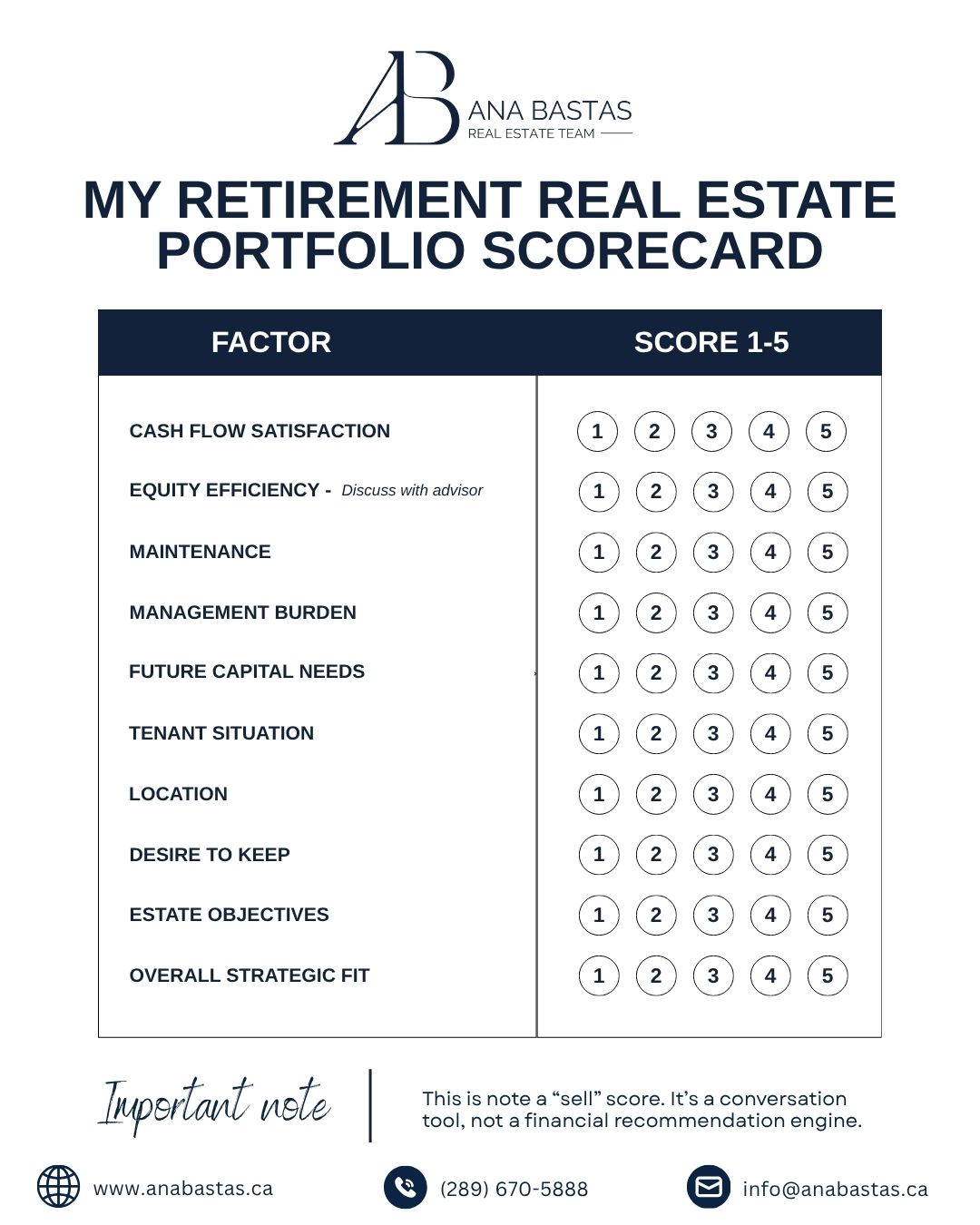
Create a scorecard.
Rate each property from 1–5.
CASH FLOW
EQUITY
MAINTENANCE
MANAGEMENT BURDEN
FUTURE CAPITAL COSTS
TENANT STABILITY
LOCATION
PERSONAL DESIRE TO KEEP
ESTATE VALUE TO FAMILY
STRATEGIC FIT
Now compare.
The weakest property may become obvious.
What If You Own a Condo Rental?
Review:
Current market value.
Mortgage.
Rent.
Condo fees.
Property taxes.
Insurance.
Management.
Maintenance.
Status of the condominium corporation.
Potential capital concerns.
Tenant situation.
Marketability.
A condo that was a fantastic investment ten years ago should still be reviewed based on today's numbers.
What If You Own a House Rental?
Consider:
Exterior maintenance.
Roof.
Windows.
HVAC.
Landscaping.
Tenant turnover.
Potential renovation requirements.
Current rent.
Current value.
Mortgage.
A detached rental can provide strong long-term ownership benefits while also requiring more physical-property management.
What If You Own a Cottage?
A cottage deserves its own conversation.
Is it:
An investment?
A family lifestyle asset?
A rental?
A future retirement property?
An estate asset?
Something your children genuinely want?
Don't evaluate it solely on rental return if the primary purpose is family lifestyle.
But also don't ignore its carrying costs and estate implications.
What If You Own Commercial Real Estate?
Commercial real estate should be reviewed separately.
Considerations may include:
Lease structure
Tenant quality
NOI
Capitalization rate
Financing
Capital expenditures
Vacancy
Lease expiries
Property management
Marketability
and the property's role in the broader portfolio.
Commercial assets often require a more detailed investment analysis than a residential rental.
Should You Pay Off the Rental Mortgage Before Retirement?
That's not a universal real estate recommendation.
Some people prioritize lower debt.
Others evaluate leverage differently.
The decision may depend on:
Interest rate
Cash flow
Tax considerations
Liquidity
other assets
and the broader financial plan.
Discuss debt strategy with your financial, mortgage and tax professionals.
What If Selling Creates a Large Amount of Cash?
Suppose selling a rental could create:
$600,000 in net proceeds before applicable tax consequences.
The next question is not:
“What should Ana tell me to invest it in?”
That's not my role.
The next step is to take the real estate numbers to your financial advisor/planner and accountant.
They can help determine what the capital means within your:
Retirement
Investment
Tax
and estate strategy.
What Ana Can Help Determine
From the real estate side, we can establish:
CURRENT MARKET VALUE
LIKELY SELLING RANGE
CURRENT MARKET RENT
where appropriate.
PROPERTY COMPETITION
MARKETABILITY
PRE-SALE WORK
ESTIMATED REAL ESTATE TRANSACTION COSTS
TIMING
SELLING STRATEGY
POTENTIAL REAL ESTATE ALTERNATIVES
Then we coordinate with the client's other professionals.
What Your Accountant Should Help Determine
Potential:
Tax consequences
Capital-gain implications
CCA/recapture considerations where applicable
Ownership-specific issues
Timing considerations
and other tax matters.
What Your Financial Advisor/Planner Should Help Determine
How the property fits within:
Retirement income
Investment allocation
Risk
Liquidity
Long-term planning
and broader financial objectives.
What Your Estate Lawyer Should Help Determine
Potential:
Will implications
Ownership structure
Power of Attorney
Beneficiary planning
Estate administration
and succession considerations.
One Property — One Page
For every rental you own, create a one-page review.
PROPERTY
Address: ________
Current estimated value: $________
Mortgage: $________
Approximate gross equity: $________
Monthly rent: $________
Estimated monthly expenses: $________
Approximate cash flow: $________
Potential upcoming repairs: ________
Management burden: Low / Medium / High
Desire to keep: Low / Medium / High
Potential selling considerations: ________
Accountant review required: Yes / No
Estate review required: Yes / No
Then repeat for every property.
The Ana Bastas Retirement Portfolio Review
For clients approaching retirement with multiple properties, our process can be:
1. INVENTORY
What do you own?
↓
2. VALUE
What is each property worth today?
↓
3. EQUITY
How much real estate equity exists?
↓
4. PERFORMANCE
What does each investment property actually produce?
↓
5. PROPERTY CONDITION
What capital expenses may be approaching?
↓
6. LIFESTYLE
How much work do you want in retirement?
↓
7. PROFESSIONAL REVIEW
Accountant.
Financial advisor/planner.
Estate lawyer.
Mortgage professional where appropriate.
↓
8. PROPERTY-BY-PROPERTY DECISION
Keep.
Improve.
Professionally manage.
Monitor.
Or sell.
THE GOAL ISN'T TO OWN THE MOST REAL ESTATE.
THE GOAL IS TO OWN THE REAL ESTATE THAT STILL SERVES YOUR PLAN.
You Don't Need to Sell Anything to Have a Portfolio Review
This is important.
A portfolio review isn't:
“Which property can Ana list?”
It's:
“What do I own, what is it worth, and what role does each property play?”
You may conclude:
Keep everything.
Great.
Or you may identify one property that no longer makes sense.
Either way, you have better information.
Start Before You Retire
If retirement is five years away, this is an excellent time to review the portfolio.
Why?
Because you have time to:
Plan.
Prepare.
Complete repairs.
Review tenants.
Speak with your accountant.
Consider tax timing.
Update estate documents.
Evaluate financing.
Sell strategically if appropriate.
Don't wait until retirement month to start restructuring a multi-property portfolio.
→ Read: Should I Sell & Downsize in Retirement?
Ready for a Real Estate Portfolio Review?
If you own:
Your home + one rental
Multiple rentals
A cottage
Commercial property
or a combination,
let's establish the real estate numbers.
Then you can take accurate information to your financial, tax and legal professionals.
DON'T KEEP A PROPERTY FOR 20 MORE YEARS JUST BECAUSE YOU'VE ALREADY OWNED IT FOR 20 YEARS.
Make every property earn its place in your next chapter.
BOOK A RETIREMENT REAL ESTATE PORTFOLIO REVIEW →
REQUEST A PROPERTY VALUE REVIEW →
FAQ SECTION
Should I sell my rental property before I retire?
Not automatically. Review the property's cash flow, equity, management burden, upcoming expenses, tax implications and role within your broader retirement plan before deciding.
Is rental income good for retirement?
Rental properties can provide income, but gross rent should not be confused with net cash flow. Property expenses, financing, maintenance, vacancy and taxes all need to be considered.
Should I keep a mortgage on a rental property in retirement?
There is no universal answer. Debt strategy depends on the property's economics and your broader financial, tax and liquidity circumstances. Review it with qualified financial, mortgage and tax professionals.
Should I sell a rental because it has a lot of equity?
Not solely because of equity. However, substantial equity combined with relatively weak property performance can be a reason to review whether the asset still fits your objectives.
Do I pay tax when I sell a rental property in Ontario?
Selling an investment property can have tax consequences depending on the circumstances. Have your accountant or qualified tax professional estimate the implications under current rules before making a decision.
Should I sell all my rentals when I retire?
Not necessarily. A property-by-property analysis may identify some assets worth keeping and others that no longer fit your retirement or lifestyle objectives.
Should I hire a property manager when I retire?
Potentially. Professional management can reduce day-to-day landlord responsibilities, but the cost should be included when evaluating the property's financial performance.
What happens to rental properties when I die?
Ownership and estate circumstances vary. An estate lawyer should review how each property is held and how it fits within your will and broader estate plan.
Categories
- All Blogs (1311)
- Ana Bastas Real Estate Team (1)
- Ana Bastas Realtor (1)
- Ana bastas Realty (1)
- Brampton (1)
- Burlington (2)
- Buy & Travel™ Program (12)
- Buyer (213)
- Divorce (18)
- Downsizing (10)
- Events (8)
- First Time Home Buyers (140)
- Georgetown (21)
- Georgetown Buyers (8)
- Halton Hills (265)
- Hamilton (23)
- Holidays (1)
- How To (128)
- Interest Rates (2)
- Investor (8)
- Landlord (94)
- Lifestyle (128)
- Milton (78)
- Mississauga (1)
- Mortgage (6)
- Niagara (37)
- Oakville (3)
- Real Estate News (161)
- Realtor (21)
- Renter (97)
- Seller (193)
- Tax's (19)
- Tips (14)
- Toronto (135)
- Wealth Building (8)
- Wellington (3)
- YYZ (107)
Recent Posts









"My job is to find and attract mastery-based agents to the office, protect the culture, and make sure everyone is happy! "