
Buying a Century Home in Ontario: What Buyers Need to Know

Buying a Century Home in Ontario: What Buyers Need to Know Before Purchasing

Should You Buy a 100-Year-Old House?
Absolutely—if it's the right house for you and you understand what you're buying.
Century homes can offer things that are increasingly difficult to recreate:
Established neighbourhoods.
Mature trees.
Larger lots.
Architectural character.
Original millwork.
High ceilings.
Unique layouts.
Walkable communities.
History.
But a century home has also had approximately:
100 YEARS OF OWNERSHIP.
Think about what can happen during that time.
Different owners may have:
Rewired portions.
Changed plumbing.
Built additions.
Finished basements.
Removed walls.
Added bathrooms.
Replaced windows.
Changed heating systems.
Waterproofed foundations.
Renovated kitchens.
Insulated walls.
Repaired roofs.
Updated electrical panels.
Sometimes professionally.
Sometimes decades ago.
Sometimes recently.
Sometimes with documentation.
Sometimes without it.
So:
DON'T JUST ASK, “HOW OLD IS THE HOUSE?”
Ask:
“WHAT HAS HAPPENED TO THIS HOUSE DURING THOSE 100 YEARS?”
Century Home Doesn't Mean Problem Home
This distinction is extremely important.
A 100-year-old home that has been:
Carefully maintained.
Professionally renovated.
Properly updated.
Consistently repaired.
can present a very different ownership proposition from a much newer house that has been neglected.
AGE IS DATA—not a verdict.
The actual condition matters.
Don't Expect a Century Home to Behave Like New Construction
Century homes were built:
In another era.
Using different materials.
Under different construction practices.
For different lifestyles.
That doesn't mean:
“Anything goes because it's old.”
It means buyers need perspective.
Your inspection is not intended to transform:
1920
into:
2026.
The goal is:
UNDERSTAND CONDITION, SAFETY, FUNCTION, RISK AND FUTURE COST.
Start With the Home Inspection
A qualified home inspection can be particularly valuable when purchasing an older property.
Depending on accessibility and scope, an inspector may evaluate components including:
Structure.
Foundation.
Roof.
Electrical.
Plumbing.
HVAC.
Attic.
Insulation.
Exterior.
Windows.
Interior.
Visible moisture conditions.
But remember:
A HOME INSPECTION IS VISUAL—not destructive.
The inspector generally can't simply:
Open finished walls.
Remove floors.
Dig up the yard.
See every concealed pipe.
Inspect every concealed electrical conductor.
That's why century homes can sometimes require:
SPECIALIST FOLLOW-UP.

Electrical Systems
Century homes deserve careful electrical consideration because the electrical system may have evolved substantially since construction.
You may encounter:
Newer electrical panel.
Older wiring.
Partial rewiring.
Knob-and-tube.
Modern copper wiring.
Previous renovations.
Additions.
Older outlets.
Multiple eras of electrical work.
A newer panel doesn't automatically mean:
THE ENTIRE HOUSE HAS BEEN REWIRED.
READ: Knob-and-Tube Wiring in Ontario Homes →
Knob-and-Tube
If knob-and-tube is identified:
Don't panic.
But don't ignore it.
Investigate:
Is it active?
How much remains?
Condition?
Previous modifications?
Insurance requirements?
Financing implications?
Upgrade recommendations?
Cost?
OLD WIRING IS INFORMATION—not automatically a reason to abandon the house.
What About Aluminum Wiring?
Aluminum branch-circuit wiring is generally associated with a later construction era than a typical century home's original wiring.
But:
Century homes can have additions.
Century homes can have major renovations.
Century homes can contain electrical work from multiple eras.
So don't assume every component is:
100 years old.
READ: Aluminum Wiring in Ontario Homes →
Plumbing
A century home's plumbing can tell the story of decades of renovations.
You may find:
Older supply piping.
Copper.
PEX.
Galvanized steel.
Cast-iron drainage.
Newer PVC/ABS components.
Multiple materials throughout the house.
Again:
MIXED MATERIALS DON'T AUTOMATICALLY MEAN BAD PLUMBING.
But you need to understand:
What remains.
What has been replaced.
What condition it is in.
What may need attention.
READ: Old Plumbing in Ontario Homes →

Sewer Line
This is easy to forget.
The kitchen may have been renovated.
The bathrooms may be new.
But:
WHAT ABOUT THE PIPE UNDERGROUND?
Depending on:
Age.
Pipe material.
Mature trees.
Previous sewer history.
Inspector recommendations.
Property conditions,
a sewer-camera inspection may be worth considering.
READ: Sewer Line Inspections in Ontario →
Mature Trees Are Beautiful—But Look Underground Too
Century-home neighbourhoods often have:
Gorgeous tree canopy.
That's one of their biggest attractions.
But mature landscaping also means buyers should think about:
Underground infrastructure.
Drainage.
Sewer lines.
Foundations.
This does not mean:
Mature tree = sewer damage.
It means:
LOOK ABOVE AND BELOW GROUND.
Foundation
A century home's foundation may differ substantially from modern construction.
Depending on the property, age and construction, buyers may encounter:
Different foundation materials.
Historical movement.
Previous repairs.
Waterproofing.
Cracks.
Unevenness.
Alterations.
The objective isn't:
FIND A 100-YEAR-OLD HOUSE THAT HAS NEVER MOVED.
It's:
UNDERSTAND WHETHER THE CONDITION TODAY REQUIRES FURTHER INVESTIGATION.
READ: Foundation Cracks in Older Ontario Homes →
Sloping Floors
This is one of the most common century-home questions.
Buyer walks through the dining room and says:
“The floor isn't level.”
Does that automatically mean:
Foundation failure?
No.
But neither should we say:
“It's 100 years old. That's normal.”
Instead ask:
How significant is it?
Is movement suspected?
Are there other indicators?
Has structural work occurred?
Does the inspector recommend further evaluation?
CHARACTER AND STRUCTURAL CONCERN ARE NOT THE SAME THING.
Let the appropriate professional distinguish between them.
Water and Basement Moisture
Century-home basements deserve particular attention because buyers may encounter:
Moisture.
Efflorescence.
Previous waterproofing.
Sump systems.
Foundation repairs.
Finished areas.
Drainage improvements.
Previous flooding.
The key question remains:
WHERE DID THE WATER COME FROM?
Foundation?
Surface drainage?
Plumbing?
Sewer?
Another source?
READ: Water & Basement Moisture in Older Ontario Homes →
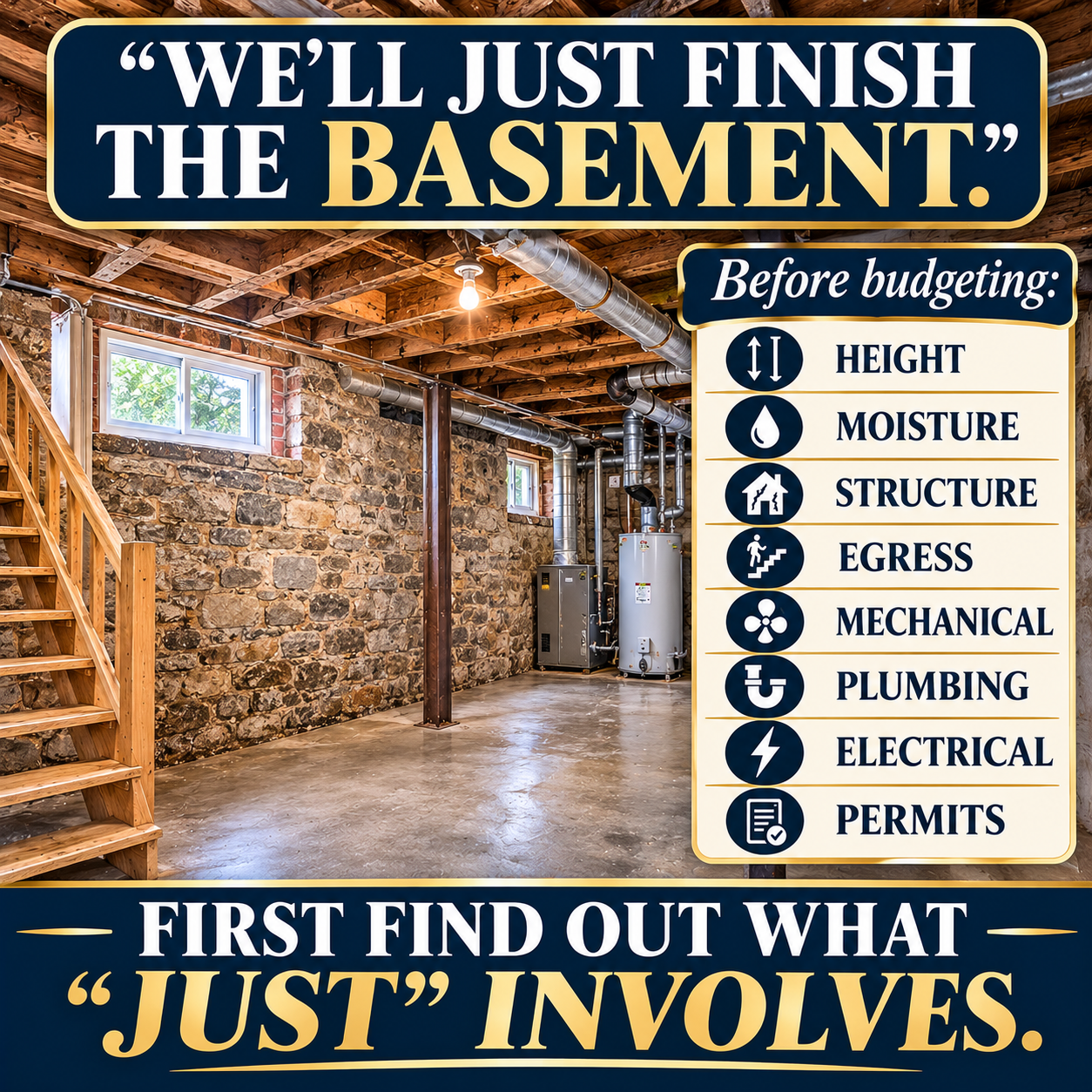
Century-Home Basements May Not Have Been Designed as Living Space
This matters enormously.
A buyer may see:
Low ceiling.
Stone/concrete walls.
Utility areas.
Limited windows.
and think:
“We'll just finish it.”
Maybe.
But first understand:
Moisture.
Ceiling height.
Structure.
Mechanical systems.
Egress.
Insulation.
Electrical.
Plumbing.
Applicable building requirements.
DON'T ASSUME EVERY BASEMENT CAN BECOME THE BASEMENT YOU SAW ON PINTEREST.
Asbestos
Century homes may contain building materials installed or renovated during periods when asbestos-containing materials were used.
Potential areas may include certain:
Insulation.
Plaster-related materials.
Textured finishes.
Flooring.
Pipe insulation.
Cement products.
Other historical building materials.
But:
ASBESTOS PRESENT ≠ AUTOMATICALLY UNSAFE HOUSE.
The risk changes materially when asbestos-containing materials are:
Damaged.
Deteriorating.
Disturbed.
Renovated.
Demolished.
READ: Asbestos in Older Homes Ontario →
Your Renovation Plans Matter
This is particularly important with century homes.
Buyer A:
Loves original plaster.
Loves woodwork.
Wants minimal changes.
Buyer B:
Wants open concept.
Wants new kitchen.
Wants new bathrooms.
Wants central HVAC.
Wants basement finished.
Wants walls removed.
Same house.
COMPLETELY DIFFERENT DUE-DILIGENCE REQUIREMENTS.

Renovating Can Reveal What Was Previously Hidden
This is one of the biggest century-home risks.
Before renovation:
Wall looks fine.
After demolition:
You may discover:
Old wiring.
Old plumbing.
Structural modifications.
Environmental materials.
Previous repairs.
Water damage.
Other concealed conditions.
That's why:
THE RENOVATION BUDGET NEEDS A CONTINGENCY.
Our final article in this cluster will address this directly.
Original Plaster
Many century homes contain plaster walls and ceilings.
Buyers often love:
Solidity.
Character.
Original detailing.
But renovation can be different from working with modern drywall.
If you're planning:
Electrical upgrades.
Plumbing.
HVAC.
Structural work.
consider:
Access.
Repair.
Restoration.
Potential environmental materials.
Again:
THE COST OF THE TRADE ISN'T ALWAYS THE COST OF THE PROJECT.
Original Woodwork
Original:
Baseboards.
Trim.
Doors.
Stairs.
Built-ins.
can be some of the most valuable character elements in a century home.
Before major renovation:
DECIDE WHAT YOU'RE TRYING TO PRESERVE.
The cheapest demolition strategy isn't always the best strategy for a character property.
Windows
Century homes may have:
Original windows.
Replacement windows.
Storm windows.
A mixture.
Evaluate:
Condition.
Operation.
Water.
Air leakage.
Maintenance.
Replacement history.
But:
OLD WINDOWS ≠ AUTOMATICALLY BAD WINDOWS.
The buyer's priorities matter.
Roof
The house may be 100 years old.
The roof isn't necessarily.
Ask:
When was the current roof installed?
What material?
Repairs?
Leaks?
Flashing?
Chimney intersections?
Documentation?
The age of the house tells you almost nothing about the age of the current roof covering.
Chimneys and Fireplaces
Century homes may have:
Masonry chimneys.
Wood-burning fireplaces.
Gas inserts.
Abandoned flues.
Decorative fireplaces.
Don't assume:
FIREPLACE PRESENT = FIREPLACE READY TO USE.
If fireplace use matters:
Have the appropriate professional evaluate it.
Insurance requirements may also matter.
Heating Systems
A century home may have gone through several heating eras.
Potentially:
Boiler.
Radiators.
Forced air.
Gas.
Electric.
Heat pump.
Multiple systems.
Ask:
What heats the home today?
How old is the equipment?
How evenly?
What has been upgraded?
What maintenance is required?
Central Air Conditioning
Some century homes were never originally designed for modern central air.
If central A/C has been added:
Understand the system.
If it hasn't:
Don't assume adding it will be identical to doing so in newer construction.
Layout and existing mechanical systems can affect renovation options.
Insulation
A century home may have undergone:
Attic insulation upgrades.
Wall insulation.
Addition insulation.
Partial energy improvements.
Again:
HOUSE AGE DOESN'T TELL YOU CURRENT INSULATION PERFORMANCE.
Investigate the actual property.
Vermiculite
If vermiculite insulation is present or suspected:
Don't disturb it unnecessarily.
Appropriate investigation may be warranted because some historical vermiculite products have been associated with asbestos contamination.
This connects directly to the asbestos article.
Additions
Century homes frequently evolve.
You may find:
Rear addition.
Sunroom.
Porch enclosure.
Second-storey addition.
Kitchen extension.
Converted attic.
Ask:
When was it built?
Was appropriate approval obtained?
How is it supported?
How is it heated?
How does the roof connect?
Any water issues?
Is documentation available?
THE ADDITION MAY BE 30 YEARS OLD EVEN IF THE HOUSE IS 110.
Evaluate each component accordingly.
Removed Walls
Open-concept century home?
Beautiful.
But:
WHO REMOVED THE WALL?
Ask:
When?
Was it load-bearing?
Was engineering involved?
Was appropriate permitting obtained?
Is documentation available?
Don't assume:
Open concept = properly engineered.
And don't assume:
No paperwork immediately proves unsafe work.
Investigate.
Permits and Renovation History
Century homes can contain generations of renovations completed under:
Different owners.
Different standards.
Different permitting regimes.
Where material alterations have occurred:
Investigate available documentation.
Depending on the situation, this may involve:
Seller records.
Municipal records.
Contractor documentation.
Engineering information.
Electrical records.
Other appropriate sources.
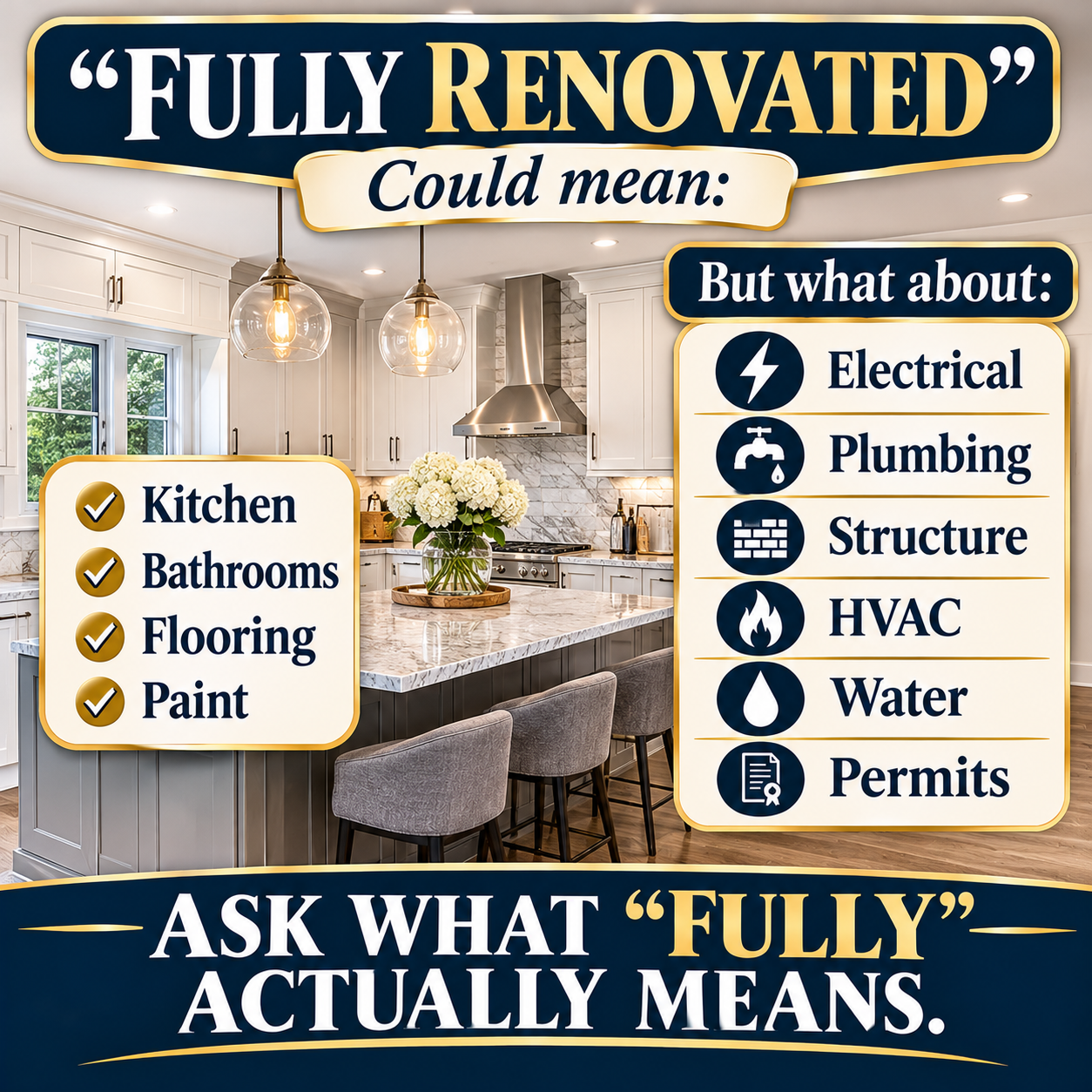
“Fully Renovated Century Home”
This phrase should trigger:
MORE QUESTIONS—not fewer.
Ask:
What was renovated?
Cosmetic or structural?
Electrical?
Plumbing?
HVAC?
Insulation?
Foundation?
Roof?
Windows?
Permits?
Contractors?
Documentation?
RENOVATED DOESN'T MEAN REBUILT.
Heritage Designation
This is an important distinction for some Ontario century homes.
An older home is not automatically a designated heritage property simply because of its age.
But if heritage status or other municipal heritage considerations apply, they can potentially affect:
Alterations.
Exterior changes.
Demolition.
Renovation planning.
Before assuming what you can change:
VERIFY THE SPECIFIC PROPERTY'S STATUS AND APPLICABLE MUNICIPAL REQUIREMENTS.
Insurance
Insurance deserves attention before the deal becomes firm where older-home conditions may be relevant.
Potential underwriting considerations may include:
Electrical.
Plumbing.
Heating.
Roof.
Previous claims.
Oil systems.
Other property-specific conditions.
DON'T ASSUME THE SELLER'S INSURANCE MEANS YOUR INSURER WILL OFFER IDENTICAL COVERAGE.
Financing
Likewise, a buyer's mortgage pre-approval doesn't mean:
Every 100-year-old house is automatically acceptable to every lender.
If inspection identifies a significant property condition:
Keep the mortgage professional informed.
Borrower approval and property approval are not necessarily the same thing.
What Will a Century Home Cost to Maintain?
There is no useful universal percentage.
Instead:
BUILD A PROPERTY-SPECIFIC CAPITAL PLAN.
|
Component |
Current Condition |
Approx. Age |
Future Action |
Budget/Quote |
|
Roof |
||||
|
Electrical |
||||
|
Plumbing |
||||
|
Sewer |
||||
|
Foundation |
||||
|
Waterproofing |
||||
|
HVAC |
||||
|
Windows |
||||
|
Insulation |
||||
|
Exterior |
||||
|
Environmental |
||||
|
Planned Renovations |
THE PURCHASE PRICE IS ONLY THE FIRST NUMBER.
Century Homes and Resale
Character can create tremendous buyer appeal.
But future buyers may ask the same questions you're asking now.
Therefore, during your ownership:
Keep invoices.
Keep permits.
Keep warranties.
Keep professional reports.
Keep renovation records.
Keep before/after photos.
Document major improvements.
GOOD RECORDS CAN BECOME PART OF THE VALUE OF AN OLDER HOME.
Should You Walk Away From a Century Home?
Sometimes.
If due diligence identifies:
Risk outside your tolerance.
Renovation outside your budget.
Insurance issues you cannot resolve.
Financing issues.
Structural concerns.
Property limitations incompatible with your plans.
then another house may be a better choice.
But:
DON'T WALK AWAY JUST BECAUSE THE HOUSE WAS BUILT IN 1910.
Walk away because:
THE FACTS DON'T WORK FOR YOU.
Don't Buy It Just Because It's Beautiful Either
The opposite mistake is equally important.
Original:
Stained glass.
Trim.
Hardwood.
Fireplace.
Front porch.
can create emotional attachment quickly.
But:
CHARACTER DOESN'T PAY FOR A FAILED SYSTEM.
Understand the numbers too.
The Ana Bastas Century Home Review
Before buying:
1. HISTORY
When was it built and what has changed?
↓
2. INSPECTION
What can we see?
↓
3. STRUCTURE
Foundation + movement + additions.
↓
4. WATER
Basement + drainage + history.
↓
5. ELECTRICAL
Original? Partial? Updated?
↓
6. PLUMBING
Supply + drainage + sewer.
↓
7. ENVIRONMENTAL
Asbestos and other relevant concerns.
↓
8. MECHANICAL
Heating + cooling + water heater.
↓
9. RENOVATIONS
What was changed, by whom and when?
↓
10. DOCUMENTATION
Permits + invoices + warranties + professional reports.
↓
11. INSURANCE & FINANCING
Confirm the specific property.
↓
12. FUTURE PLAN
What does the buyer want to change?
↓
13. CAPITAL PLAN
What could ownership require?
↓
14. DECISION
DON'T BUY A CENTURY HOME BECAUSE YOU LOVE ITS PAST UNTIL YOU UNDERSTAND ITS FUTURE.
Century Home Buyer Checklist
Fona, this should be a dedicated section inside the Ontario Older Home Buyer Due Diligence Toolkit.
STRUCTURE
☐ Foundation
☐ Cracking/movement
☐ Sloping floors
☐ Beams/posts
☐ Additions
☐ Removed walls
WATER
☐ Basement moisture
☐ Previous flooding
☐ Waterproofing
☐ Grading
☐ Downspouts
☐ Sump
☐ Sewer history
ELECTRICAL
☐ Panel
☐ Knob-and-tube
☐ Other older wiring
☐ Partial rewiring
☐ Documentation
PLUMBING
☐ Supply material
☐ Drainage material
☐ Galvanized
☐ Cast iron
☐ Sewer scope considered
☐ Water heater
ENVIRONMENTAL
☐ Asbestos considerations
☐ Vermiculite
☐ Other professional investigation where warranted
BUILDING
☐ Roof
☐ Windows
☐ Chimney/fireplace
☐ HVAC
☐ Insulation
☐ Exterior
RENOVATIONS
☐ Addition history
☐ Structural changes
☐ Kitchen/bathroom history
☐ Permits where applicable
☐ Contractor documentation
☐ Electrical documentation
TRANSACTION
☐ Insurance confirmed
☐ Financing confirmed
☐ Specialist follow-up completed
☐ Renovation plan considered
☐ Capital budget prepared
☐ Buyer comfortable proceeding
Frequently Asked Questions
Is it a bad idea to buy a 100-year-old house?
Not automatically. Condition, maintenance, renovation history and future ownership costs matter much more than age alone.
Are century homes expensive to maintain?
They can be, but there is no universal rule. A well-maintained century home may have had many major systems replaced, while a newer neglected property may require significant work.
What should I inspect when buying a century home?
Buyers should consider the structure, foundation, electrical, plumbing, sewer, roof, HVAC, water history, insulation, environmental considerations and renovation history, along with specialist evaluation where warranted.
Do century homes have knob-and-tube wiring?
Some may, but many have been partially or completely rewired. Home age alone does not establish the current electrical system.
Do century homes contain asbestos?
Some may contain asbestos-containing building materials, particularly from renovations or materials installed during certain historical periods. Appropriate testing may be warranted where relevant.
Should I get a sewer scope on a century home?
It can be worth considering depending on property age, pipe condition, mature trees, sewer history, inspection findings and the buyer's due-diligence objectives.
Are cracks normal in a century-home foundation?
Some historical movement or cracking may exist, but buyers shouldn't diagnose a crack as harmless simply because the home is old. Professional evaluation may be appropriate depending on the condition.
Can I renovate a century home?
Often yes, but renovation feasibility depends on the property, structural conditions, building requirements, heritage considerations where applicable and the scope of work.
Is every century home a heritage property?
No. Age alone doesn't automatically establish heritage designation. Verify the specific property's status and applicable municipal requirements.
Can I insure a century home?
Many century homes are insured, but underwriting can depend on property-specific conditions such as electrical, plumbing, heating and other factors. Confirm the specific property with your insurer.
Is a renovated century home safer to buy?
Not automatically. Determine what was actually renovated, whether major systems were updated and what documentation exists.
Should I walk away from a century home with problems?
Not automatically. Quantify the issues, obtain professional advice and determine whether the cost and risk fit your budget and goals.
Categories
- All Blogs (1413)
- Ana Bastas Real Estate Team (1)
- Ana Bastas Realtor (1)
- Ana bastas Realty (1)
- Brampton (2)
- Burlington (10)
- Buy & Travel™ Program (12)
- Buyer (348)
- Community News (2)
- Divorce (22)
- Downsizing (21)
- Events (73)
- First Time Home Buyers (154)
- Georgetown (38)
- Georgetown Buyers (8)
- Halton Hills (272)
- Hamilton (29)
- Holidays (18)
- How To (140)
- Interest Rates (11)
- Investor (51)
- Join ABR Team (4)
- Landlord (105)
- Lifestyle (177)
- Milton (83)
- Mississauga (3)
- Mortgage (23)
- Niagara (39)
- Oakville (6)
- Older Home (6)
- Real Estate News (235)
- Realtor (73)
- Renter (99)
- Seller (266)
- seller education series (3)
- Tax's (28)
- Tips (42)
- Toronto (148)
- Wealth Building (15)
- Wellington (4)
- YYZ (105)
Recent Posts






"My job is to find and attract mastery-based agents to the office, protect the culture, and make sure everyone is happy! "