
Renovating an Older Home in Ontario: Hidden Costs to Budget For
Renovating an Older Home in Ontario: Hidden Costs Buyers Should Budget For
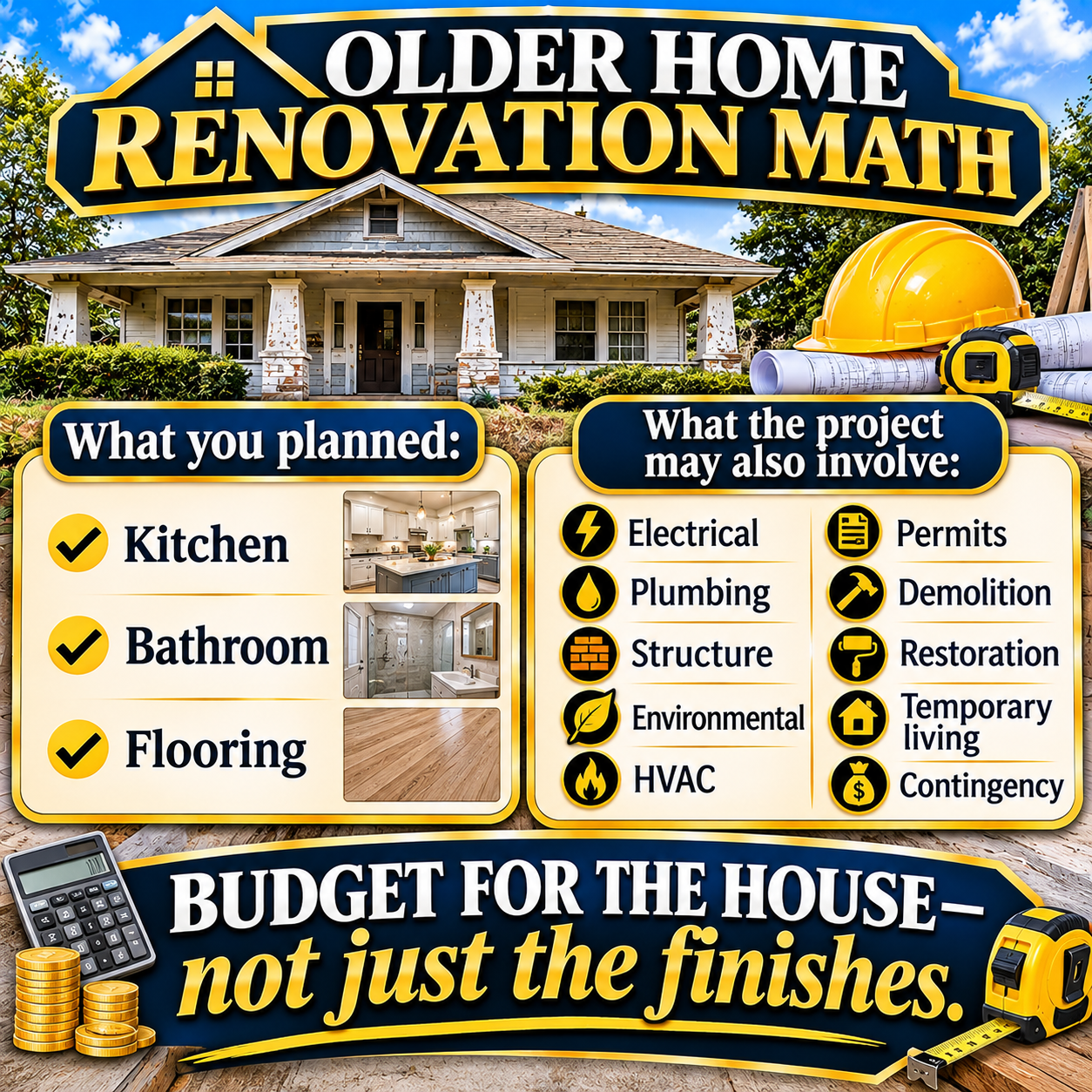
“The Renovation Should Cost About $100,000.”
Maybe.
But my next question is:
WHAT DOES THE $100,000 INCLUDE?
Does it include:
Demolition?
Electrical?
Plumbing?
Structural work?
Engineering?
Permits?
Environmental testing?
Asbestos management if required?
HVAC changes?
Drywall?
Plaster repair?
Painting?
Flooring?
Disposal?
Temporary accommodation?
Storage?
Landscaping?
Contingency?
Because:
THE KITCHEN QUOTE ISN'T NECESSARILY THE PROJECT COST.
Why Older-Home Renovations Can Be Different
An older home may have been:
Built under different construction practices.
Renovated several times.
Rewired partially.
Replumbed partially.
Added onto.
Reconfigured.
Insulated later.
Finished over.
Repaired by multiple owners.
That means when you open a wall, you aren't necessarily seeing:
The original house.
You may be seeing:
100 YEARS OF DECISIONS.
The Renovation You Can See vs. the Renovation You Can't
Buyers tend to budget for things they can see.
Cabinets.
Countertops.
Appliances.
Flooring.
Tile.
Fixtures.
But the expensive surprises often live:
BEHIND
the finishes.
Potentially:
Wiring.
Plumbing.
Framing.
Insulation.
Environmental materials.
Moisture damage.
Previous alterations.
Structural conditions.
Mechanical systems.
WHAT'S BEHIND THE WALL CAN MATTER MORE THAN WHAT YOU PUT ON THE WALL.

Demolition Creates Information
Before demolition:
Everything may look fine.
Then the wall opens.
Suddenly you can see:
Wiring.
Plumbing.
Framing.
Insulation.
Previous renovations.
Moisture evidence.
Environmental materials.
This doesn't mean every older-home renovation becomes a disaster.
It means:
DEMOLITION REMOVES THE UNCERTAINTY—and sometimes uncertainty has a price.
Hidden Cost #1 — Asbestos
This is one of the most important examples.
Certain older building materials may contain asbestos.
If those materials are:
Intact.
In good condition.
Left undisturbed,
the situation can be very different from a renovation where those materials need to be:
Cut.
Removed.
Sanded.
Drilled.
Demolished.
The renovation can change the relevance of the material.
YOUR RENOVATION PLAN CAN TURN AN EXISTING MATERIAL INTO A PROJECT COST.
READ: Asbestos in Older Homes Ontario →
Testing Can Affect the Timeline
If suspect materials need professional testing before renovation:
Build that into the project schedule.
If additional procedures or professional remediation are required:
Build those into the schedule too.
A renovation timeline that assumes:
Demolition starts Monday
can fall apart quickly if the house requires investigation before materials can appropriately be disturbed.
DUE DILIGENCE CAN SAVE MORE TIME THAN RUSHING.
Hidden Cost #2 — Electrical
Suppose you're renovating a kitchen.
You want:
New appliances.
New lighting.
Island outlets.
More receptacles.
Induction range.
New fixtures.
The electrical work may extend beyond:
“Move this outlet.”
An older electrical system may require professional evaluation to determine what is needed for the planned renovation.
READ: Knob-and-Tube Wiring Ontario →
READ: Aluminum Wiring Ontario →
A New Panel Doesn't Mean a New Electrical System
This deserves repeating.
NEW ELECTRICAL PANEL ≠ ENTIRE HOUSE REWIRED.
An older home can contain:
Newer panel.
Newer kitchen wiring.
Older wiring elsewhere.
Multiple renovation eras.
When planning a major renovation:
UNDERSTAND THE EXTENT OF THE SYSTEM—not just the panel.
Hidden Cost #3 — Plumbing
Beautiful bathroom renovation?
You may budget:
Vanity.
Tile.
Shower.
Toilet.
Fixtures.
But what happens when the walls open and you discover older plumbing that the professional recommends addressing?
Or you decide:
Move the shower.
Move the toilet.
Relocate the vanity.
Now you're changing more than finishes.
MOVING WATER AND DRAINAGE CAN CHANGE THE PROJECT.
READ: Old Plumbing in Ontario Homes →
Hidden Cost #4 — Sewer
Your renovation may be entirely inside the house.
But the property still depends on:
Underground drainage infrastructure.
If the buyer is already investing heavily in an older home, understanding the sewer can help prevent another significant unplanned capital item from appearing immediately after the renovation.
READ: Sewer Line Inspections in Ontario →
DON'T SPEND EVERY DOLLAR ABOVE GROUND WITHOUT THINKING ABOUT WHAT'S
UNDERGROUND.
Hidden Cost #5 — Foundation
Suppose your renovation plan includes:
Finished basement.
New flooring.
Home theatre.
Gym.
Bedroom.
But inspection identifies:
Foundation concerns.
Water.
Movement.
Previous repairs.
Those need to be appropriately understood before spending heavily on finishes.
READ: Foundation Cracks in Older Ontario Homes →
DON'T DECORATE OVER A QUESTION YOU HAVEN'T ANSWERED.
Hidden Cost #6 — Water Management
Water can destroy expensive finishes.
Before investing heavily in a basement, understand:
Moisture history.
Grading.
Foundation.
Drainage.
Sump systems.
Sewer history.
Plumbing.
Previous waterproofing.
READ: Water & Basement Moisture in Older Ontario Homes →
SOLVE THE WATER BEFORE YOU BUILD AROUND IT.
Hidden Cost #7 — Structural Changes
Open concept is one of the most common renovation goals.
Buyer says:
“We'll just take this wall out.”
That word again:
JUST.
Before removing walls:
Is it structural?
What supports what?
Is engineering required?
What approvals are required?
What happens above?
What mechanical/electrical/plumbing runs through it?
A wall can be carrying much more than:
Drywall.
Removing a Wall Can Affect Other Systems
Inside that wall may be:
Electrical.
Plumbing.
HVAC.
Structural framing.
So:
REMOVE WALL
can become:
STRUCTURE
ELECTRICAL
PLUMBING
HVAC
FLOORING
CEILING
DRYWALL
PAINT
ONE DESIGN DECISION CAN TOUCH HALF THE HOUSE.
Hidden Cost #8 — Permits & Professional Fees
Depending on the project, you may require input or approvals involving:
Municipality.
Designer.
Architect.
Engineer.
Qualified trades.
Other professionals.
Permit and professional requirements depend on:
Property.
Municipality.
Scope.
Work proposed.
Don't build a renovation budget based only on:
Labour + materials.
THE PROJECT MAY REQUIRE PROFESSIONAL AND MUNICIPAL COSTS TOO.
Hidden Cost #9 — Previous Renovations
One of the biggest unknowns in an older home isn't:
Original construction.
It can be:
WHAT SOMEBODY CHANGED 40 YEARS AGO.
You may discover:
Removed framing.
Unusual electrical work.
Altered plumbing.
Covered openings.
Previous water damage.
Different construction materials.
Other modifications.
That doesn't mean:
Every undocumented renovation is defective.
But:
OLDER HOMES CAN CONTAIN MULTIPLE GENERATIONS OF WORK.
Buying a Century Home?
This becomes even more relevant.
A 100-year-old house may have had:
Five kitchens.
Four bathrooms.
Two additions.
Three heating systems.
Multiple electrical upgrades.
Several roof replacements.
The house you buy today isn't simply:
The house built in 1915.
It is:
THE ORIGINAL HOUSE + EVERY MAJOR DECISION MADE SINCE.
READ: Buying a Century Home in Ontario →
Hidden Cost #10 — Restoration
This is one buyers frequently miss.
Suppose the plumber charges:
$X
to replace a pipe.
But to access it:
Wall opened.
Tile removed.
Cabinet removed.
Ceiling opened.
Then afterward:
Drywall.
Plaster.
Tile.
Cabinetry.
Paint.
Trim.
need restoration.
THE TRADE'S QUOTE MAY NOT BE THE PROJECT'S TOTAL COST.
Plaster vs. Drywall
Some older homes contain:
Traditional plaster.
Repairing or modifying plaster can involve different labour and restoration considerations than modern drywall.
If preserving:
Original trim.
Crown moulding.
Medallions.
Millwork.
access work may become even more detailed.
CHARACTER CAN BE WORTH PRESERVING—but preservation should be part of the budget.
Hidden Cost #11 — Matching Old Finishes
Sometimes a repair affects:
Three floorboards.
But the original flooring is:
90 years old.
Matching it may be difficult.
Likewise:
Tile.
Trim.
Brick.
Plaster texture.
Cabinetry.
Stone.
A small repair can create a larger restoration decision because:
NEW MATERIAL DOESN'T ALWAYS MATCH OLD MATERIAL.
Hidden Cost #12 — HVAC
Changing a home's layout may affect:
Heating.
Cooling.
Ductwork.
Radiators.
Venting.
Equipment.
An open-concept renovation can change more than:
How the room looks.
If mechanical changes are part of the vision:
Include them in professional planning.
Hidden Cost #13 — Insulation
Opening walls can reveal:
Different insulation.
Missing insulation.
Previous upgrades.
Older materials.
Conditions requiring further evaluation.
A renovation can create an opportunity to improve building performance—but:
AN OPPORTUNITY IS STILL A COST.
Hidden Cost #14 — Windows and Exterior Work
Kitchen renovation becomes:
New rear doors.
Then:
New patio.
Then:
Grading.
Then:
Landscaping.
Then:
Exterior lighting.
This is another form of:
SCOPE CREEP.
Define where the project ends.
Hidden Cost #15 — Temporary Accommodation
Can your family live in the home during:
Demolition?
Kitchen removal?
Major electrical work?
Plumbing shutdown?
Environmental remediation?
Major structural work?
Maybe.
Maybe not.
If not, budget:
Rent.
Hotel.
Storage.
Moving.
Additional meals.
Transportation.
LIVING SOMEWHERE ELSE IS PART OF THE RENOVATION COST IF THE RENOVATION REQUIRES IT.
Hidden Cost #16 — Time
A six-month renovation and a twelve-month renovation don't have the same financial impact.
Time can affect:
Mortgage carrying.
Utilities.
Insurance.
Temporary housing.
Storage.
Financing.
Personal stress.
Opportunity cost.
TIME IS A LINE ITEM EVEN WHEN IT ISN'T ON THE CONTRACTOR'S INVOICE.
Hidden Cost #17 — Change Orders
Sometimes the house causes the change.
Sometimes:
WE DO.
Renovation begins:
“Let's just do the kitchen.”
Then:
Floors.
Stairs.
Powder room.
Lighting.
Fireplace.
Doors.
Trim.
Built-ins.
This is how:
$100,000
becomes:
Much more.
CONTROL THE SCOPE OR THE SCOPE WILL CONTROL THE BUDGET.
The Most Expensive Phrase in Renovation
“WHILE WE'RE AT IT…”
While we're at it:
Let's move the wall.
Let's redo the floors.
Let's add pot lights.
Let's replace the stairs.
Let's renovate the powder room.
Each decision may be perfectly reasonable.
But:
IT STILL NEEDS TO BE BUDGETED.
Hidden Cost #18 — Living With the Renovation
Not every cost is financial.
Renovations can involve:
Noise.
Dust.
Decisions.
Delays.
Contractors.
Deliveries.
Temporary inconvenience.
Disrupted routines.
For families:
Children.
School.
Pets.
Work schedules.
matter too.
A RENOVATION NEEDS TO FIT YOUR LIFE—not just your spreadsheet.
Renovation Contingency
Older-home renovations contain uncertainty.
That's why a contingency can be important.
However:
THERE IS NO SINGLE PERCENTAGE I WOULD PRESCRIBE FOR EVERY PROJECT.
The appropriate amount depends on:
Property age.
Project scope.
Amount of demolition.
Existing documentation.
Professional assessment.
Complexity.
Financial capacity.
Risk tolerance.
The principle is simple:
IF THE RENOVATION ONLY WORKS FINANCIALLY WHEN ABSOLUTELY NOTHING GOES WRONG, THE PLAN MAY BE TOO TIGHT.
YOUR RENOVATION BUDGET SHOULD HAVE ROOM FOR THE HOUSE TO SURPRISE YOU.
Especially when the house has been standing longer than you've been alive.
Renovation Cost vs. Market Value
This is critical.
SPENDING $200,000 DOESN'T AUTOMATICALLY ADD $200,000 OF VALUE.
Some renovations may:
Improve marketability.
Improve functionality.
Improve enjoyment.
Improve value.
But cost and value are not identical.
Before a major project, especially if resale matters:
Understand the local market.
Don't Renovate a Georgetown House Based on Toronto Numbers
Or:
Oakville based on Hamilton.
Niagara based on Burlington.
Ottawa based on Georgetown.
Buyer expectations and property values vary by:
Municipality.
Neighbourhood.
Property type.
Price point.
Lot.
School district.
Buyer demographic.
Market conditions.
RENOVATION VALUE IS LOCAL.
This is where Ana's market expertise belongs.
Over-Improvement
Suppose surrounding homes sell around:
$1.1M–$1.3M.
And you create:
A $500,000 ultra-luxury interior.
That may be perfect for your lifestyle.
But don't automatically assume:
The market will reimburse every dollar.
PERSONAL VALUE AND RESALE VALUE ARE DIFFERENT.
Neither is wrong.
Know which one you're buying.
Renovating for Yourself vs. Renovating for Resale
LONG-TERM HOME
Lifestyle can justify choices that don't maximize immediate return.
FLIP / SHORT HOLD
Marketability, cost control and resale become more important.
RENTAL
Durability, operating economics and tenant demand matter.
THE SAME RENOVATION SHOULD NOT BE ANALYZED THE SAME WAY FOR EVERY OWNER.
Fixer-Upper Connection
If you're buying specifically because you plan to renovate:
This article and our Fixer-Upper Guide should be read together.
READ: Buying a Fixer-Upper in Ontario →
Remember:
DON'T ASK WHETHER YOU CAN AFFORD TO BUY THE FIXER.
ASK WHETHER YOU CAN AFFORD TO COMPLETE THE PLAN.
Get the Right Professionals Involved Early
Depending on the property and renovation, your team may include:
Realtor.
Home inspector.
Contractor.
Architect/designer.
Engineer.
Electrician.
Plumber.
Environmental professional.
Mortgage professional.
Insurance professional.
Lawyer.
Accountant for investment/tax matters.
You may not need everyone.
But:
THE BIGGER THE PROJECT, THE LESS SENSE IT MAKES TO RELY ON ONE PERSON FOR EVERY ANSWER.
Ana's Older-Home Renovation Framework
Before buying or renovating:
1. HOUSE
What exists today?
↓
2. HISTORY
What has already been changed?
↓
3. INSPECTION
What visible issues exist?
↓
4. VISION
What do you actually want to create?
↓
5. DEMOLITION
What will need to be opened or disturbed?
↓
6. HIDDEN SYSTEMS
Electrical + plumbing + structure + environmental + mechanical.
↓
7. PROFESSIONALS
Who needs to evaluate what?
↓
8. SCOPE
Necessary work + desired work.
↓
9. APPROVALS
Permits + engineering + other requirements where applicable.
↓
10. BUDGET
Construction + professional + restoration costs.
↓
11. CONTINGENCY
Plan for uncertainty.
↓
12. TIMELINE
How long can this realistically take?
↓
13. CARRYING
What does that time cost?
↓
14. VALUE
What does the local market support?
↓
15. LIFE
Can your household tolerate the project?
↓
16. DECISION
DON'T BUDGET FOR THE RENOVATION YOU CAN SEE. BUDGET FOR THE HOUSE YOU'RE ABOUT TO OPEN UP.
Older-Home Renovation Budget Worksheet
Fona, this should become the final major worksheet inside the Ontario Older Home Buyer Due Diligence Toolkit.
PURCHASE / PRE-RENOVATION
☐ Home inspection
☐ Specialist inspections
☐ Sewer scope where appropriate
☐ Environmental testing where appropriate
☐ Contractor review
☐ Structural review where warranted
☐ Insurance considerations
☐ Financing confirmed
CORE SYSTEMS
☐ Electrical
☐ Plumbing
☐ Sewer
☐ Foundation
☐ Water/drainage
☐ HVAC
☐ Roof
☐ Windows
☐ Insulation
ENVIRONMENTAL
☐ Suspect materials identified
☐ Testing where appropriate
☐ Professional recommendations
☐ Remediation/management budget where required
☐ Restoration considered
DESIGN
☐ Kitchen
☐ Bathrooms
☐ Basement
☐ Layout
☐ Flooring
☐ Lighting
☐ Millwork
☐ Exterior
PROFESSIONAL
☐ Contractor
☐ Designer/architect where applicable
☐ Engineer where applicable
☐ Electrical professional
☐ Plumber
☐ Environmental professional
☐ Permit/municipal costs
CONSTRUCTION
☐ Demolition
☐ Disposal
☐ Structural
☐ Electrical
☐ Plumbing
☐ HVAC
☐ Insulation
☐ Drywall/plaster
☐ Flooring
☐ Painting
☐ Finishes
RESTORATION
☐ Walls
☐ Ceilings
☐ Trim
☐ Flooring
☐ Tile
☐ Cabinetry
☐ Exterior
☐ Landscaping
INDIRECT COSTS
☐ Temporary housing
☐ Storage
☐ Additional moving
☐ Utilities
☐ Insurance
☐ Financing
☐ Carrying costs
☐ Timeline delays
FINANCIAL
☐ Property-specific quotations
☐ Contingency
☐ Emergency reserve remains
☐ Total project cost calculated
☐ Finished value considered
☐ Over-improvement considered
FINAL
☐ Project financially feasible
☐ Financing available
☐ Household can tolerate renovation
☐ Timeline realistic
☐ Professionals identified
☐ Buyer understands uncertainty
☐ Buyer comfortable proceeding
Frequently Asked Questions
Are older homes more expensive to renovate?
They can be, particularly where renovations involve older systems, concealed conditions, environmental materials or restoration. But the condition and renovation history of the specific house matter more than age alone.
What hidden costs should I expect when renovating an older home?
Potential costs can include electrical, plumbing, structural work, environmental investigation, permits, professional fees, demolition, restoration, temporary housing, financing and concealed conditions.
Should I test for asbestos before renovating an older Ontario home?
Where suspect materials may be disturbed, appropriate professional assessment and testing may be warranted before renovation. Follow applicable requirements and professional guidance.
Does a new electrical panel mean an older home was rewired?
No. A newer panel alone does not establish that all branch wiring throughout the home was replaced.
Why does moving plumbing increase renovation cost?
Relocating fixtures can require changes to supply and drainage systems and may affect walls, floors and other building components.
How much contingency should I have for an older-home renovation?
There is no universal percentage appropriate for every project. Property age, scope, demolition, complexity and available information should influence the amount.
Do renovations always require permits in Ontario?
No single rule applies to every renovation. Requirements depend on the municipality and work being performed. Verify requirements for the specific project.
Does renovation cost equal added home value?
No. Spending a particular amount doesn't guarantee the home's market value increases by the same amount.
Should I renovate before moving into an older home?
It depends on the scope, budget, urgency and household. Some projects may be easier before occupancy, while others can be completed gradually.
Can I live in an older home during a major renovation?
Sometimes. Major demolition, utility interruptions, environmental work and household circumstances can affect whether that is practical.
What should I renovate first in an older home?
Understand significant structural, water, electrical, plumbing and other building-system concerns before prioritizing purely cosmetic improvements, based on professional recommendations for the property.
Is buying an older home worth the renovation risk?
It can be. Older homes can offer excellent locations, architecture and value. The key is understanding the condition, renovation scope, financial exposure and your tolerance for the project before purchasing.
Categories
- All Blogs (1413)
- Ana Bastas Real Estate Team (1)
- Ana Bastas Realtor (1)
- Ana bastas Realty (1)
- Brampton (2)
- Burlington (10)
- Buy & Travel™ Program (12)
- Buyer (348)
- Community News (2)
- Divorce (22)
- Downsizing (21)
- Events (73)
- First Time Home Buyers (154)
- Georgetown (38)
- Georgetown Buyers (8)
- Halton Hills (272)
- Hamilton (29)
- Holidays (18)
- How To (140)
- Interest Rates (11)
- Investor (51)
- Join ABR Team (4)
- Landlord (105)
- Lifestyle (177)
- Milton (83)
- Mississauga (3)
- Mortgage (23)
- Niagara (39)
- Oakville (6)
- Older Home (6)
- Real Estate News (235)
- Realtor (73)
- Renter (99)
- Seller (266)
- seller education series (3)
- Tax's (28)
- Tips (42)
- Toronto (148)
- Wealth Building (15)
- Wellington (4)
- YYZ (105)
Recent Posts







"My job is to find and attract mastery-based agents to the office, protect the culture, and make sure everyone is happy! "