
Selling the Family Home After a Spouse Dies: An Ontario Guide for Widows & Widowers

Selling the Family Home After a Spouse Dies: An Ontario Guide for Widows & Widowers
You Do Not Have to Decide What to Do With the House Today
After losing a spouse, there can suddenly be an overwhelming number of decisions.
There may be:
Funeral arrangements.
Family.
Paperwork.
Banking.
Insurance.
Lawyers.
Estate matters.
Bills.
Belongings.
And somewhere in the middle of all of that, someone may ask:
“What are you going to do with the house?”
Unless circumstances require an immediate decision, you don't necessarily need to know yet.
The home may have been where you spent:
20 years.
30 years.
40 years.
Perhaps longer.
It may be where you raised your children.
Where you celebrated holidays.
Where you retired together.
Where much of your life as a couple happened.
Deciding whether to leave that home deserves more consideration than simply determining what it could sell for.
First: Separate the Immediate Decisions From the Future Decisions
Not everything needs to happen at once.
There may be immediate matters that require attention from:
The estate lawyer
Financial institutions
Insurance providers
Accountant
Financial advisor/planner
Mortgage lender
Government agencies
and other appropriate professionals.
The question:
“Should I sell the house?”
may not need to be one of the first decisions.
Start With the Legal Situation
Before making assumptions about who owns the property or who has authority to sell it, speak with a qualified Ontario estate lawyer.
The answer can depend on factors including:
How title is held
The estate
The will
Survivorship
Any mortgage or secured debt
The specific circumstances of ownership
and other legal considerations.
Do not rely on what happened when a friend's spouse died.
Your situation may be different.
Gather the Property Documents
When you're ready, begin creating one folder.
Include whatever applies:
Deed/title information
Mortgage statements
Property-tax information
Home insurance
Utility information
Condominium documents
Rental contracts
Renovation records
Warranties
Survey
Property-related receipts
Home-service contracts
Keys
Alarm information
You don't need to understand every document immediately.
Just begin getting everything into one place.
What If Your Spouse Handled Everything?
This is very common.
One spouse may have handled:
The mortgage.
Insurance.
Utilities.
Contractors.
Property taxes.
Banking.
Investments.
And suddenly the surviving spouse has to understand systems they may never have managed.
If that's you:
Don't be embarrassed to ask questions.
Start with a list.
Who is the mortgage with?
When are taxes paid?
Who insures the property?
Are there automatic payments?
Are there rental contracts?
Who cuts the grass?
Who services the furnace?
What utilities are in your spouse's name?
One item at a time.
Don't Cancel Things Without Understanding Them
When reviewing household expenses, avoid rapidly cancelling services simply because they're in your spouse's name.
First understand:
What is this?
Is it required?
Is it protecting the property?
Does ownership/account information need to be changed?
Who should I speak with?
For financial, insurance and legal matters, contact the appropriate provider or professional.
The First Real Estate Question Isn't “Should I Sell?”
It's:
“DOES THIS HOME STILL WORK FOR ME?”
The answer may have changed.
Perhaps the house felt perfect when there were two of you.
Now you may be looking at:
Four bedrooms.
Three bathrooms.
A finished basement.
Large yard.
Double garage.
And thinking:
“This is a lot of house for one person.”
Or you may think:
“I love this house and I don't want to go anywhere.”
Both reactions are valid.
OPTION 1 — Stay
There is nothing wrong with staying.
If:
You love the home.
You feel comfortable there.
You can afford it.
You can maintain it.
The layout works.
Your community is nearby.
You want to remain.
then staying may be the right decision.
Being widowed does not create an obligation to downsize.
OPTION 2 — Stay for Now and Revisit Later
This can be an excellent middle ground.
You may decide:
“I'm not ready to move this year.”
Fine.
Perhaps you stay for:
Six months.
A year.
Two years.
Then reassess.
During that time you can:
Understand finances.
Organize documents.
Declutter slowly.
Learn the home's value.
Explore housing options.
Talk with family.
Make decisions without unnecessary urgency.
OPTION 3 — Downsize Locally
Perhaps you want:
Less maintenance.
Fewer stairs.
Less space.
But you don't want to leave your community.
You might explore:
A bungalow
Condominium
Townhome
Smaller detached home
55+ community
Life lease
Retirement-oriented community
in the same general area.
This may allow you to simplify the property without giving up:
Friends.
Family.
Church.
Doctors.
Activities.
Familiarity.
OPTION 4 — Move Closer to Family
After losing a spouse, proximity to children and grandchildren may become more important.
Perhaps your family lives in:
Oakville.
Burlington.
Milton.
Niagara.
Ottawa.
Or elsewhere.
Moving closer may provide greater connection and support.
But don't make that decision solely because your children currently live somewhere.
Ask:
Would I enjoy living there independently too?
Adult children can move.
Your next community needs to work for you.
OPTION 5 — Consider Retirement Living
Some surviving spouses discover that what they miss isn't square footage.
It's:
Company.
A retirement-oriented community may offer:
Social opportunities.
Activities.
Meals depending on the community.
Lower maintenance.
Services.
Support options.
A built-in community.
That doesn't mean it's automatically right for you.
But it deserves consideration alongside condos and bungalows.
READ: Best Retirement Communities in Georgetown & Halton Region →
The Financial Question: Can You Comfortably Stay?
This should be reviewed carefully.
Your household finances may have changed after your spouse's death.
Potentially:
Income changes.
Pension arrangements change.
Benefits change.
Expenses change.
Insurance proceeds may be involved.
Investment arrangements may change.
The house may also have:
A mortgage.
Property taxes.
Insurance.
Utilities.
Maintenance.
Landscaping.
Snow removal.
Repairs.
Don't make assumptions about affordability.
Have your qualified financial professional help you understand your new financial picture.
Calculate What the Home Actually Costs
Start with:
Mortgage
$________
Property Tax
$________
Insurance
$________
Utilities
$________
Maintenance
$________
Landscaping
$________
Snow Removal
$________
Cleaning
$________
Other
$________
TOTAL MONTHLY / ANNUAL HOME COST
$________
Then ask:
Is this comfortable for me to maintain long term?
Could Services Make Staying Easier?
Perhaps the house itself isn't the problem.
Maybe your spouse handled:
Grass cutting.
Snow.
Repairs.
Garbage.
Heavy cleaning.
Home maintenance.
Before deciding you need to move, calculate the cost of outsourcing those responsibilities.
You may discover:
“I don't need to sell. I need a landscaper, snow-removal service and handyman.”
That's a very different solution.
But Think Five Years Ahead
If you decide to stay, don't evaluate the home solely based on today.
Ask:
Will the stairs still work for me?
Is the laundry accessible?
Could I create main-floor living?
Can I maintain the yard?
What major repairs are approaching?
What happens if I stop driving?
How close am I to family?
How connected am I to my community?
The objective isn't to predict every future circumstance.
It's to make an informed housing decision.
READ: Aging in Place vs. Downsizing in Ontario →
Understand Your Home Equity
The home may now represent one of your largest assets.
Establish:
Current estimated market value
$________
Mortgage / secured debt
$________
Approximate gross equity
$________
If selling becomes an option, we can then estimate:
Selling costs
and
Approximate net proceeds.
That information can be taken to your financial professional.
Don't Sell Simply Because the House Is Valuable
Imagine your home is worth:
$1.5 million.
That doesn't automatically mean:
“You should sell and invest the money.”
If you love the house and can comfortably remain there, keeping it may be appropriate.
The financial professional should help evaluate how your home fits within your broader plan.
My role is to provide accurate real estate information.
Don't Stay Simply Because the House Is Valuable Either
The opposite can also happen.
Someone stays because:
“This house is our biggest asset.”
But they're struggling with:
Maintenance.
Stairs.
Costs.
Isolation.
Unused space.
The fact that a property is valuable doesn't mean you need to live in it forever.
You can separate:
The value of the asset
from
whether it's still the right home.
The Emotional Side of Selling the Family Home
This can be the hardest part.
Selling may feel like:
Leaving your spouse.
Closing a chapter.
Losing another piece of your shared life.
That's why the decision shouldn't be reduced to:
“The market is good.”
The house is both:
A financial asset
and
a place filled with memories.
Both matter.
The Memories Don't Transfer With the Deed
This may take time to feel true.
Selling a property doesn't sell:
Your marriage.
Your family history.
Christmas mornings.
Birthdays.
Sunday dinners.
Your children's childhood.
The life you built together.
Those belong to you.
But you also don't need to force yourself to believe that before you're ready.
Give yourself time.
Don't Start Decluttering With Your Spouse's Belongings
If possible, begin elsewhere.
Start with:
Pantry.
Linen closet.
Garage supplies.
Paperwork.
Storage.
Unused household items.
There may be no reason to begin the downsizing process with the most emotionally difficult belongings.
READ: How to Downsize a Home After 30+ Years →
What Should You Do With Your Spouse's Belongings?
There is no universal timeline.
Some people are ready to sort belongings relatively soon.
Others need much longer.
When you're ready, categories might include:
KEEP
FAMILY
DONATE
SELL
UNSURE
The:
UNSURE
category can be especially important.
You don't need to decide everything immediately.
Ask Family Before Disposing of Meaningful Items
Before selling or donating:
Jewellery.
Watches.
Photographs.
Letters.
Military items.
Artwork.
Religious items.
Family furniture.
Collections.
Personal documents.
ask whether family members want them.
But establish deadlines.
Otherwise the house can become long-term storage for everyone else's belongings.
Adult Children: Be Careful With “Helping”
If you're helping a widowed parent, avoid walking into the house saying:
“Mom, you don't need all this.”
or:
“Dad, this house is way too big for you.”
Start with:
“How are you feeling about staying here?”
Then listen.
Your parent's house is not simply an estate asset.
It's their home.
Adult Children Should Take Their Own Belongings
If your childhood bedroom and half the basement still contain your things:
Take them.
Don't tell your widowed parent:
“Just keep that box for me.”
Reducing their workload is one of the most practical ways you can help.
Be Careful About Family Pressure
Different children may have different opinions.
One says:
“Sell.”
Another says:
“Keep the family home.”
Another wants the property.
Another lives across the country.
Ultimately, subject to legal ownership and decision-making circumstances, the surviving homeowner's needs and wishes matter.
When financial or estate interests become complicated, involve the appropriate lawyer and other professionals.
Don't Renovate Immediately
A common reaction is:
“If we're going to sell Mom's house, we need to renovate everything.”
Stop.
Before spending:
$20,000.
$50,000.
$100,000.
have the property evaluated.
An older home doesn't automatically require modernization before selling.
READ: Should You Renovate Before Downsizing? →
What Might Be Worth Addressing?
Property-specific recommendations could include:
Repairs
Cleaning
Decluttering
Painting
Lighting
Flooring
Landscaping
Staging
or potentially:
Very little.
The objective isn't to erase decades of history and create a model home.
It's to prepare the property appropriately for its market.
What If the House Needs Major Work?
Sometimes a longtime family home has:
Old kitchen.
Old bathrooms.
Older mechanical systems.
Deferred maintenance.
Original finishes.
That's okay.
One strategy may be to renovate.
Another may be:
SELL THE PROPERTY IN ITS CURRENT CONDITION AND PRICE IT ACCORDINGLY.
Which strategy makes more sense depends on:
Cost
Timeline
Market
Buyer profile
Expected selling outcome
and the homeowner's willingness to manage renovations.
What If You Don't Want Strangers Walking Through the House?
This is understandable.
Showings can feel particularly intrusive when you're grieving.
A thoughtful listing strategy can consider:
Showing windows
Notice
Scheduling
Preparation
Security
and potentially moving before listing if financially and practically appropriate.
We don't need to make the process harder than it already is.
What If You Want to Move Before Selling?
For some widowed homeowners, this can be easier emotionally.
Move into the new home.
Then prepare the old house.
Clean.
Declutter.
Stage.
Photograph.
Show.
Sell.
without living through the listing.
But this strategy needs to be evaluated financially before purchasing another property.
What If You Need the Sale Proceeds to Buy?
Then selling first may be more appropriate.
We can structure the real estate strategy around:
Timing.
Closing.
Financing.
Temporary accommodation if necessary.
Purchase conditions where appropriate.
The key is to determine the sequence before entering transactions.
Understand What Downsizing Actually Costs
Don't calculate:
$1.5M house
minus
$800K condo
=
$700K available.
There are transaction and moving costs.
Calculate the actual potential net result.
READ: What Does It Cost to Downsize in Ontario? →
What If There Is Still a Mortgage?
Don't panic.
Determine:
Current balance.
Payment.
Renewal.
Payout considerations.
Home value.
Equity.
Then discuss financing implications with your mortgage and financial professionals.
READ: Should You Pay Off Your Mortgage Before Retirement? →
What If There Are Rental Properties Too?
Sometimes the surviving spouse suddenly inherits responsibility for an entire real estate portfolio.
Perhaps the deceased spouse managed:
Rental properties.
Tenants.
Mortgages.
Contractors.
Bookkeeping.
If that's the situation, don't automatically sell everything.
But don't automatically keep everything either.
Inventory the portfolio and have each property reviewed.
READ: Should You Sell Your Rental Properties Before Retirement? →
Beware of Making Major Decisions Under Pressure
After a spouse dies, you may suddenly receive advice from:
Family.
Friends.
Neighbours.
Financial salespeople.
Contractors.
Realtors.
Everyone may have an opinion.
You don't need to act on all of them.
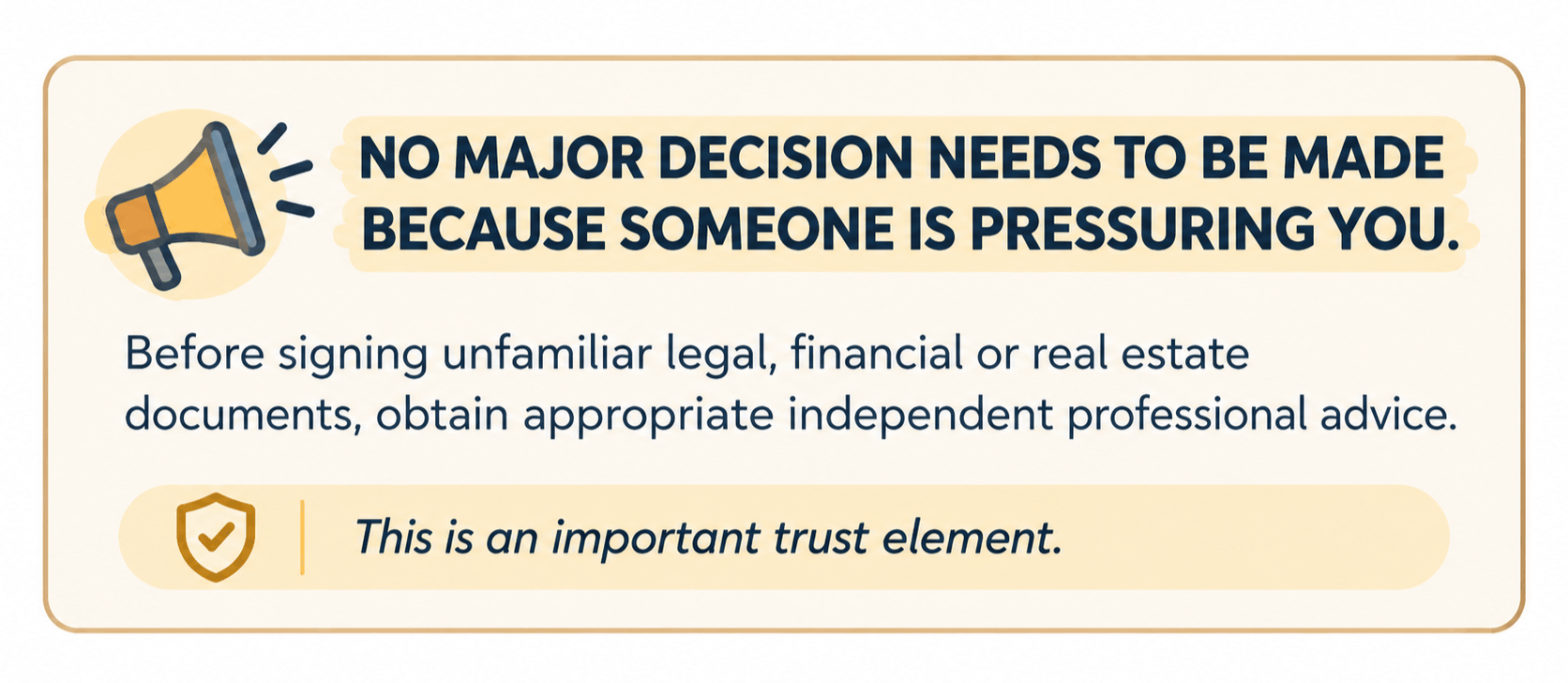
For major financial, legal and real estate decisions:
Understand who is advising you.
Understand their role.
Understand how they're compensated.
Get appropriate professional advice.
Take time where circumstances allow.
Protect Yourself From Scams
Unfortunately, major life transitions can increase vulnerability to fraud.
Be cautious about unexpected:
Calls.
Emails.
Contractors.
Investment opportunities.
Requests for money.
Property buyers.
Pressure to sign documents quickly.
Never feel embarrassed to say:
“I need my lawyer to review this.”
or:
“I need to speak with my family/advisor first.”
The 90-Day Question
Instead of asking:
“Am I selling?”
ask:
“What information would help me make a better decision over the next 90 days?”
Maybe you need:
A home value.
A lawyer meeting.
A financial review.
A mortgage statement.
A condo tour.
A retirement-community tour.
Help organizing the house.
Conversations with your children.
That's progress without forcing a decision.
If You Decide to Stay
Then let's make staying intentional.
Review:
Property maintenance.
Future repairs.
Accessibility.
Monthly costs.
Services.
Transportation.
Home value.
Emergency contacts.
Property documents.
And establish when you'll revisit the decision.
Maybe annually.
If You Decide to Sell
Then we create a plan around you, not just the property.
WHERE ARE YOU GOING?
↓
WHEN DO YOU WANT TO MOVE?
↓
WHAT IS THE HOME WORTH?
↓
WHAT SHOULD WE PREPARE?
↓
WHAT SHOULD WE LEAVE ALONE?
↓
WHAT BELONGINGS NEED HELP?
↓
SHOULD YOU MOVE FIRST?
↓
HOW DO WE MARKET THE PROPERTY?
↓
HOW DO WE COORDINATE CLOSING?
ONE STEP AT A TIME.
The Ana Bastas SRES® Approach After the Loss of a Spouse
My role isn't to arrive and immediately ask:
“When are we listing?”
The process begins differently.
1. LISTEN
What do you want?
↓
2. UNDERSTAND THE HOME
What is the property and what does it require?
↓
3. ESTABLISH VALUE
What is its current market position?
↓
4. EXPLORE OPTIONS
Stay? Modify? Downsize? Move closer to family? Retirement living?
↓
5. COORDINATE
Lawyer, financial professional, accountant, mortgage professional and other specialists where required.
↓
6. CREATE A TIMELINE
No unnecessary urgency.
↓
7. PREPARE THE PROPERTY
Only what makes strategic sense.
↓
8. MOVE & SELL
When and if that becomes the right decision.
You Can Call Me Before You're Ready to Sell
In fact, that's when I'd prefer you call.
You don't need to have:
Cleaned the basement.
Sorted your spouse's belongings.
Chosen a condo.
Spoken with movers.
Decided to list.
You can simply say:
“I'm not sure what I'm going to do with the house.”
That's enough.
We can start by understanding your options.
YOU DO NOT NEED TO MAKE A REAL ESTATE DECISION SIMPLY BECAUSE YOUR LIFE HAS CHANGED.
WHEN YOU'RE READY, WE CAN BUILD THE PLAN ONE STEP AT A TIME.
BOOK A CONFIDENTIAL HOME & DOWNSIZING CONSULTATION →
REQUEST A COMPLIMENTARY HOME VALUE REVIEW →
FAQ SECTION
Do I have to sell my house after my spouse dies?
No. The death of a spouse does not itself mean the surviving spouse needs to sell. Whether staying or moving makes sense depends on ownership, finances, lifestyle, property suitability and personal preferences.
What happens to a house when a spouse dies in Ontario?
It depends on how the property is owned and the specific estate circumstances. Have an Ontario estate lawyer review the title, will and other relevant documentation rather than assuming ownership automatically transfers in a particular way.
How soon should I sell my house after my spouse dies?
There is no universal timeline. Legal or financial circumstances may require certain actions, but the decision to sell should not be rushed unnecessarily if circumstances allow time to evaluate your options.
Should a widow or widower downsize?
Not automatically. Consider whether the existing home remains affordable, manageable, accessible and emotionally right, as well as whether another housing option would better support the next stage of life.
Should I renovate before selling my late spouse's home?
Not before having the property evaluated. Significant renovations may or may not improve the net selling outcome enough to justify their cost and disruption.
How do I start sorting my spouse's belongings?
There is no required timeline. When ready, consider starting with less emotional areas of the home and leaving highly sentimental belongings until later.
Can my children decide whether I should sell my home?
Family can provide valuable support, but legal ownership and decision-making authority depend on the circumstances. The surviving homeowner's wishes should remain central where they have authority to make the decision.
Who should I speak with before selling after my spouse dies?
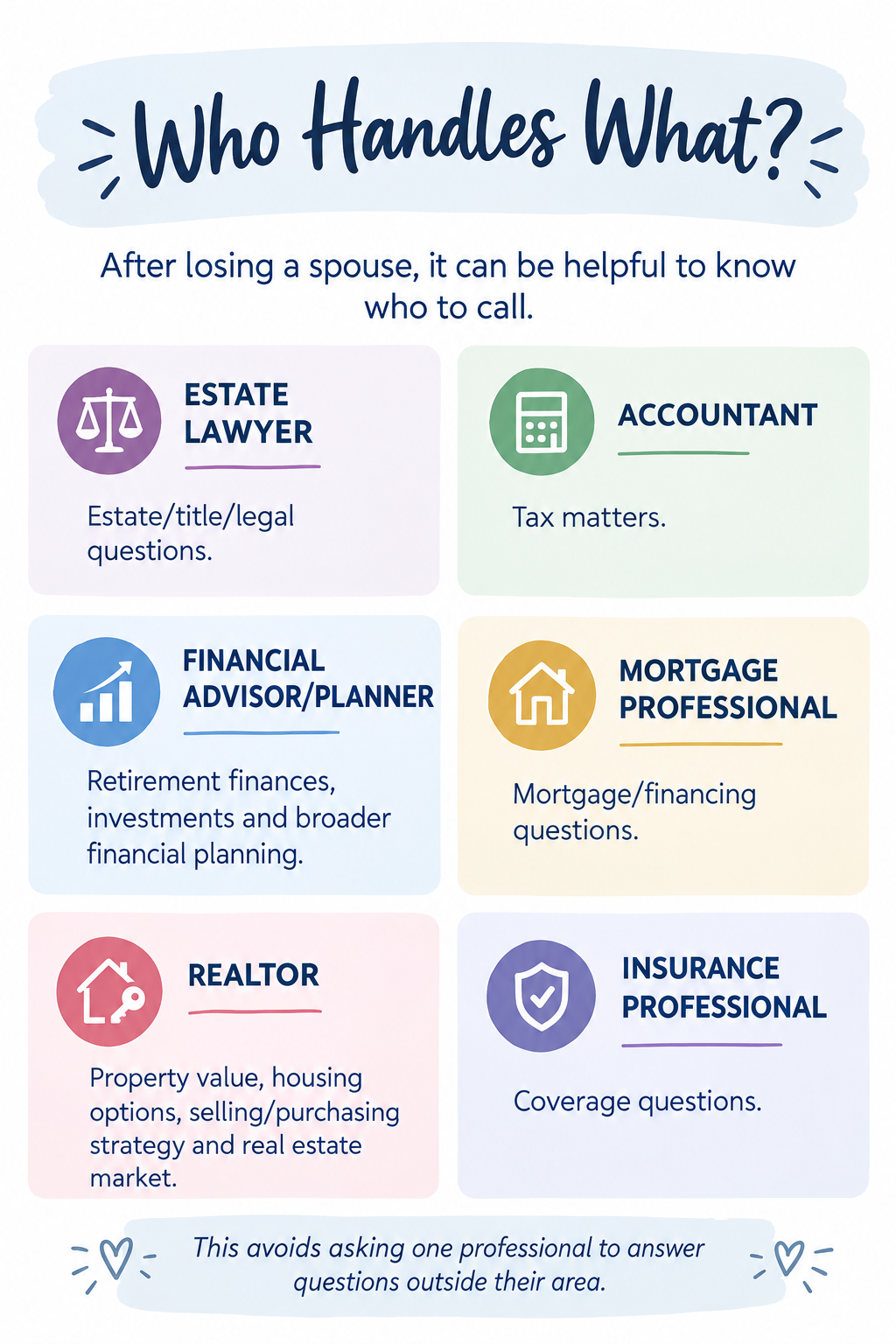
Depending on your circumstances, your professional team may include an estate lawyer, accountant, financial advisor/planner, mortgage professional and Realtor.
Categories
- All Blogs (1323)
- Ana Bastas Real Estate Team (1)
- Ana Bastas Realtor (1)
- Ana bastas Realty (1)
- Brampton (1)
- Burlington (2)
- Buy & Travel™ Program (12)
- Buyer (213)
- Divorce (18)
- Downsizing (11)
- Events (8)
- First Time Home Buyers (140)
- Georgetown (23)
- Georgetown Buyers (8)
- Halton Hills (265)
- Hamilton (23)
- Holidays (1)
- How To (129)
- Interest Rates (2)
- Investor (9)
- Landlord (95)
- Lifestyle (128)
- Milton (80)
- Mississauga (1)
- Mortgage (6)
- Niagara (37)
- Oakville (3)
- Real Estate News (161)
- Realtor (21)
- Renter (97)
- Seller (194)
- Tax's (19)
- Tips (15)
- Toronto (135)
- Wealth Building (9)
- Wellington (3)
- YYZ (107)
Recent Posts








"My job is to find and attract mastery-based agents to the office, protect the culture, and make sure everyone is happy! "