
What Does It Cost to Downsize in Ontario? Complete Selling, Buying & Moving Cost Guide

What Does It Cost to Downsize in Ontario? Complete Selling, Buying & Moving Cost Guide
If I Sell for $1.5 Million and Buy for $800,000, Do I Keep $700,000?
This is one of the first calculations homeowners make when considering downsizing.
Current home:
$1,500,000
New home:
$800,000
Difference:
$700,000
It looks straightforward.
But that $700,000 isn't necessarily the amount you'll have left after moving.
There may be costs associated with:
Selling
Buying
Legal work
Land transfer tax
Moving
Preparing the current home
Preparing the new home
Mortgage discharge or financing
Condominium requirements
and other transaction-specific expenses.
So the better question is:
“WHAT WILL I ACTUALLY HAVE LEFT AFTER THE ENTIRE MOVE?”
That's the number that matters when downsizing is part of your retirement plan.
Start With Your Current Home Value
Before calculating anything else, establish a realistic estimate of your home's current market position.
Not:
“My neighbour thinks it's worth $1.6 million.”
Not:
“An online calculator says $1.7 million.”
And not:
“The house down the street listed for $1.8 million.”
We need to consider:
Recent comparable sales
Current competition
Location
Lot
Size
Condition
Renovations
Layout
Basement
Parking
Market conditions
and property-specific features.
REQUEST A COMPLIMENTARY HOME VALUE REVIEW →
STEP 1 — Calculate Your Estimated Sale Proceeds
Begin with:
EXPECTED SELLING PRICE
$________
Then subtract the amounts that would need to come out of the transaction.
Potential items can include:
Mortgage payout
Real estate remuneration
HST where applicable
Legal expenses
Mortgage discharge-related costs where applicable
Adjustments
Other property-specific closing expenses
This gives you a much more useful number:
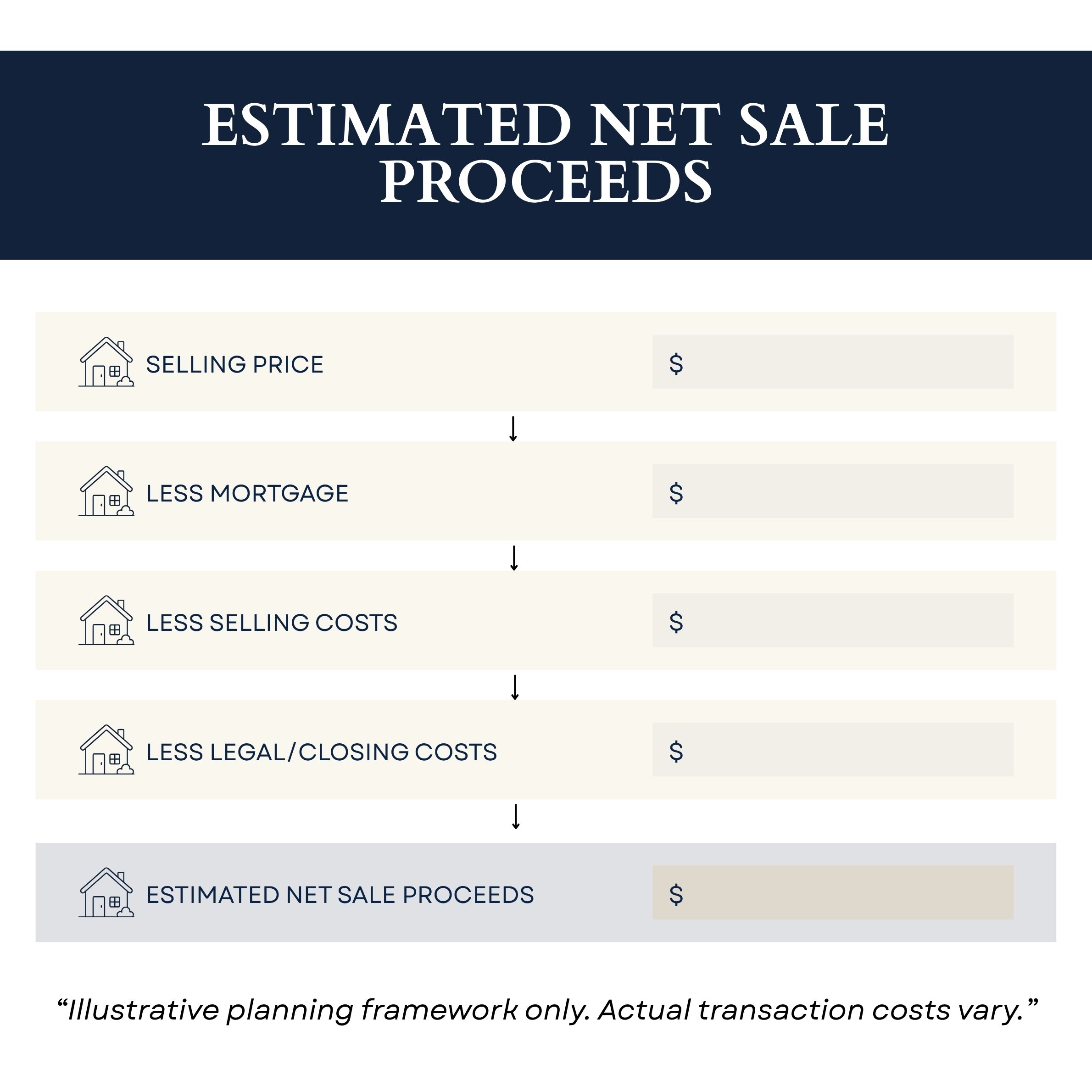
COST #1 — Your Mortgage
If you still have a mortgage, it generally needs to be accounted for when determining what equity is actually available from the sale.
Example:
Home sells:
$1,500,000
Mortgage balance:
$300,000
Before considering other selling costs, you're now working from approximately:
$1,200,000
not $1.5 million.
This sounds obvious, but when homeowners mentally calculate:
“House value minus new house,”
they sometimes forget the existing financing.
Ask Your Lender for the Actual Payout Information
Your mortgage balance shown online may not necessarily equal the exact amount required on a particular closing date.
Depending on the mortgage and transaction, there may be:
Accrued interest
Discharge-related costs
Prepayment charges
or other lender-specific amounts.
Ask your lender or mortgage professional for appropriate payout information when you're seriously considering a sale.
COST #2 — Real Estate Remuneration
When selling through a brokerage, real estate remuneration is part of the transaction economics.
The amount varies based on the listing arrangement and services agreed upon.
It should be discussed clearly before you list.
For downsizing calculations, don't ignore it.
We want to estimate:
What will I likely net?
not simply:
What might the property sell for?
COST #3 — HST Where Applicable
Certain professional services involved in a real estate transaction may be subject to HST.
This can include real estate remuneration and various professional services.
When preparing a downsizing budget, make sure quotes clearly identify whether applicable taxes are included.
A quote of:
$5,000
and:
$5,000 + applicable tax
are not the same budget.
COST #4 — Legal Fees and Disbursements
You'll generally need a real estate lawyer to complete the legal aspects of your sale and purchase.
Depending on the transaction, legal costs may include:
Professional fees
Disbursements
Registration-related expenses
Title-related work
Mortgage-related work
and applicable taxes.
Ask your lawyer for an estimate based on your specific transaction.
COST #5 — Preparing the Current Home for Sale
This category can range dramatically.
One seller may spend:
Very little.
Another may spend tens of thousands.
Potential preparation costs include:
Decluttering
Junk removal
Storage
Cleaning
Painting
Repairs
Flooring
Landscaping
Window cleaning
Staging
Contractors
Moving furniture
But remember our rule:
DO NOT RENOVATE BEFORE YOU HAVE A SELLING STRATEGY.
READ: Should You Renovate Before Downsizing? →
Home Preparation Is Not About Making the House Perfect
Your preparation budget should be based on:
What will likely improve the selling outcome?
not:
What would make the house look nicest?
Those are different.
Before spending $50,000, understand whether the market is reasonably likely to reward that expenditure.
COST #6 — Decluttering and Disposal
After 30+ years, this can become a real line item.
Potential costs include:
Dumpster/bin rental
Junk removal
Professional organizer
Downsizing specialist
Storage
Document shredding
Furniture removal
Donation pickup where charges apply
Estate-sale assistance
The cost varies enormously based on the amount of property and the amount of work you're comfortable doing yourself.
READ: How to Downsize a Home After 30+ Years →
COST #7 — Professional Moving
Moving costs depend on:
Distance
Size of home
Number of belongings
Number of movers
Time
Packing services
Boxes/materials
Storage
Specialty items
Elevator access
Travel
Furniture assembly
and timing.
Get multiple written estimates and understand exactly what's included.
COST #8 — Storage
Storage can become a hidden downsizing cost.
You sell the large house.
You move to a condo.
But you can't decide what to do with everything.
So you rent a storage unit.
Then another year passes.
And another.
Calculate:
Monthly storage cost × expected number of months.
If you don't have a clear exit plan for stored belongings, storage can become a long-term expense rather than a temporary moving cost.
STEP 2 — Calculate the Cost of Your Next Home
Now we move to the purchase side.
Start with:
PURCHASE PRICE
$________
Then potentially add:
Ontario land transfer tax
Toronto municipal land transfer tax if applicable
Legal expenses
Title insurance where applicable
Home inspection
Status certificate/legal review considerations for condos
Mortgage-related expenses where applicable
Moving
Immediate improvements
Furniture
Condo deposits/move-related requirements where applicable
and other transaction-specific costs.
COST #9 — Ontario Land Transfer Tax
Ontario purchasers generally need to account for provincial land transfer tax when acquiring property, subject to applicable exemptions or rebates.
The amount depends on the purchase price and circumstances.
Because tax rules can change, Fona should not hard-code a calculation into the article unless the current Ontario calculation is verified immediately before publication.
Instead, link to an appropriate current official Ontario resource or our verified calculator.
COST #10 — Toronto Municipal Land Transfer Tax
If your replacement property is in Toronto, there may also be municipal land transfer tax in addition to Ontario land transfer tax.
This can materially change the transaction-cost calculation.
Someone selling in Halton and purchasing in Toronto should not use the same closing-cost assumption as someone purchasing in Georgetown or Niagara.
Location matters.
COST #11 — Legal Costs on the Purchase
The purchase side also involves legal work.
Depending on your transaction, your lawyer can explain:
Professional fees
Disbursements
Registration
Title insurance
Mortgage-related work
Adjustments
and other closing costs.
Get an estimate rather than using a random online number.
COST #12 — Home Inspection / Due Diligence
Depending on the property and transaction, you may choose or need various forms of due diligence.
For example:
Home inspection
Specialized inspections
Condominium status certificate review
Legal review
Well/septic considerations for certain properties
or other property-specific investigations.
Build appropriate due-diligence costs into your purchase budget.
COST #13 — Condo Fees
This isn't necessarily a closing cost.
But it can completely change the financial outcome of downsizing.
Suppose you eliminate your mortgage by moving into a condo.
Wonderful.
But now your condo fees are:
$900/month.
That's:
$10,800/year.
The condo may still be exactly the right decision.
But you need to compare:
ONGOING COSTS
as well as:
TRANSACTION COSTS.
COST #14 — Condo Move-In Requirements
Some condominium corporations have specific moving procedures.
Depending on the building, you may need to consider:
Elevator reservations
Deposits
Moving hours
Insurance documentation
or other building-specific requirements.
Confirm these before moving day.
COST #15 — New Furniture
This is one people forget.
You move from a large traditional detached home to a contemporary condo.
Then discover:
Your sectional doesn't fit.
Your dining table is enormous.
Your king bedroom suite overwhelms the room.
Your storage furniture doesn't work.
Suddenly you're buying:
Sofa.
Dining set.
Storage.
Lighting.
Bedroom furniture.
Balcony furniture.
Include a realistic furniture budget if the new property requires it.
COST #16 — Improvements to the New Home
You may want to complete work before moving in.
For example:
Painting
Flooring
Lighting
Closet systems
Window coverings
Bathroom modifications
Accessibility improvements
Kitchen changes
It's easier to complete many of these before the movers arrive.
But they still reduce the amount of capital ultimately released through downsizing.
COST #17 — Utility and Service Transitions
Smaller expenses add up.
Potential costs can include:
Internet setup
Utility setup
Alarm/security changes
Key/fob deposits
Cleaning
Mail forwarding
Service cancellation
New household equipment
Individually, these may be modest.
Collectively, they deserve a miscellaneous transition budget.
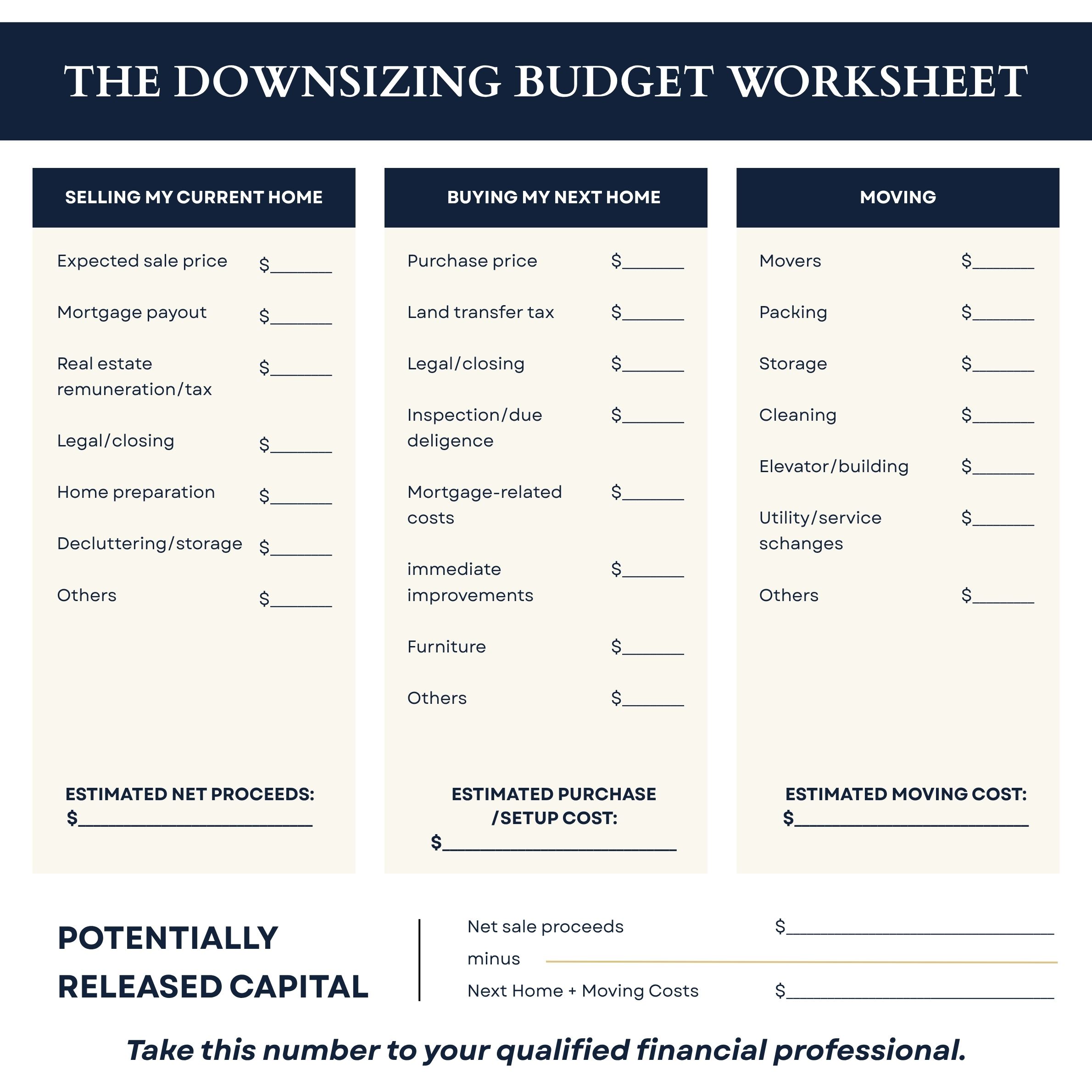
The Real Downsizing Equation
This is the equation I want every downsizer to understand.
CURRENT HOME SALE PRICE
minus
Mortgage
minus
Selling Costs
=
ESTIMATED NET SALE PROCEEDS
Then:
REPLACEMENT HOME PRICE
plus
Purchase Costs
plus
Moving
plus
Immediate Improvements
plus
Other Transition Costs
=
TOTAL COST OF NEXT HOME / MOVE
Then:
NET SALE PROCEEDS – TOTAL TRANSITION COST = POTENTIALLY RELEASED CAPITAL
That's the retirement planning number we want to estimate.
A Hypothetical Downsizing Example
Let's use deliberately simplified numbers.
CURRENT HOME
Sale price:
$1,500,000
Mortgage:
$200,000
Other selling/closing/preparation costs:
$80,000
Illustrative net proceeds:
$1,220,000
Now:
REPLACEMENT HOME
Purchase price:
$800,000
Purchase/moving/immediate setup costs:
$50,000
Illustrative total:
$850,000
Potentially released capital:
$370,000
Not:
$700,000
That's a dramatic difference.
Why This Matters for Retirement Planning
Imagine you told your financial advisor:
“Downsizing should free up around $700,000.”
They begin planning around that number.
Then the actual move leaves:
$370,000.
That's a very different retirement scenario.
This is why the real estate calculation needs to happen before the broader financial plan relies on released home equity.
Don't Forget Your Monthly Costs After the Move
Downsizing has two financial effects:
1. CAPITAL
How much equity do you release?
2. CASH FLOW
How do your monthly housing costs change?
You need both.
Example: Current Detached Home
Mortgage:
$________
Property tax:
$________
Insurance:
$________
Utilities:
$________
Maintenance:
$________
Landscaping/snow:
$________
TOTAL MONTHLY:
$________
Example: Future Condo
Mortgage:
$________
Condo fee:
$________
Property tax:
$________
Insurance:
$________
Utilities:
$________
Parking/storage:
$________
TOTAL MONTHLY:
$________
Now compare.
Downsizing Doesn't Always Save Money Every Month
This surprises people.
You could sell a large mortgage-free house and move into a luxury condo.
You may release equity.
But the condo could have substantial monthly fees.
Conversely, you could move to a smaller bungalow and continue paying for:
Landscaping.
Snow.
Exterior maintenance.
Repairs.
The objective isn't simply to own fewer square feet.
It's to choose a housing structure that works for your retirement.
Compare at Least Three Scenarios
Before making a decision, I recommend evaluating:
SCENARIO A — STAY
No transaction costs.
Current monthly costs.
Future maintenance.
Equity remains in current home.
SCENARIO B — DOWNSIZE LOCALLY
Sell current home.
Purchase smaller home in same general area.
Calculate equity released.
Calculate future monthly costs.
SCENARIO C — RELOCATE
Sell current home.
Purchase in a different market.
Calculate equity released.
Calculate monthly costs.
Evaluate lifestyle impact.
READ: Halton vs. Niagara for Retirement →
What About Renting Instead of Buying?
Some downsizers may consider selling and renting.
That could potentially:
Release more home equity.
Eliminate property maintenance.
Provide flexibility.
But it also introduces:
Monthly rent
Future rent changes
Less control over the property
Different estate implications
and other considerations.
Renting isn't automatically better or worse.
It should be included as another housing scenario if it genuinely interests you.
What About a Retirement Community?
A retirement residence or service-based community should be evaluated differently from purchasing a condo or bungalow.
The monthly cost may include combinations of:
Housing
Meals
Activities
Housekeeping
Support
Amenities
and other services.
Don't compare:
Condo fee
to:
Retirement residence monthly fee
without understanding what each actually includes.
READ: Best Retirement Communities in Georgetown & Halton →
What About a Life Lease?
Life lease arrangements can have different:
Ownership structures
Entry costs
Monthly costs
Resale provisions
Exit provisions
and legal arrangements.
Understand the specific agreement before comparing it with a condominium.
READ: Life Lease vs. Condo in Ontario →
What About the Cost of NOT Downsizing?
This deserves its own calculation.
Staying avoids:
Selling costs
Buying costs
Moving costs
and the disruption of relocating.
But staying may involve future:
Roof
Windows
HVAC
Driveway
Bathrooms
Accessibility modifications
Landscaping
Snow removal
Cleaning
Major maintenance
So don't compare:
Cost of moving
to:
$0 cost of staying.
That's not necessarily accurate.
Compare:
MOVE COST
versus
EXPECTED COST OF STAYING
over a reasonable planning period.
The Emotional Cost Matters Too
Not everything belongs in Excel.
There is also:
Stress.
Time.
Leaving neighbours.
Sorting belongings.
Family disagreements.
Learning a new neighbourhood.
Adjusting to a smaller home.
Those factors matter.
But there can also be emotional benefits:
Less responsibility.
A fresh start.
More travel.
Closer family.
Easier living.
A home that fits better.
Money is only one part of the decision.
The Ana Bastas Downsizing Financial Process
When someone tells me:
“We're thinking about downsizing because we want to free up some money for retirement.”
I don't want to guess.
We calculate.
STEP 1 — CURRENT HOME VALUE
What might it realistically sell for?
↓
STEP 2 — CURRENT MORTGAGE
What needs to be repaid?
↓
STEP 3 — SELLING COSTS
What will it cost to sell and prepare?
↓
STEP 4 — REPLACEMENT HOUSING
What does the next home realistically cost?
↓
STEP 5 — PURCHASE + MOVING COSTS
What will the entire transition cost?
↓
STEP 6 — POTENTIAL RELEASED EQUITY
What's actually left?
↓
STEP 7 — MONTHLY COST COMPARISON
Does future housing cost more or less each month?
↓
STEP 8 — FINANCIAL PROFESSIONAL REVIEW
What does the resulting capital and cash-flow difference mean within your retirement plan?
NOW YOU CAN MAKE AN INFORMED DECISION.
Start With the Home Value
You cannot calculate downsizing accurately if the first number is wrong.
If you're thinking about moving—even two years from now—start by understanding the current market position of your property.
REQUEST A COMPLIMENTARY HOME VALUE REVIEW →
There is no obligation to list.
The purpose is to begin with better information.
Thinking About Downsizing?
Before touring condos every weekend, let's determine:
What your current home may sell for.
What you may actually net.
What your preferred next home costs.
What the transaction may cost.
How much equity you may actually release.
Then you can take those numbers to your financial professional.
DOWNSIZING ISN'T ABOUT THE DIFFERENCE BETWEEN TWO LIST PRICES.
IT'S ABOUT WHAT YOU HAVE LEFT AFTER THE ENTIRE TRANSITION.
BOOK A DOWNSIZING & RETIREMENT STRATEGY CALL →
REQUEST A COMPLIMENTARY HOME VALUE REVIEW →
FAQ SECTION
How much does it cost to downsize in Ontario?
There is no single amount. Costs depend on the current property, mortgage, listing arrangement, home preparation, replacement property, land transfer tax, legal work, moving and other transaction-specific expenses.
How do I calculate how much money I'll have after downsizing?
Estimate the net proceeds from your current home after mortgage and selling costs. Then subtract the complete cost of purchasing, closing, moving into and preparing your replacement home.
Do I pay land transfer tax when downsizing in Ontario?
Purchasers in Ontario generally need to account for provincial land transfer tax, subject to applicable rules, exemptions or rebates. Additional municipal land transfer tax may apply in Toronto. Verify current requirements for your transaction.
Do sellers pay land transfer tax in Ontario?
Land transfer tax is generally associated with the purchase/acquisition side rather than simply selling your existing Ontario home. Your lawyer should confirm transaction-specific obligations.
Do I need to renovate before downsizing?
Not automatically. Have the property evaluated before spending significantly on renovations so the likely market benefit can be compared with the cost, time and disruption.
Is moving to a condo always cheaper?
No. A condo may reduce certain maintenance responsibilities but introduce monthly condominium fees and other costs. Compare total monthly housing expenses.
Does downsizing always release home equity?
No. The amount released depends on your existing mortgage, selling costs, replacement-home cost, transaction costs and moving expenses.
Should I sell my home before buying when downsizing?
There isn't one correct answer. The strategy depends on finances, market conditions, housing availability, timing and your tolerance for risk. This should be planned before entering into transactions.
Categories
- All Blogs (1315)
- Ana Bastas Real Estate Team (1)
- Ana Bastas Realtor (1)
- Ana bastas Realty (1)
- Brampton (1)
- Burlington (2)
- Buy & Travel™ Program (12)
- Buyer (213)
- Divorce (18)
- Downsizing (11)
- Events (8)
- First Time Home Buyers (140)
- Georgetown (21)
- Georgetown Buyers (8)
- Halton Hills (265)
- Hamilton (23)
- Holidays (1)
- How To (128)
- Interest Rates (2)
- Investor (8)
- Landlord (94)
- Lifestyle (128)
- Milton (79)
- Mississauga (1)
- Mortgage (6)
- Niagara (37)
- Oakville (3)
- Real Estate News (161)
- Realtor (21)
- Renter (97)
- Seller (193)
- Tax's (19)
- Tips (14)
- Toronto (135)
- Wealth Building (8)
- Wellington (3)
- YYZ (107)
Recent Posts










"My job is to find and attract mastery-based agents to the office, protect the culture, and make sure everyone is happy! "